
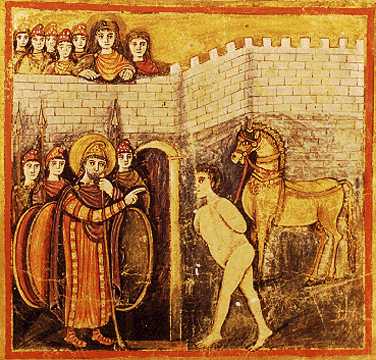
Courtesy of Wikipedia
Trojan War Spy
We think of espionage as a fairly recent phenomenon, post Revolutionary War stuff. Well, I’m here to remind you that it’s been around a very long time, maybe even as far back as the actions of the Serpent in the Garden of Eden.
What I am focusing on here is the one who tricked the Trojans…
According to Wikipedia:
In the Aeneid, he pretended to have deserted the Greeks and, as a Trojan captive, told the Trojans that the giant wooden horse the Greeks had left behind was intended as a gift to the gods to ensure their safe voyage home. He told them that the horse was made so big that the Trojans would not be able to move it into their city, because if they did they would be invincible to later Achaean invasion. His story convinced the Trojans because it included the former details as well as an explanation that he was left behind to die by the doing of Odysseus, who was his enemy. The Trojans brought the Trojan Horse into their city against the advice of Cassandra (given the gift of prophecy by Apollo, but condemned to never be believed for not returning his love) and Laocoön (because two serpents came out of the water and strangled him and his sons, which the Trojans saw as a punishment for attacking the horse with a spear). Inside the giant wooden horse were Greek soldiers, who, as night fell, disembarked from the horse and opened the city gates, thus sealing the fate of Troy. He was also an Achaean spy who told the Greeks when the soldiers in the horse had begun their fight.
This scene is in neither the Iliad nor the Odyssey but is in the Aeneid; it is central to the perspective Virgil builds, in support of the actual Roman sentiment, of the Greeks as cunning, deceitful, and treacherous.
Why is this important?
It may be a past life of mine. The section in the Wikipedia report that discusses Quintus of Smyrna’s The Trojan Epic goes into more graphic detail of the process that the Trojan’s put him through. They cut off his ears and his nose to get him to talk. This is a tactic that is as old as the hills. If information is extracted under duress, even physical harm, it is more believable.
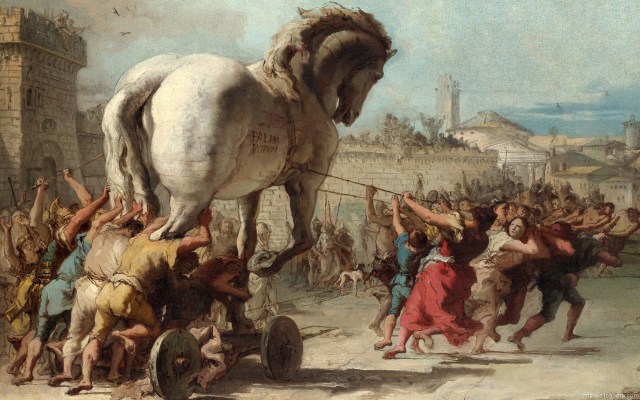
Courtesy of techcrunch.com
During a recent psychic ‘visit’ to the past, the lady reading the cards noted the lack of structure to a particular fighter’s ears. Strange detail, to be sure, but one that helps to pin other elements to my story. In a different discussion with the same reader, I shared the fact that when researching the Trojan War, I was torn between the two sides of the conflict. She suggested I had been a spy.
This is a role I’ve been before, for sure: see my Pierre-Esprit Radisson post, “Hero or Villain?”
Conclusion
If you’re going to be a character in the history of the world, remember that the Villain gets the best lines.
Civilization as we know it now would never have come about had the city of Troy not been overrun by Greeks bearing ‘gifts’. I feel part of the fabric of all life. I regret nothing from the past. It was a ‘job’ that had to be done, and like the line from “Live and Let Die”, you’ve got to give the other feller hell.


 cdsmiller17
Pingback: As Above, So Below | cdsmiller17
Pingback: Spies: A Legacy of the Cold War | cdsmiller17
Pingback: Legendary Lost Locations | cdsmiller17
Pingback: Re-Writing History: Is It Fake News or… | cdsmiller17
Pingback: John Dee’s Associate in All Things Mystical | cdsmiller17
Pingback: Why Did He Do It? He “Married the Wrong Person” | cdsmiller17