
The Star of Bethlehem (October 1, 7 BCE)

They say that facts get in the way of a good story. And the ‘greatest story ever told’ concerned the birth of Jesus. As you know, I’ve told the story of Jesus’ birth chart before (and ‘something’ doesn’t want me to revisit this, but I’m going to press on, anyway).
This theory is ubiquitous in medieval astronomy. It should be noted that in 1603-1604, Kepler observed a great conjunction and calculated that a similar one would have occurred 7 BCE, giving rise to the notion that the star of Bethlehem was a conjunction of Saturn, Jupiter and Mars. See W. Burke-Gaffney, “Kepler and the Star of Bethlehem,” Journal of the Royal Astronomical Society of Canada 31 (1937).
Footnote 250 (Fabian_columbia_0054D_12087)
There’s a bit of faulty astrological information here. During the whole of 7 BCE, Mars was not in conjunction with Jupiter and Saturn. Here’s the chart for the third and final conjunction between these two planets in that year.
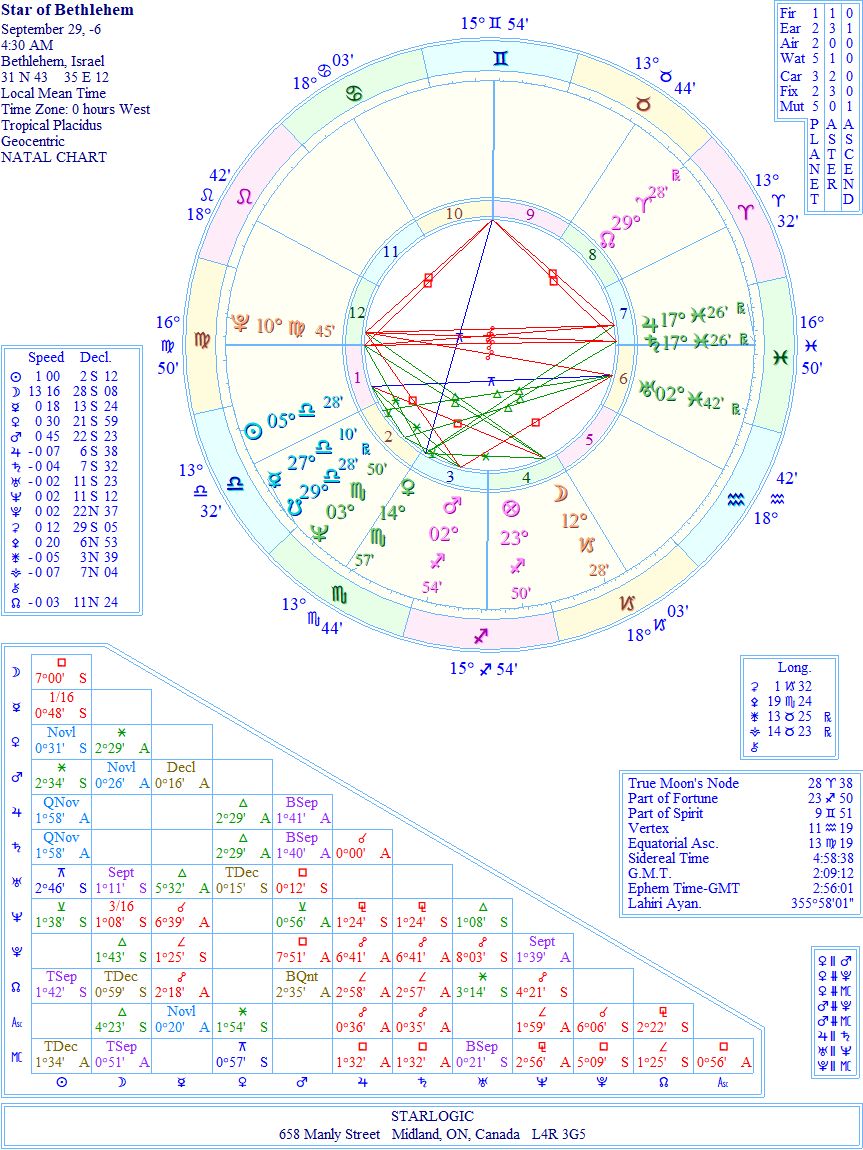
Originally, I was going to delineate the two inconjuncts shown here, but then decided to suggest that Sun inconjunct Uranus represents Gabriel’s visit and Venus inconjunct the Midheaven is Mary’s reaction. This could be the event chart for the Annunciation. It may also represent John the Baptist’s birth chart. (But, as I will show later, that event is ‘off’ by quite a few months.)

Hmm.
A Post Script to My Post Script
Trying to tie the Annunciation to Jesus’ birth date of legend, December 25th, the Catholic Church has designated March 25th to be the ‘real’ date. Would you like to see the chart for that? It’s randomized.

Perhaps that Mars/Pluto conjunction in opposition to the stellium in Pisces might just be the moment of impregnation of Mary. The Sun inconjunct Neptune seems to confirm the hidden nature of the event.


 cdsmiller17