
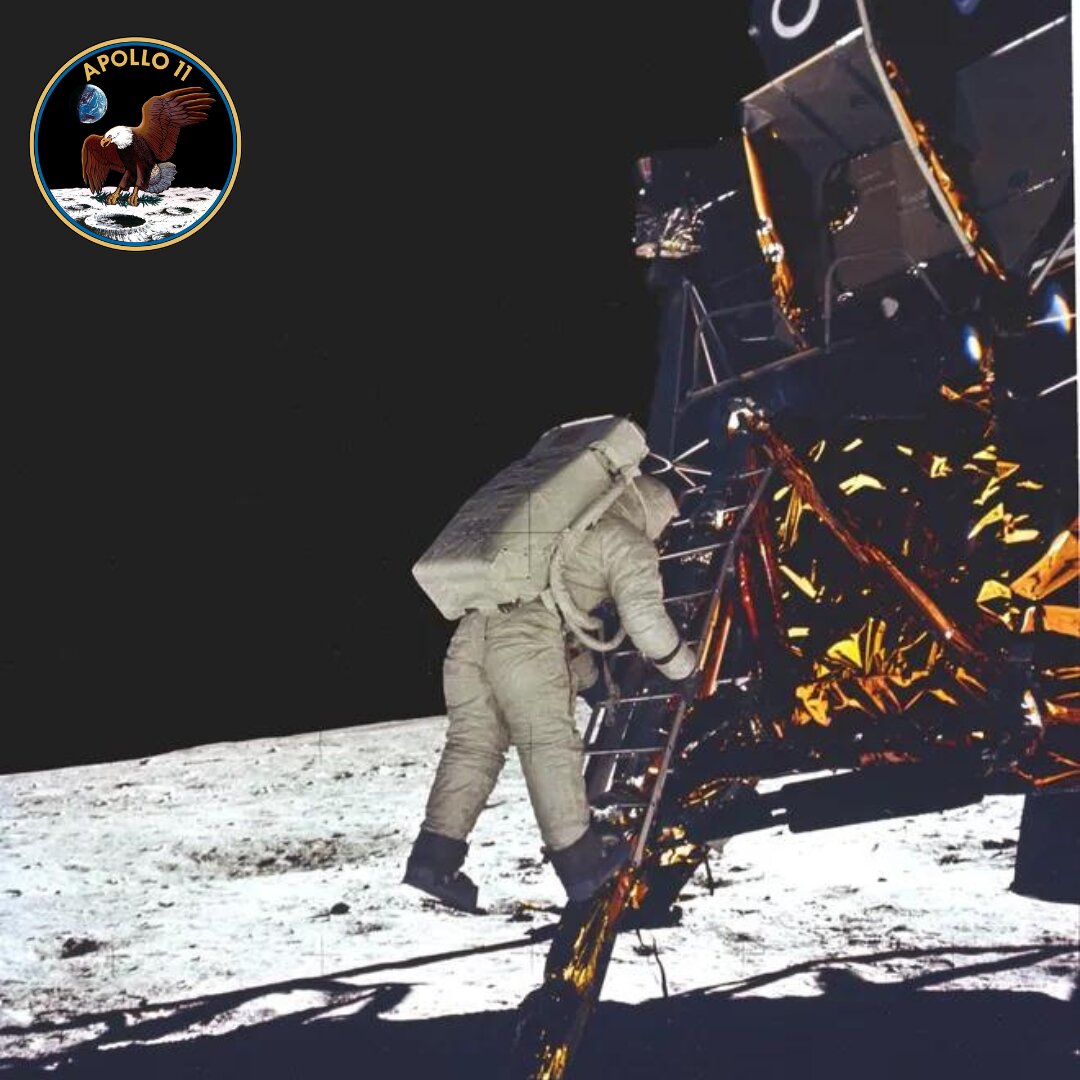
Moon Landing (July 20, 1969)
The History
The moon is a moving target. It travels around the earth at more than 2,000 miles per hour. During Apollo 11’s three-day journey, the moon moved more than 165,000 miles. Therefore, the spacecraft was aimed at a spot in space 165,000 miles ahead of the moon – and it had to reach this spot at exactly the same time that the moon did.
Apollo 11 lifted off launch pad 39A at Cape Kennedy at 9:32 a.m. (Eastern Daylight-Saving Time) on July 16, 1969. On board were Astronauts Neil A. Armstrong, Michael Collins, and Edwin E. (Buzz) Aldrin, Jr.
At 1:45 p.m. (EDST) on July 20, 1969 the Lunar Module (LM) Eagle, with Armstrong and Aldrin aboard, separated from the spacecraft Columbia. By 4:17 p.m. of the same day, the Eagle landed on the moon on the rocky plain called the Sea of Tranquility. At 10:56 p.m. Armstrong set foot as the first man on the moon, stating,
“One small step for man, one giant leap for mankind.”
Later, at 11:14 p.m., Aldrin joined Armstrong on the moon’s surface in order to collect lunar samples and set up scientific experiments. Aldrin described the view of the moon from the surface as “magnificent desolation.” At 12:50 p.m. on July 24, 1969, Apollo 11 splashed down in the Pacific Ocean.
Miller, Christopher. At This Point in Time: Charting the History of the Human Spirit (p. 16). BookBaby. Kindle Edition.
The Human Spirit
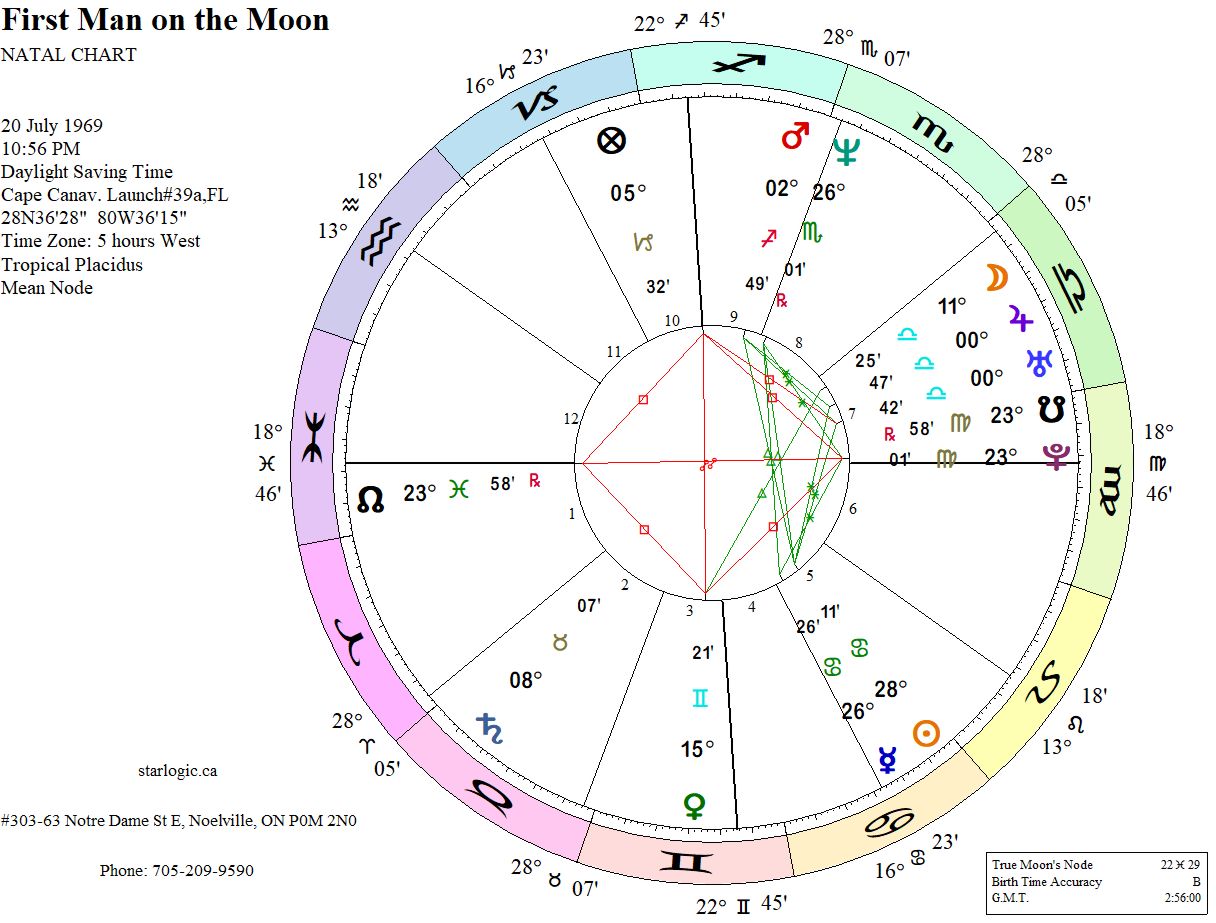
This is a very interesting chart. For one thing, it is a bit difficult to erect a chart for an event that happened on the moon. Literally, all aspects that have to do with the moon are null and void because the chart takes the point of view of someone standing at Cape Kennedy, (now Cape Canaveral) Florida, at the time and date specified, and the Ascendant and Midheaven would not apply.
So, except for an inconjunct aspect between Saturn and the Moon, all the remaining planets are in beneficial aspect to each other: altogether there are five conjunctions, eight sextiles and four trines. These aspects, when drawn on the chart, show up as a double-pointed arrow, directed mainly at the Jupiter-Uranus conjunction at 0° Libra in the Seventh House. This is the sign of cosmic reciprocity, of cooperation rather than competition, of consciousness objectified through associations and partnerships. Jupiter is the principle of expansion and growth as expressed in the accumulation of material wealth, but without the miserliness of a marked Saturnian trait; a balance of feeling and thought, of heart and mind, that yields…hopefulness. Uranus gives the perseverance to cope with and conquer material obstacles, yet is subject to sudden changes of attitude; eminently the planet of science and invention, particularly aviation, electricity, and astrology. To me, this conjunction represents NASA (the National Aeronautics and Space Administration), an agency of the United States government established to direct and aid civilian research and development in aeronautics and aerospace technology. Their first target was landing a man on the moon.
To the First Man on the Moon, I would say: You probably have a secret, quiet place that is all your own, where you can go and be alone with your thoughts. (Sun in Cancer). Anything new is somehow more interesting than what is old, and you particularly enjoy making innovations yourself. (Sun Conjunct Mercury) In group activities, you are at your best either as a leader or working independently. (Sun Trine Mars) Almost everything you do and everyone around you will be affected by your ability to see life on a grand scale and to put it all into proper perspective. (Sun Sextile Jupiter) You enjoy tinkering with machinery and want to know as much as possible about how every gadget works. (Sun Sextile Uranus) You feel a great need to see something in the world besides the material facts that are taught in school. And because you are unusually sensitive to anything mystical, you may very well find it. (Sun Trine Neptune)
When you are emotionally upset, your whole view of the world changes. (Mercury in Cancer) Probably you will be interested in foreign places and people, and you may love to travel. (Mercury Sextile Jupiter) Discovery gives you pleasure. (Mercury Sextile Uranus) You can see beauty in the world that is hidden from others. Also you are an idealist who dreams of a better world in which all the problems of this one have been solved. (Mercury Trine Neptune) This aspect will help your career, because you convince people of your point of view without making them feel that you are pushing them around. (Mercury Sextile Pluto)
You will have many more opportunities than most people, and favourable circumstances will seem to occur without any effort on your part. (Mars Sextile Jupiter) An extremely independent person, you need to be free to go your own way. Also, you are a very high-energy person who hates to sit still. (Mars Sextile Uranus) At its highest level of expression, this aspect signifies a willingness to put your own affairs second to higher, more spiritual principles. (Mars Conjunct Neptune)
You don’t mind going off in a new direction by yourself if no one else wants to follow you. According to your liberal temperament, everyone should be allowed to be themselves. (Jupiter Conjunct Uranus) You have a strong drive to achieve something of significance, and you want to have the power to make positive and creative changes in your world. Most people with this aspect find that it provides considerable help in making a name for themselves. (Jupiter Conjunct Pluto)
This aspect undoubtedly signifies a generation of children who will have very powerful effects upon the rest of the culture, for they will be revolutionaries in the truest sense. They will be very eager and restless for change, but at the same time patient enough to learn how to really bring it about. They will undoubtedly have a very powerful impact on everyone in society. (Uranus Conjunct Pluto)
I think Man’s first steps on the moon were ‘allowed’ by the Cosmos, as a glimpse of our possibilities. I wrote the following in a poem, Off Base:
I think that we should not be too concerned/ With distant interplanetary life,/ At least for three or four more earthly years;/ I feel, as yet, we haven’t really learned/ To conquer all our worldly woes and strife,/ To help appease our apprehensive fears.
This is as true now as it was in 1969 when I wrote the poem; before we ‘conquer’ space, we must cooperate and get our act together on earth.


 cdsmiller17