
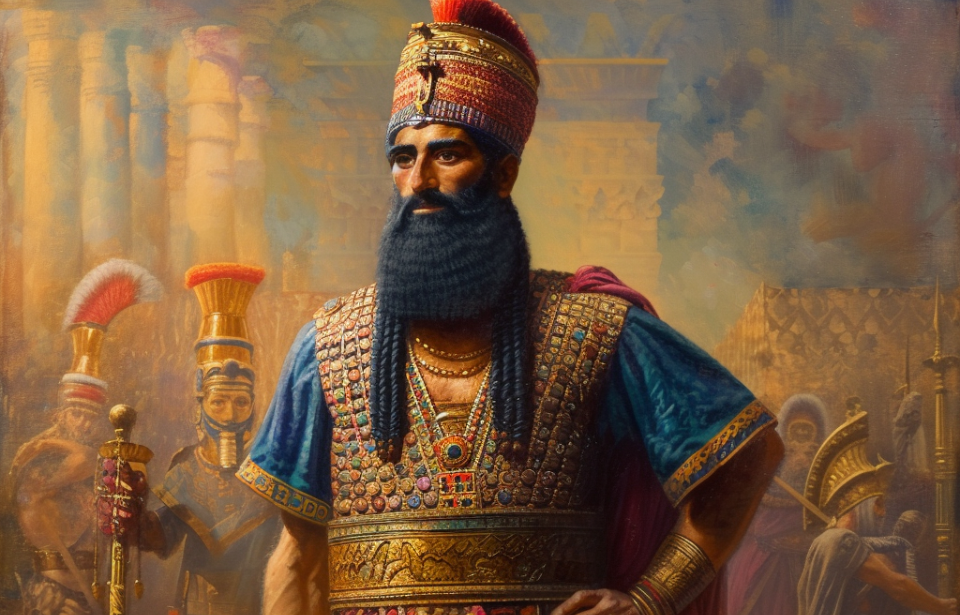
Nebuchadnezzar II (c.642 BC – October 7, 562 BC)
Now, this is going to be a bit esoteric, so just ride along with me for a bit, to see where it takes us.
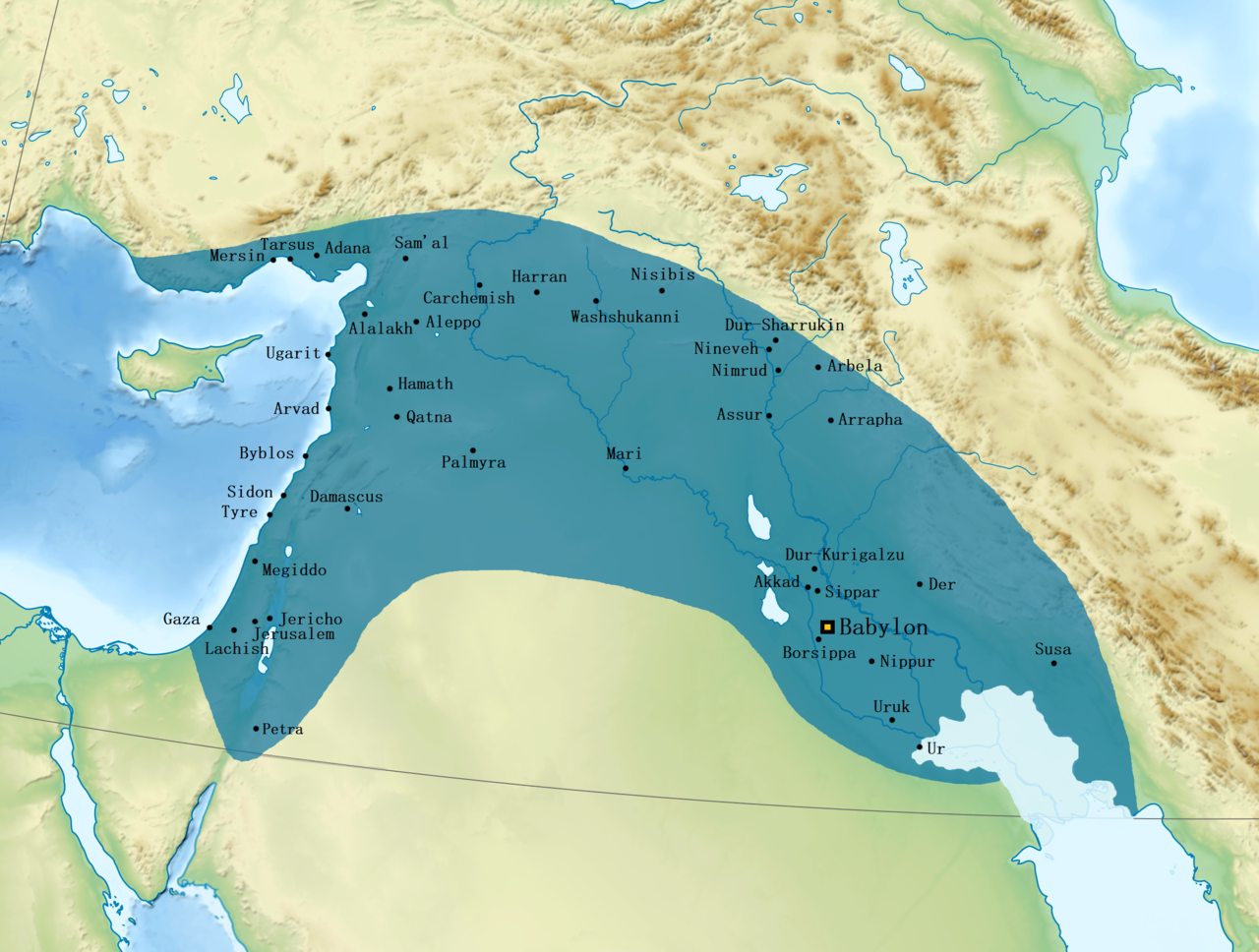
We all know who this great king of Babylon was, but after his death, God sent his ‘son’ a message.
In the Book of Daniel, considered by scholars to be a work of historical fiction, the figure of Nebuchadnezzar differs considerably from his portrayal in the Book of Jeremiah. He is for the most part depicted as a merciless and despotic ruler. The king has a nightmare, and asks his wise men, including Daniel and his three companions Shadrach, Meshach and Abednego, to interpret the dream, but refuses to state the dream’s contents. When the servants protest, Nebuchadnezzar sentences all of them (including Daniel and his companions) to death. By the end of the story, when Daniel has successfully interpreted the dream, Nebuchadnezzar shows much gratitude, showering Daniel with gifts, appointing him the governor of the “province of Babylon” and making him the chief of the kingdom’s wise men. A second story again casts Nebuchadnezzar as a tyrannical and pagan king, who, after Shadrach, Meshach and Abednego refuse to worship a newly erected golden statue, sentences them to death through being thrown into a fiery furnace. They are miraculously delivered, and Nebuchadnezzar then acknowledges God as the “lord of kings” and “god of gods”. Though Nebuchadnezzar is also mentioned as acknowledging the Hebrews’ God as the true god in other passages of the Book of Daniel, it is apparent that his supposed conversion to Judaism does not change his violent character, given that he proclaims that anyone who speaks amiss of God “shall be cut in pieces and their houses shall be made a dunghill”. In a third story, Daniel interprets another dream as meaning that Nebuchadnezzar will lose his mind and live like an animal for seven years before being restored to his normal state (Daniel 1-4). The Nebuchadnezzar in the Book of Daniel, a fickle tyrant who is not particularly consistent in his faith, contrasts with the typical “servant of God” in other books of the Bible.
Given that Nebuchadnezzar is referred to as the father of Belshazzar in the Book of Daniel, it is probable that this portrayal of Nebuchadnezzar, especially the story of his madness, was actually based on Belshazzar’s actual father, Nabonidus, the last king of the Neo-Babylonian Empire (r. 556–539 BC). Separate Jewish and Hellenistic traditions exist concerning Nabonidus having been mad, and it is likely that this madness was simply reattributed to Nebuchadnezzar in the Book of Daniel through conflation. Some later traditions conflated Nebuchadnezzar with other rulers as well, such as the Assyrian Ashurbanipal (r. 669–631 BC), the Persian Artaxerxes III (r. 358–338 BC), the Seleucids Antiochus IV Epiphanes (r. 175–164 BC) and Demetrius I Soter (r. 161–150 BC) and the Armenian Tigranes the Great (r. 95–55 BC). The apocryphal Book of Judith, which probably applies the name “Nebuchadnezzar” to Tigranes the Great of Armenia, refers to Nebuchadnezzar as a “king of the Assyrians”, rather than of the Babylonians, and demonstrates that Nebuchadnezzar was still viewed as an evil king, responsible for destroying Jerusalem, looting its temple, taking the Jews hostage in Babylon, and for the various misdeeds ascribed to him in later Jewish writings.
See, I told you this was going to be convoluted. Let’s look at his death chart, set for noon.

Notice that six days were removed by converting the calendar from Julian to Gregorian. In truth, we cannot presume anything about this chart to be correct, but of the two inconjuncts in his ‘fatal’ chart, only one can be relied upon: Venus inconjunct Neptune. Hmm, interesting.
And this is the writing that was written, MENE, MENE, TEKEL, UPHARSIN. This is the interpretation of the thing: MENE; God hath numbered thy kingdom, and finished it. TEKEL; Thou art weighed in the balances, and art found wanting. PERES; Thy kingdom is divided, and given to the Medes and Persians.
Can there be a modern equivalent of this?
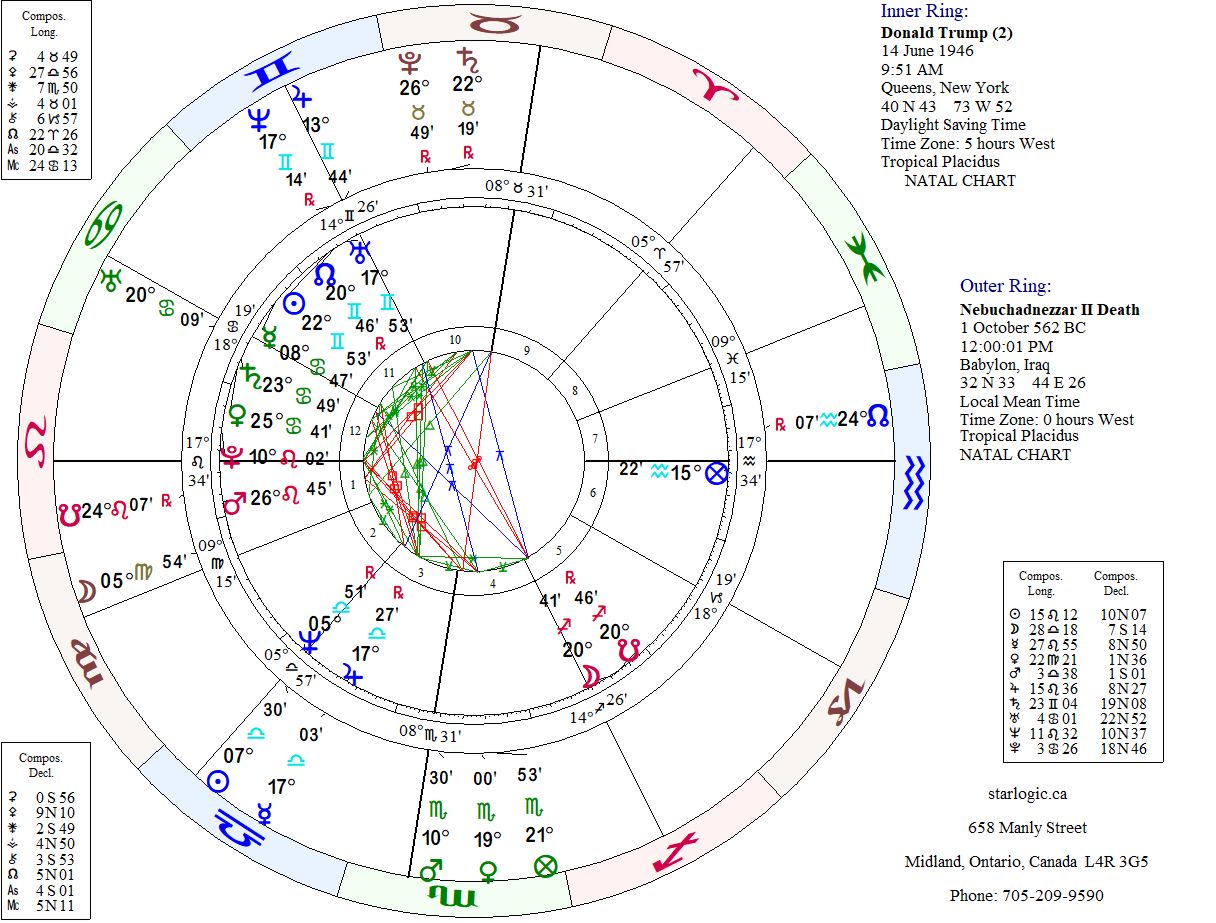
Remember how evangelical Christians saw Trump as the second coming of Cyrus the Great? What if he were Nebuchadnezzar II instead? Those aspects featuring planets @ 17° are interesting, are they not?
And, not to make to fine a point: Babylon was broken up, and its empire was scattered.
Warning, warning! Read the writing on the wall.


 cdsmiller17