
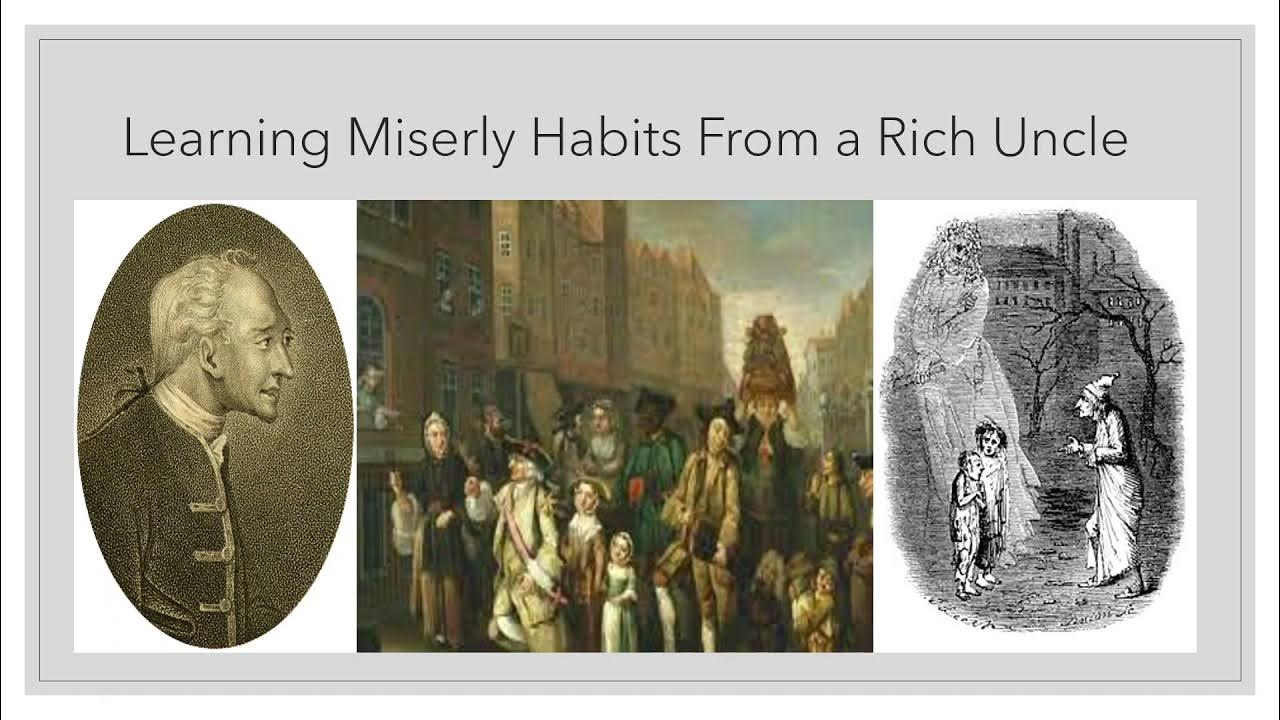
John Elwes MP (April 7, 1714 – November 26, 1789)
Imagination is a wonderful thing. But sometimes it can lead to paranoia about your money and then life turns miserable. Did you ever think about where the word ‘miserable’ comes from? Penny-pinching in the 18th century wasn’t much fun. Such was the life of John Elwes, MP for Berkshire, UK.
After his parliamentary career ended, Elwes devoted his full energies to being a miser as he moved about among his many properties. At his neglected estates he continued to forbid repairs, joined his tenants in postharvest gleaning, and sat with his servants in the kitchen to save the cost of a fire elsewhere. Even on the coldest day of winter he was known to sit fireless at his meals, saying that eating was “exercise enough” to keep him warm. If a stableboy put out hay for a visitor’s horse, Elwes would sneak out and remove it. In his last years, he had no fixed abode and frequently shifted his residence between his unrented London properties in the neighbourhood of Marylebone, seeking out the ones that were temporarily unoccupied. A couple of beds, a couple of chairs, a table, and an “old woman” (housekeeper) were said to be all his furnishings. This same housekeeper was known to frequently catch colds because there were never any fires and often no glass in the windows.
This practice nearly cost Elwes his life when he fell desperately ill in one of these houses and no one could find him. Only by chance was he rescued. His nephew, Colonel Timms, who wanted to see him, inquired in vain at Elwes’s bankers and at other places. A pot boy recollected having seen an “old beggar” go into a stable at one of Elwes’s uninhabited houses in Great Marlborough Street and lock the door behind him. Timms knocked at the door, but when no one answered, sent for a blacksmith and had the lock forced. According to Edward Walford in Volume 4 of his Old and New London (1878):
“In the lower part (of the house) all was shut and silent, but on ascending the stairs they heard the moans of a person seemingly in distress. They went to the chamber, and there on an old pallet bed they found Mr. Elwes, apparently in the agonies of death. For some time he seemed quite insensible.”
He remained in this condition until some “cordials” could be administered by a neighbouring apothecary. After he had sufficiently recovered, Elwes stated that he believed he had been ill for “two or three days” and that there was an “old woman” in the house, but that for some reason or other, she had “not been near him”; that she had “been ill herself”, but that he supposed she must have “recovered” and “gone away”. Upon searching the premises, however, Timms and the apothecary found the woman stretched lifeless on the floor, having apparently been dead for two days.
Towards the end of his life, Elwes grew feverish and restless, hoarding small quantities of money in different places, continually visiting all the places of deposit to see that they were safe. He began suffering from delusion, fearing that he would die in poverty. In the night, he was heard struggling with imaginary robbers, crying: “I will keep my money! I will! Don’t rob me! Oh, don’t!” When asked who was there, Elwes would reply: “Sir, I beg your pardon, my name is Elwes, I have been unfortunate enough to be robbed in this house, which I believe is mine, of all the money I have in the world of five guineas and a half, and half a crown.” The family doctor was sent for, and, looking at the dying miser, was heard to remark: “That man, with his original strength of constitution, and lifelong habits of temperance, might have lived twenty years longer, but for his continual anxiety about money.” Even his barrister, who drew up his £800,000 will, was forced to undertake his writings in the firelight by the dying man’s bedside in order to save the cost of a candle.
Elwes was known to sleep in the same worn garments he wore during the day. He was discovered one morning between the sheets with his tattered shoes on his feet, an old torn hat on his head, and a stick in his hand. It was in this condition he died on 26 November 1789. His burial took place in Stoke-by-Clare. After having lived on only £50 a year, Elwes left £500,000 (approximately £81,000,000 as of 2021) to his two illegitimate, George and John (whom he loved but would not educate, believing that “putting things into people’s heads is the sure way to take money out of their pockets”), and the rest to his nephew.
If that sounds like the plot of Scrooge’s visitation by three ghosts (as warned by Marley), it may be that Charles Dickens had John Elwes in mind when he wrote “A Christmas Carol”.

John Elwes Birth Chart

The timing is randomized. Other astrology sites have the birth date as stated, but since this is before 1753, it must be Old Style, which means that 11 days are added to equivalate the date to New Style.
There are two loaded houses in his chart: the 11th House (of Associations) and 3rd (of Short Journeys). Obviously a different timing would change them into different houses, but I think I’ll leave well enough alone. The Moon in his Gemini 12th House (of the Unconscious) could be significant to his delusions. And the Saturn/Pluto conjunction in Virgo may be where the penny-pinching comes from. Who knows?
My curiosity was piqued by the idea that Elwes may have telegraphed his reality to Dickens, somehow.

Was Charles Dickens the reincarnation of John Elwes? It looks like it. What do you think?


 cdsmiller17
LikeLike