
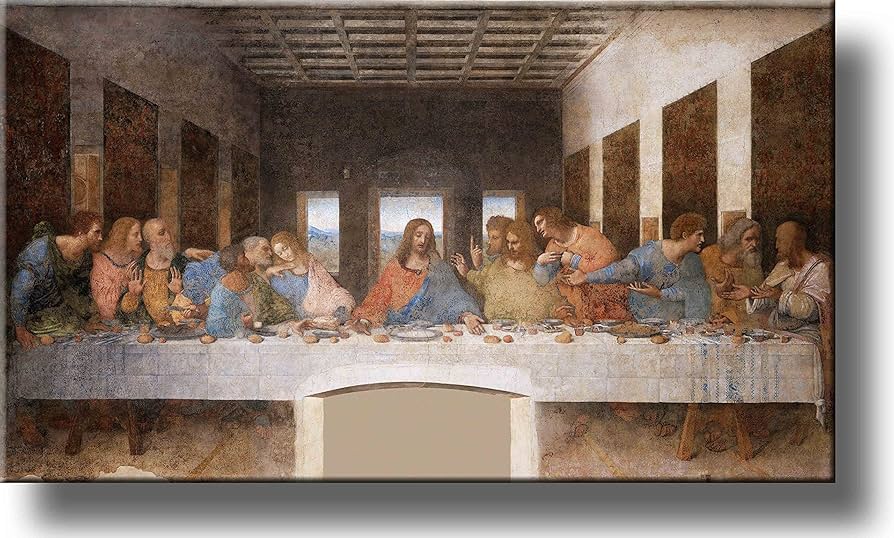
The Last Supper (Nisan 14, 30 AD)
Because the Jewish calendars have two reference points, sunrise and sunset, it gets very complicated for mere mortals to know to which Julian day any Jewish day refers to. Hence most modern people believe the idea that Jesus was crucified on a Friday before sundown (i.e. before the Sabbath).
I. The Choice of Dates
The day of the crucifixion was a Wednesday, Thursday or Friday. The Jewish day of the month was either Nisan 14 or Nisan 15, depending on whether the Last Supper was not, or was, the Passover. The day might be measured as beginning at sunrise or sunset, or both, depending on the calendars in use. A comparison of these variables with the astronomical calculations of Nisan 1, and the following Passover, yields the following possible dates for consideration:1Chart XXIX
Possible Astronomical Dates of the Crucifixion
Date Day Jewish Day Calendar 30 CE, April 6 Thursday Nisan 14 Sunrise 30 CE, April 7 Friday Nisan 14 Sunset 30 CE, April 7 Friday Nisan 15 Sunrise 31 CE, March 282 Wednesday Nisan 15 Sunset 33 CE, April 3 Friday Nisan 14 Sunrise 33 CE, April 3 Friday Nisan 14 Sunset 34 CE, March 24 Wednesday Nisan 14 Sunset Note that the alignment of the sunset and sunrise calendars on April 7, 30 CE allows both Nisan 14 and Nisan 15 to fall on the same Friday. This alignment is not possible for the other dates considered. This consideration is critical to the possibility of there having been two Passovers observed, as discussed below.
I was alerted to this problem by a YouTube video from the Temple 2030 channel:
We’ll have to take his word for it. In my own calculations, Jesus died @ 2:44 pm on April 4, 30 AD. The discrepancy of dates is due to the fact that it converted the Julian calendar to our modern Gregorian one.
His theory sets the day and date of the Passover to sundown on Thursday, April 6, 30 AD (O.S.). Oh dear.
The Last Supper is typically celebrated on what is known as Holy Thursday. One would think that this should make it an open-and-shut case. But some believe it may have actually been Wednesday when he observed the Last Supper with his disciples.
Why?
The issue here is that the Gospel of John seems to be inconsistent with the Synoptic Gospels. John 13:1-2, John 18:28, and John 19:13-14 seem to indicate that the Last Supper happened before Passover. And it seems that Jesus dies as the Passover lamb. While the Synoptics seem to place it as the Passover meal.
Others who hold to a Wednesday meal do so because they believe there are too many events that would have to take place. He would have been arrested, tried, and then crucified at 9 a.m. the next morning.
One would need to squeeze in a sham trial before the Sanhedrin, an appearance to Pilate, a journey to Herod, a second visit to Pilate, and then being crucified.
Though it seems difficult to fit all of that into such a narrow window, it is not impossible, though. And others will point to Mark 15:42 as evidence of a Friday crucifixion.
It clearly says that Jesus was crucified “the day before the Sabbath.” And thus, it was on the night before (Thursday) that he had this meal with his disciples.
Most hold that the traditional Friday crucifixion and Thursday meal are consistent with the scriptural record, though a bit tricky to navigate. While others believe that a Wednesday meal and a Thursday crucifixion actually fit the narrative even better.
Thankfully, all believers are in agreement that he died, was buried, and on Sunday, he rose from the grave. We just aren’t exactly certain of which day.
Now do you see why this is such a contentious issue? We may be celebrating our Good Friday and Easter Sunday on the wrong days. Maundy Thursday might really be Maundy Wednesday. OK?


 cdsmiller17
LikeLike
Upon reflection, since the Jewish days are actually sundown to sundown, a Wednesday night, now, would actually be a Thursday night, then. So, no harm dome.
LikeLike