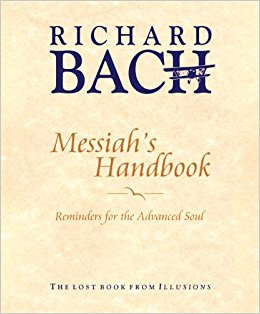
Ten years ago, I sent this book to my future wife, Susan. This is how I inscribed the book:
“To my soulmate, Sue.
“Here’s an interesting addition to our mental processes.
“I hope you can see the concepts for what they are: enigmas meant to get us thinking…
“You aren’t required to agree with him — I certainly don’t, frequently — But he is provocative!
“143
“Chris xo”
From the dust cover flyleaf
In Illusions: The Adventures of a Reluctant Messiah , Richard Bach met Donald Shimoda, a fellow pilot with the keys to the universe who barnstormed the Midwest in a Travel Air biplane.
Part of Shimoda’s secret was a small book, bound in what look like suede — Messiah’s Handbook: Reminders for the Advanced Soul. “Open it,” he said, “and whatever you need to know is there.”
Lost for decades and rediscovered, here it is in print at last — reminders for those who have outgrown cynicism and doubt.
Reminders for the Advanced Soul
“Many happy, successful people
at one time
have considered suicide.
They decided against it.”
“What you knew
before you were born
isn’t lost.
You only hide it till you’re tested,
till it’s time to remember.
And sure enough, when you want,
you’ll find some odd funny beautiful way
to find it again.”
“You are the game-playing,
fun-having creatures;
you are the otters of the universe.”
Courtesy of YouTube
“Unconditional love is
no more a force in spacetime
than it is in chess,
or soccer or ice hockey.
Rules define life in games,
and unconditional love
doesn’t recognize rules.”
“From time to time it’s fun to close your eyes,
and in that dark say to yourself,
‘I am the sorcerer, and when I open my eyes
I shall see a world that I have created,
and for which I and only I
am completely responsible.’
Slowly then, eyelids open
like curtains lifting stage-center.
And sure enough,
there’s your world,
just the way you built it.”
“You wait a lifetime to meet Someone
who understands you, accepts you as you are.
At the end, you find that Someone, all along,
has been you.”
“You learn most
when you play against an opponent
who can beat you.”
Courtesy of WikiHow
“You are free to smile
in the midst of massive tests and challenges,
knowing that you have chosen to play this game,
and that you have dominion
over all the appearances of earth.”
“You are a creature of light.
From light you have come,
to light shall you go,
and surrounding you through every step
is the light of your infinite being.”
“You gave your life
to become the person you are right now.
Was it worth it?”
Conclusion
After all these years, I now see that what Richard Bach was trying to share with the reader is quite true.
He had a moment of enlightenment. We are the beneficiaries. We are the Messiahs.
In the second half of the 20th Century, we began to exam the ‘dark side of life’ (Richard Rohr). Having gone through two World Wars in the space of two generations, we needed to understand man’s inhumanity to his fellow men.
The 1955 Film
In 1947, Catholic priest Father O’Shea (Humphrey Bogart) makes his way to a remote mission in China to replace a priest who was killed there. He meets Dr. David Sigman (E.G. Marshall), his wife Beryl (Agnes Moorehead), and nurse Anne Scott (Gene Tierney), the only other Western residents. They run a hospital for the surrounding villagers, at a time when competing warlords and Communists are engaged in civil war.
O’Shea delivers his debut Sunday sermon, in both English and Chinese for his appreciative parishioners. His work among them and his respect for local customs soon earn him their respect.
Anne becomes uncomfortable as she is attracted to him. Beryl suggests to her husband that Anne be sent back to the United States, but he refuses to consider it, needing her work at the hospital. Beryl suggests that O’Shea consult with Reverend Martin, a Protestant minister at another American mission, for advice. He agrees.
When O’Shea meets Martin (Robert Burton), he makes a startling, unsolicited confession. He says he is not a Catholic priest, but Jim Carmody, an American pilot who had flown supplies over The Hump during World War II. He crashed during the war and was rescued by a local warlord, General Yang (Lee J. Cobb), becoming his trusted second-in-command … and his prisoner. When one of Yang’s soldiers killed Father O’Shea, Carmody deserted and decided to masquerade as the replacement priest. After recounting his story to Martin, Carmody writes a full account to the Catholic bishop.
General Yang tracks down Carmody, bringing an army and insisting that Carmody serve him in the internal warfare of China. Carmody proposes they settle the matter with their customary game of dice, wagering five years of loyal service against his freedom and the safety of the local villagers. After Yang loses, he coerces Carmody into playing again, this time for the future of the Protestant mission. When he loses again, Yang resigns himself to perpetuating the myth of Father O’Shea, who was saintly enough to turn aside a powerful warlord.
Before Carmody leaves the mission, he tells Anne the truth [Wikipedia]
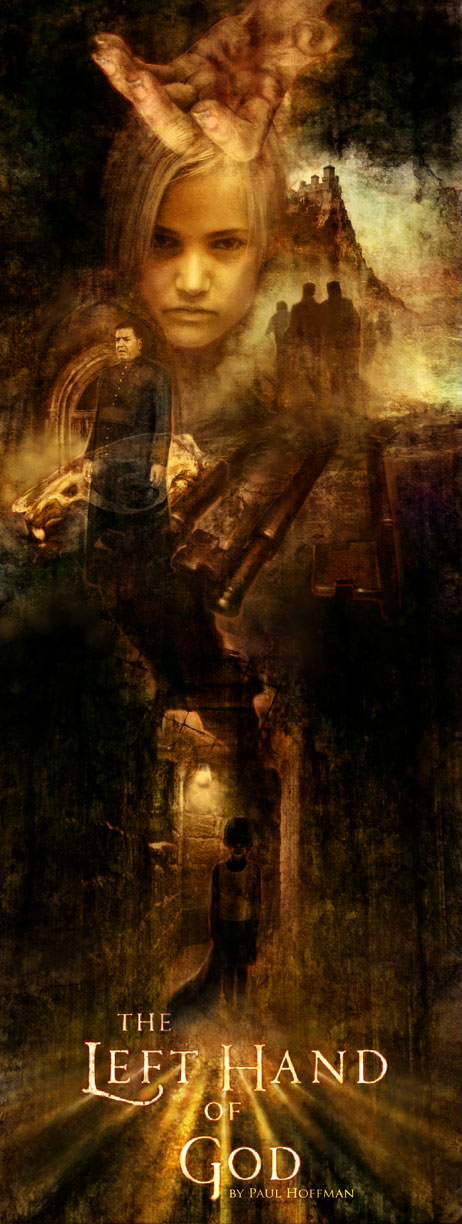
The 2010 Novel
Courtesy of DeviantArt
Thomas Cale, a 14-year-old boy is just another recruit of the great conflict between Redeemers and Antagonists – or so he thinks. Along with his two “friends” (friendship is forbidden and Cale is in general reluctant to make any closer bonds) named Kleist and Vague Henri, Cale not only finds a room full of delicious food, much different from their usual fare at the Sanctuary, but they also witness something they have been told is Devil’s temptation and sinful – two beautiful girls entertaining a crowd of their jailers.
Putting himself and his companions in a mortal danger, Cale assassinates the Lord Redeemer Picarbo as a revenge for killing one of the two girls; he also rescues the other one, Riba, and then engineers and executes an escape from the Sanctuary, something unthinkable for most of his fellow prisoners.
On their way to Memphis, a major city of the Matterazzi and their nearest safe haven, they encounter a slaughtered group of Matterazzi delegates with only one survivor, Chancellor Vipond. Cale and his companions are eventually captured by a Matterrazi armed group and escorted to Memphis, where they are eventually given a limited freedom and assigned to assist the local nobility.
Cale gets into a fight with several of the best local young warriors, including his temporary superior Conn Matterazzi, which he wins. This act immediately draws a great amount of attention to him and when Cale manages to rescue the Matterazzi princess Arbell Swan-Neck from the Redeemers who kidnapped her, the three former Redeemer recruits become a personal guard of the Matterazzi princess, who is both impressed and intimidated by Cale. The two soon fall in love.
The Redeemers continue in their provocative attempts to obtain Arbell and eventually, they silently declare a war against the Matterazzi – which seems like a reckless and foolish act given the fact that Matterazzi army is better trained, equipped and superior in all aspects.
The final confrontation however goes gravely ill for the favoured side. The Redeemers emerge victorious from the decisive battle and they seize Memphis; but are willing to leave the Matterazzi alone in exchange for one thing: Thomas Cale.
The Battle Lord of the Redeemers, Bosco, who was also responsible for the most of Cale’s training back at the Sanctuary, claims that he had a vision of Cale being a creation of God, sent to fulfil the destiny of the Redeemers and cleanse humanity. Cale is betrayed by his lover Arbell and given to the Redeemers in exchange for peace. [Wikipedia]
The Evolution of a Concept
As you can tell from the ideas presented in the two plot outlines shown above, in a short 55 years, we have gone from a love story (of sorts) to a full-fledged fantasy involving the forces of Good and Evil. What are we trying to understand?
In researching this phrase, I came across a discussion page about it. The answer seems to be that no-one sits on the Left Hand of God, and yet that answer is unsatisfactory. We so much want it to be the Devil, as that would exonerate we humans. Some even imagine that it should be a woman, such as Mary. But again, we seem to be ducking our own responsibility of how dark life is for so many here on earth.
Conclusion
Who is sitting on the Left Hand of God?Humanity is!
As I pointed out in The Right Hand of God the natural transfer of spiritual energy goes from the right hand to the left hand, continuing around the circle until it comes back to the beginning, where it is absorbed and sent out again. Life is a circle.
More likely a fantasy. At least that’s what I thought when I first read this book in 1994. We were all so much more innocent in those days.
Now, we can see how prophetic this writer’s words were.
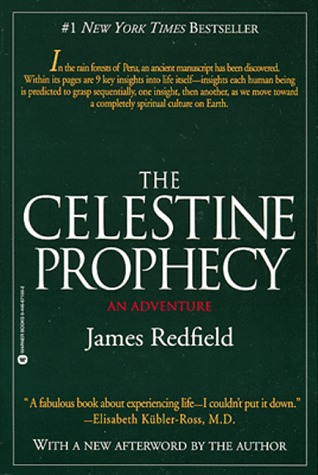
(From the dust jacket:) Are three decades of interest in modern physics, ecology, mystical religion and inter-personal psychology finally synthesizing into a new spiritual “common sense”? Are we now beginning to live this new common sense? Can it become the dominant paradigm of the next century?
The simple answer is Yes!
A List of Chapter Titles
The nine insights that Redfield has discovered are ‘hidden’ in the titles of the chapters:
A Critical Mass
The Longer Now
A Matter of Energy
The Struggle for Power
The Message of the Mystics
Clearing the Past
Engaging the Flow
The Interpersonal Ethic
The Emerging Culture
These insights drive the narrative of the book and take the reader on a rollicking ‘adventure’ into South America.
But is it Real?
That’s always an issue, isn’t it? Our rational mind wants that question answered, or else we won’t ‘buy in’ to the story.
The obvious tie-in to Carlos Castaneda’s The Teachings of Don Juan makes the reader pause and consider the implications of ‘ancient’ wisdom from indigenous people. Did they learn something ‘way back when’ that we are only just rediscovering? The simple answer is Maybe!
It could also be that the world was intended to be ‘educated’ in this time frame.
Conclusion
If you want to have an ‘adventure’ that might be only one man’s way of teaching us spiritual truths, I would heartily recommend this book. The worst that can happen is that you’ll ‘see’ the world in a different way.