
Four Lives of the Antichrist
According to the writers of the New Testament, the Antichrist from Revelation was definitely Nero. (Even his name adds up to the number of the Beast: 666.)
According to Kevin Ryerson’s Ahtun Re, Nero reincarnated as Donald Trump. I’ve run with that idea ever since. However, one question keeps coming up: what has Nero been doing since his death in the 1st century of the common era (1 CE)? Over time, I’ve had a couple of clues come up and now I’m willing to show you the complete picture. Remember, too, that the False Messiah, Sabbatai Zevi, was alive during Louise XIV’s reign in France. The other prior life for Trump was Benito Mussolini, when he was the Duce in Italy, leading up to World War II. Everything points to the End Times having already happened. Could the End Times happen again, too?
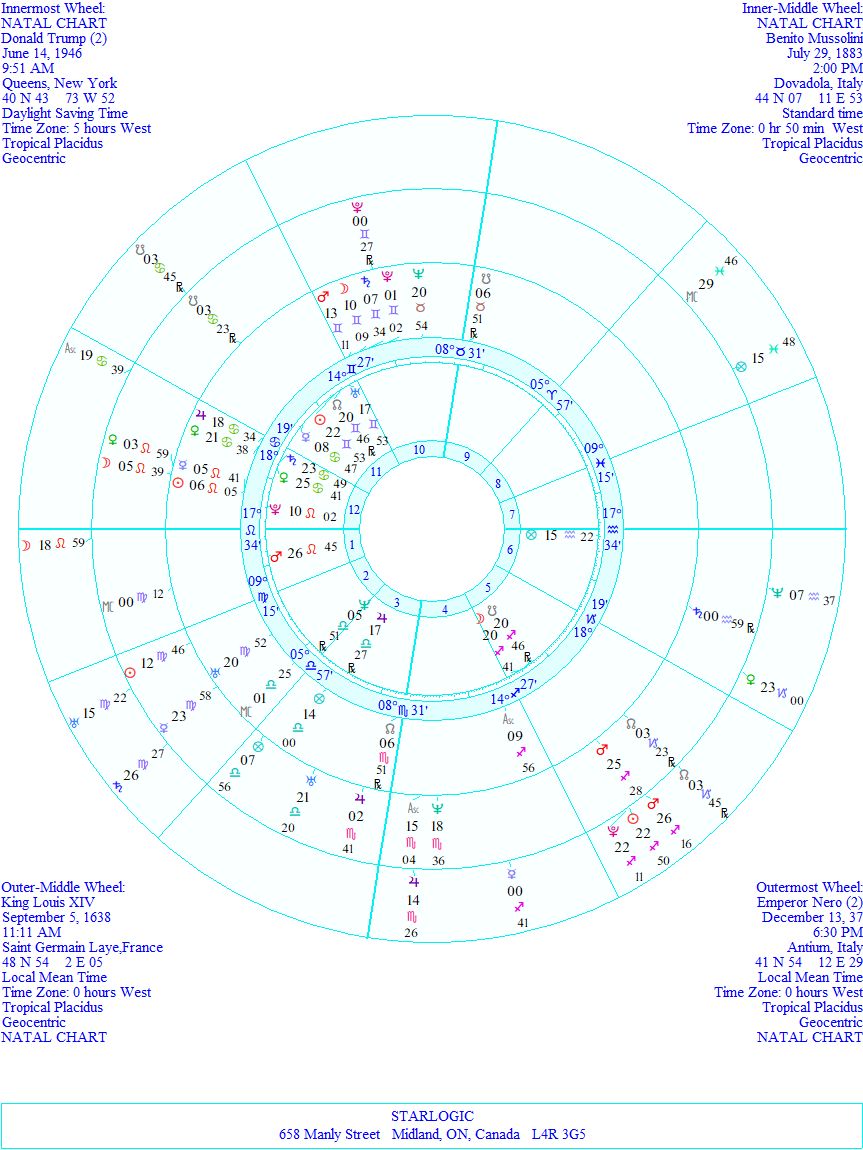
What initially strikes me is the fact that each subsequent life seems to highlight some aspects and planetary positions of the previous one. There is a good chance that the 1600 years between Nero and Louis XIV held some other incarnations which may have been in times of absolute rulership. One day, they may come to light. In the meantime:

Amen.


 cdsmiller17
The Zevi/Louis XIV contemporary time period is effectively the end of European royalty. There were (and still are) some royal houses left, but the absolute rulership of a king was over. Around the corner, in history, republics were beginning to develop.
LikeLike
Belief in Nero’s survival may be attributed in part to the obscure location of his death, although, according to Suetonius, Galba’s freedman Icelus saw the dead emperor’s body and reported back to his master. Nero was also denied the lavish burial that was accorded to popular emperors and members of the imperial family, which may have left those plebeians who loved him dissatisfied and suspicious. Furthermore, he was not buried in the Mausoleum of Augustus with the other Julio-Claudian emperors, but in a tomb on the Pincian Hill at the family burial place of the Domitii Ahenobarbi. The postmortem popularity of Nero among the Roman plebeians inspired them to lay flowers at his tomb.
Another possible source of inspiration for those who impersonated Nero was the circulation of prophecies that predicted he would regain his kingdom in the East. One version placed his resurgence at Jerusalem. These prophecies have been tied to Nero’s natal chart, which has been interpreted as pointing to a loss of his patrimony and its recovery in the East. Tacitus may have been referring to such prophecies in veiled language when he wrote of the rumors that circulated about Nero after his death, which had contributed to the belief that he had survived. The return of Nero may have inspired the author of the Book of Revelation when he wrote about the eschatological opponent called the Beast, which is mortally wounded and then miraculously heals. The number of the Beast, 666 or 616, depending on the manuscript, has been identified by some as the numerical value of the letters in Nero’s name. Nero also appears more explicitly in this role in the Ascension of Isaiah and some of the books of the Sibylline Oracles. Owing to these prophecies and others, Nero was long thought to be the Antichrist. (Wikipedia)
LikeLike