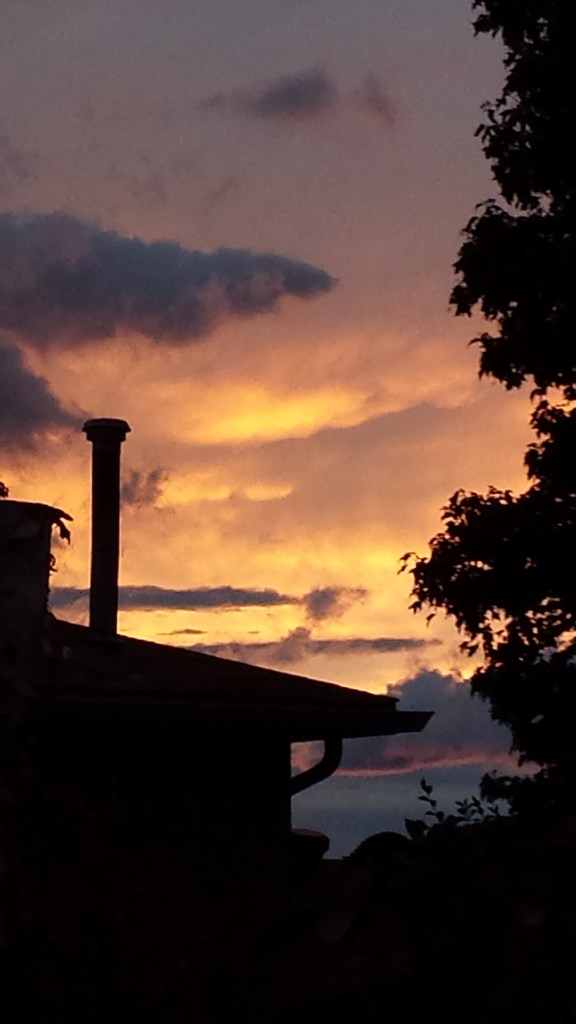
It’s that time of year again: and, as always, my mind turns its attention to the art of dying. Each leaf represents a living being; each tree, the eternal soul. When the time comes, as it will for each of us, we will have to let go of our place in this world and fall (in)to the ground, yet again. But we will grow anew when the spring comes.
Those who are closest to the ground of their being have the least distance to fall.
And, sometimes, the silent observer has to stand back to appreciate the bigger picture.
But in the end, we all go out of this world in a flaming blaze of glory.
Death in Autumn
The leaf, once a warm budding sprout, is now cold:
He is brittle and coloured for he is old;
He knows his life is finished as he closes his eyes,
I Wrote This Statement on Facebook (September 20, 2020)
I’m not posting this for public consumption. Nor am I hoping that it will be shared extensively among my friends and acquaintances. But I do wish to make a point about the individual’s right to do what they want, so long as it doesn’t infringe on anyone else’s right to do the same.
My point is this: if you want to take the risk about the pandemic as to whether to wear a mask or not, go ahead; it’s your life. But don’t expect that everyone will like or appreciate your making that choice. Other people are afraid of death, in any form, so they will fight to keep you under control (through fear, threats, whatever) so that they can rest easy in their beds at night. Strange, eh?
“Breathe deeply, the gathering gloom; watch light fade from every room…” (Moody Blues – word poem by Graeme Edge, ending their song “Nights in White Satin” 1969)
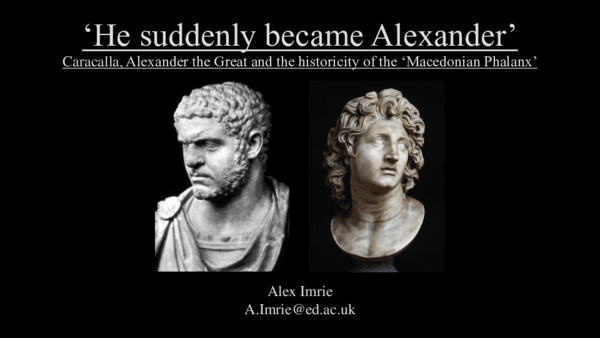
Well, it was bound to happen. The son of the first black Roman Emperor (Septimius Severus, born in Libya) gets to co-rule with his father from the tender age of 10 and then becomes sole emperor after his death in 211 AD. The echo is there, isn’t it?
Here’s an early family portrait, with one child’s face obliterated:
Here’s Marcus Aurelius Antoninus’ birth chart:
This chart is rectified to the Saturn event (becoming co-ruler with his father) at age 10. It then allows us to see his becoming sole ruler just before turning 24, when his brother, Geta, was murdered. Lovely family…
Geta’s face is the one missing from the family portrait, above.
Then:
In those days, someone could claim to be someone else reborn, and most people would accept it. There may have been a bit of pushback for this claim, though, as Alexander the Great was so admired throughout the world after more than 500 years since his death. But Caracalla was adamant.
According to Wikipedia:
‘After Caracalla concluded his campaign against the Alamanni, it became evident that he was inordinately preoccupied with the Greek-Macedonian general and conqueror Alexander the Great. He began openly mimicking Alexander in his personal style. In planning his invasion of the Parthian Empire, Caracalla decided to arrange 16,000 of his men in Macedonian-style phalanxes, despite the Roman army having made the phalanx an obsolete tactical formation. The historian Christopher Matthew mentions that the term Phalangarii has two possible meanings, both with military connotations. The first refers merely to the Roman battle line and does not specifically mean that the men were armed with pikes, and the second bears similarity to the ‘Marian Mules’ of the late Roman Republic who carried their equipment suspended from a long pole, which were in use until at least the 2nd century AD. As a consequence, the Phalangarii of Legio II Parthica may not have been pikemen, but rather standard battle line troops or possibly Triarii. Caracalla’s mania for Alexander went so far that Caracalla visited Alexandria while preparing for his Persian invasion and persecuted philosophers of the Aristotelian school based on a legend that Aristotle had poisoned Alexander. This was a sign of Caracalla’s increasingly erratic behaviour. But this mania for Alexander, strange as it was, was overshadowed by subsequent events in Alexandria.
‘When the inhabitants of Alexandria heard of Caracalla’s claims that he had killed his brother Geta in self-defence, they produced a satire mocking this as well as Caracalla’s other pretensions. In 215 Caracalla travelled to Alexandria and responded to this insult by slaughtering the deputation of leading citizens who had unsuspectingly assembled before the city to greet his arrival, before setting his troops against Alexandria for several days of looting and plunder.’
Could He Have Really Been Alexander?
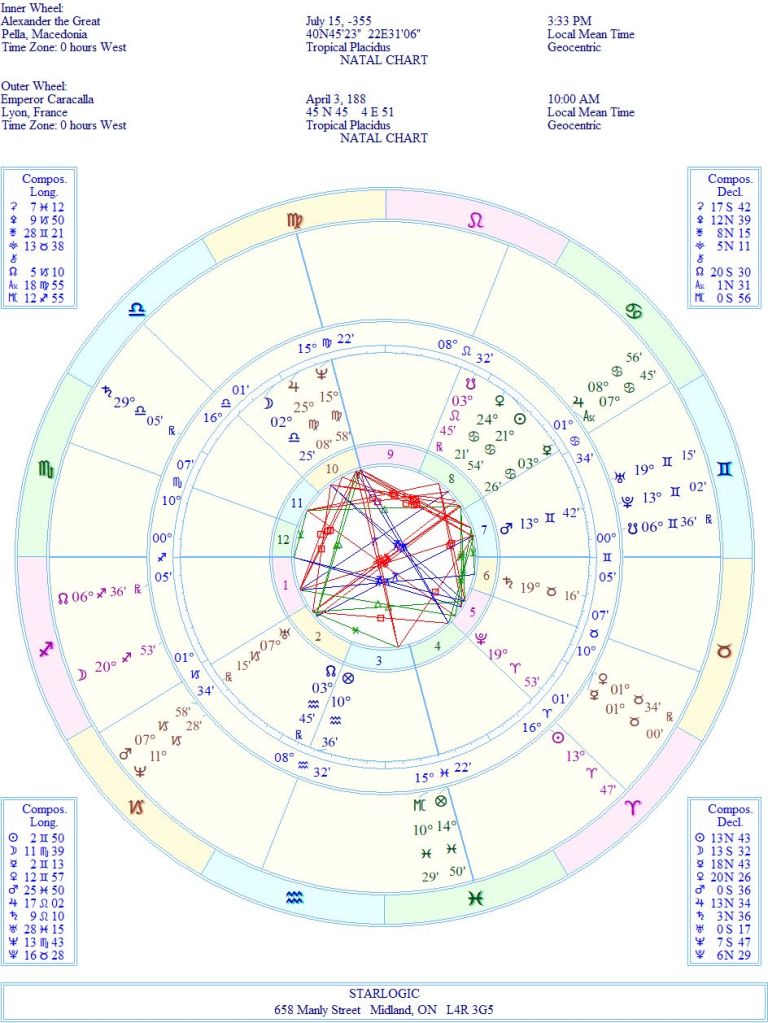
One of the ways to prove or disprove the theory is how their birth charts align. Alexander’s Mars is conjunct Caracalla’s Pluto. That’s a strong indicator, for sure. And the double Yod pointing at Caracalla’s Mercury/Venus conjunction is supported by the inconjuncts of the Moon and the Ascendant in Alexander’s chart. Plus, Caracalla’s Sun is inconjunct to Alexander’s Neptune/Midheaven conjunction. Alexander’s Mars is conjunct Caracalla’s Mars, while another Yod points at Caracalla’s Moon, with the inconjuncts of Alexander’s Saturn and Sun. I think it fair to say, Caracalla was right!
I could have also discussed the echo of his assassination at age 29, but we will leave that for another day.
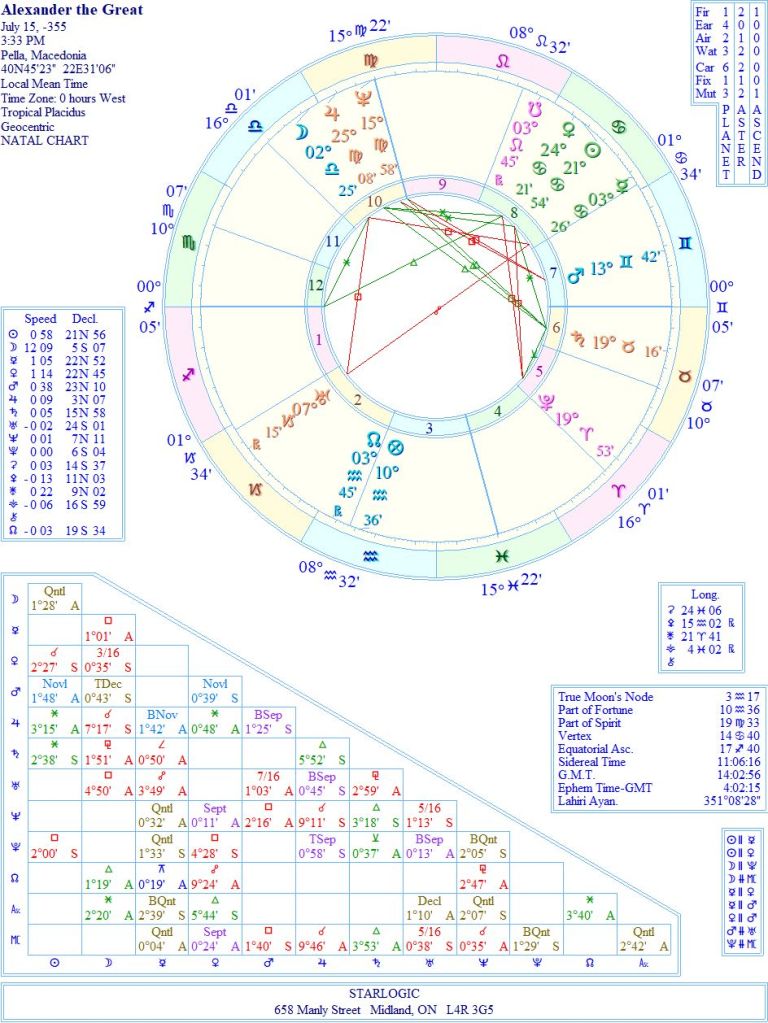
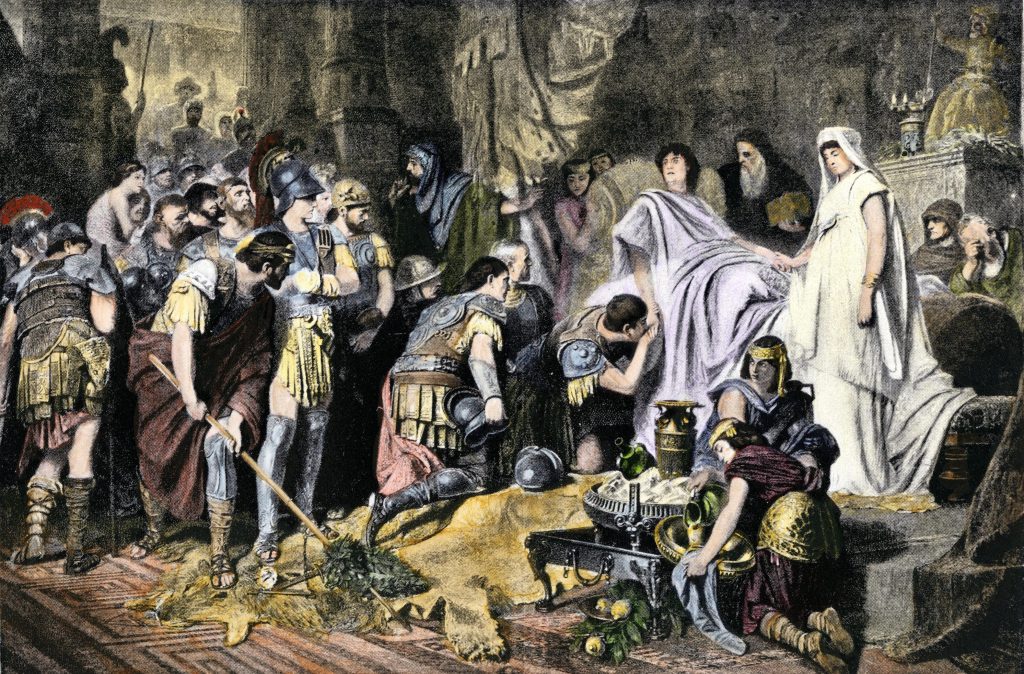
It’s one of those great mysteries. After drinking some wine, he died two weeks later. Was the wine poisoned? Did someone want him out of the way? Maybe astrology can help us see the ‘bigger’ picture.
As you can see the date has been changed to a ‘new style’ July 15th. I have rectified the chart to make his ascension to the throne occur when he’s about 20 (Saturn in Taurus). That allowed his Ascendant to move to 0 Sagittarius, the sign of a man in constant motion. The Pluto position in Aries indicates that he was tutored in the sciences and philosophy as a teenager by Aristotle. It may also be when he started to believe his mother’s story of his being the son of Zeus. The Mars position hints at his death at 32.
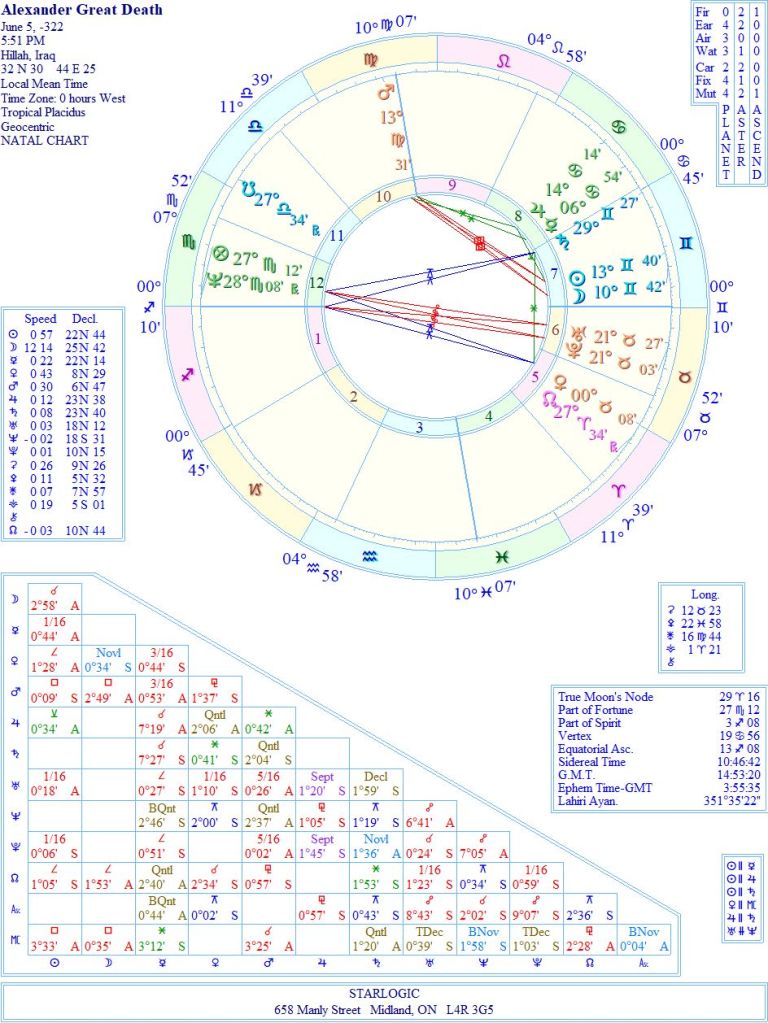
Now let’s look at his death:
Again, I’ve rectified the chart, but this time to ensure that Neptune (Mystery) in Scorpio (Hidden Matters) in the 12th House (of Unconsciousness) is very close to the Ascendant. As it turns out the time brings the same degree of Sagittarius Rising. It will make the combined charts easier to read together. The resulting double Yod points at this conjunction between Neptune and the Ascendant, with Venus and Saturn making the inconjuncts. Does this mean one was in the government and the other ‘close to him’?
Uranus and Pluto are conjunct in Taurus; the Sun and the Moon are conjunct in Gemini. The two ‘lights’ square to Mars implies murder. The opposition of Uranus/Pluto to Neptune/Ascendant means there was a conspiracy.
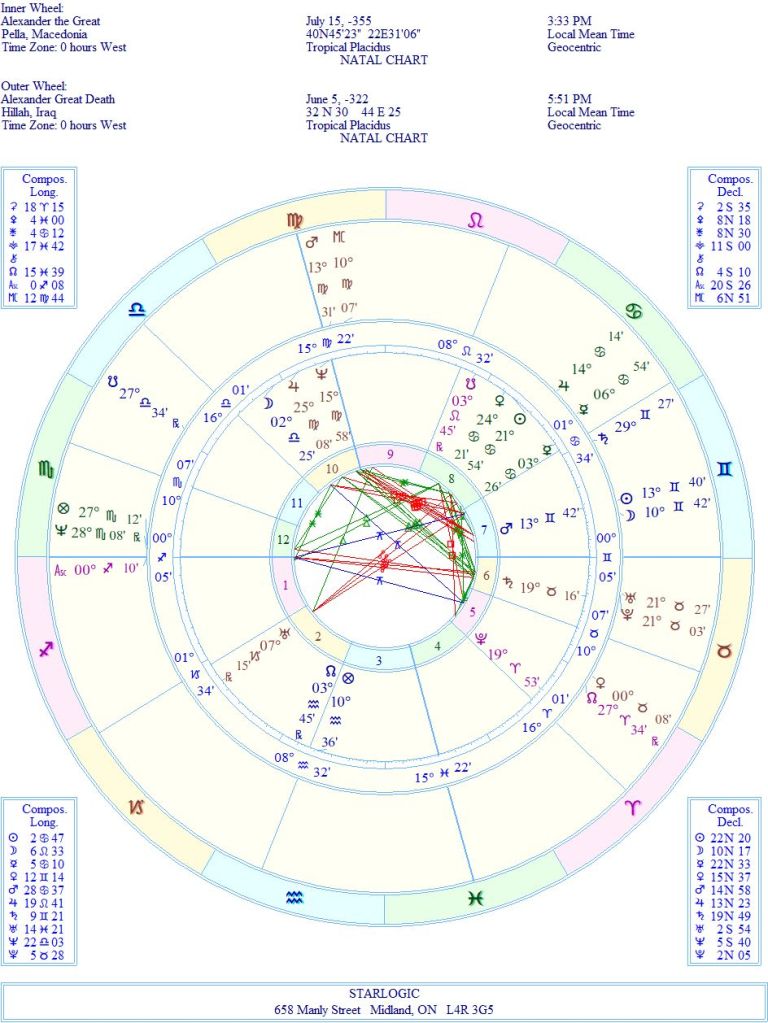
Let’s look at the combined charts now:
See how the charts align? Now we have a Yod pointing at his ‘natal’ Ascendant (from his ‘fatal’ Venus and ‘fatal’ Saturn) and a second one pointing at his ‘fatal’ Venus (from his ‘natal’ Moon and ‘natal’ Ascendant). Looks like his mother was somehow involved in the event. One can only imagine why. Perhaps this paragraph from Wikipedia will help us.
“Given the propensity of the Macedonian aristocracy to assassination, foul play featured in multiple accounts of his death. Diodorus, Plutarch, Arrian and Justin all mentioned the theory that Alexander was poisoned. Justin stated that Alexander was the victim of a poisoning conspiracy, Plutarch dismissed it as a fabrication, while both Diodorus and Arrian noted that they mentioned it only for the sake of completeness. The accounts were nevertheless fairly consistent in designating Antipater, recently removed as Macedonian viceroy, and at odds with Olympias, as the head of the alleged plot. Perhaps taking his summons to Babylon as a death sentence and having seen the fate of Parmenion and Philotas, Antipater purportedly arranged for Alexander to be poisoned by his son Iollas, who was Alexander’s wine-pourer.”
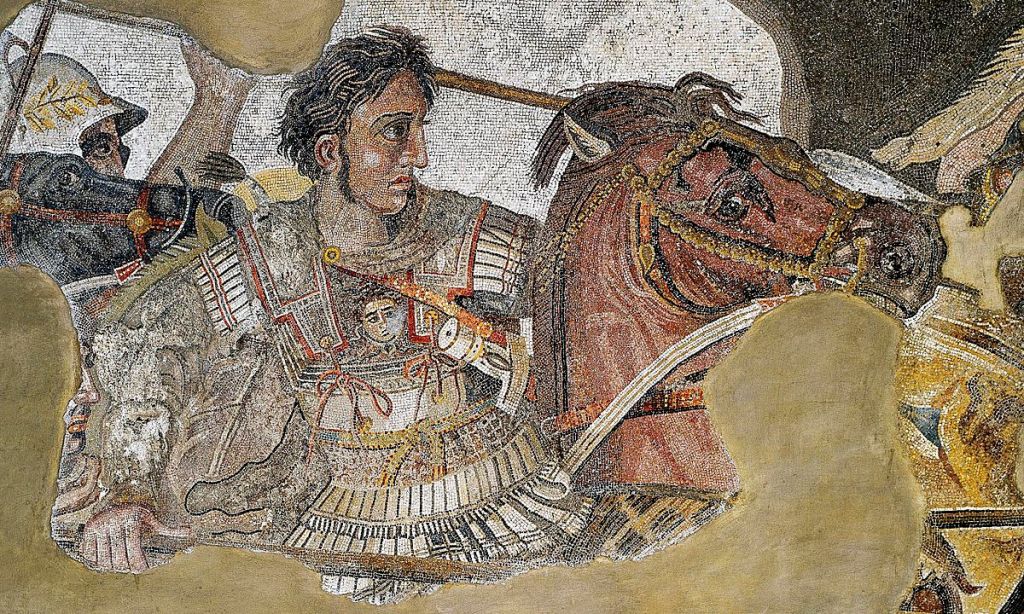
This is an historic battle for many reasons, but the most obvious is that a Macedonian army defeated the Persians in their own back yard. And the Persians under Darius III had the superior force.
Evidently, there had been a lunar eclipse the day before this battle (which is how historians know what the date was, exactly). This should have been a clue that a new day had dawned. And the Macedonian army had overslept, while the Persian army had been up all night. One side wasn’t battle ready until noon, while the other side was already battle weary, It doesn’t take a genius to see that something would have to give.
Here’s the battle chart:
The Yod pointing at the (New) Moon is the battle result being telegraphed at the start. Saturn and Pluto are the inconjuncts to the Moon. Uranus is opposite the Moon and about halfway between the other two planets. The king, Darius III, is represented by the Sun, which has already been eclipsed, by this time of the day. The Sun is conjunct Mars but the God of War will be useless for the Persian king. He’d already missed his chance.
I got an email yesterday from myjewishlearning.com seeking a donation of $6.13. It suggested that by my doing so I would be performing one of the 613 mitzvahs as instructed in the first five books of the Old Testament, the Torah. That got me thinking.
‘The Talmud notes that the Hebrew numerical value (gematria) of the word Torah is 611, and combining Moses’s 611 commandments with the first two of the Ten Commandments which were the only ones heard directly from God, adds up to 613. The Talmud attributes the number 613 to Rabbi Simlai, but other classical sages who hold this view include Rabbi Simeon ben Azzai and Rabbi Eleazar ben Yose the Galilean. It is quoted in Midrash Shemot Rabbah 33:7, Bamidbar Rabbah 13:15–16; 18:21 and Talmud Yevamot 47b.
‘Many Jewish philosophical and mystical works (e.g. by Baal HaTurim, the Maharal of Prague and leaders of Hasidic Judaism) find allusions and inspirational calculations relating to the number of commandments.
‘The tzitzit (“knotted fringes”) of the tallit (“[prayer] shawl”) are connected to the 613 commandments by interpretation: principal Torah commentator Rashi bases the number of knots on a gematria: the word tzitzit (Hebrew: ציצת (Biblical), ציצית, in its Mishnaic spelling) has the value 600. Each tassel has eight threads (when doubled over) and five sets of knots, totalling 13. The sum of all numbers is 613. This reflects the concept that donning a garment with tzitzit reminds its wearer of all Torah commandments.’
‘613 is a prime number, the first number of prime triplet (p, p + 4, p + 6), middle number of sexy prime triple (p − 6, p, p + 6). It is the index of a prime Lucas number.
‘613 is a centered square number with 18 per side, a circular number of 21 with a square grid and 27 using a triangular grid. It is also 17-gonal.
‘613 is the sum of squares of two consecutive integers, 17 and 18, and is also a lucky number and thus a lucky prime.’
Tarot number 17
Tarot number 18
In other words The Stars and The Moon. Interesting.
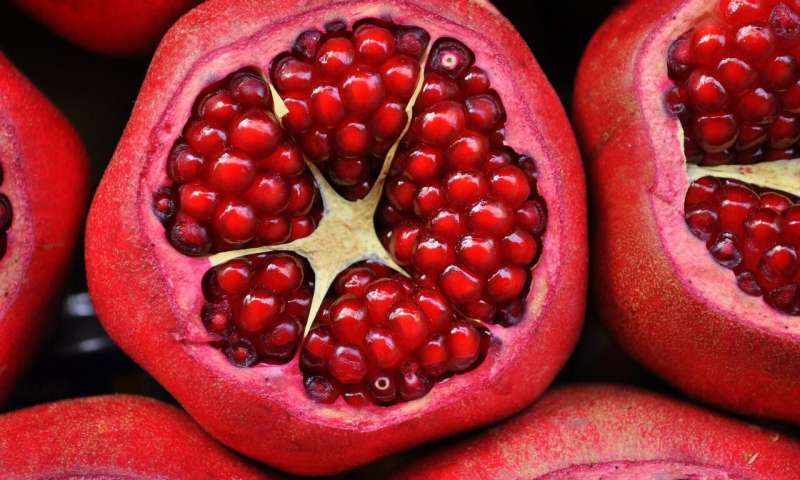
The pomegranate is said in Judaism to have 613 seeds.
So what have all these entries about 613 have in common? They’re about God, and how to reach perfection: 6+1+3=10.
For all have sinned, and come short of the glory of God