Star: 2 – Mercury: The Winged Star (part 2)

Are there messengers from “Across the Universe”? John Lennon thought so: ‘Sounds of laughter, shades of life, are ringing through my open ears, inciting and inviting me.’

Life*Time Astrology

Early in Jesus’ life, the Archangels appeared to those connected with him several times. This happily brings me to A.T. Mann’s concept of Life*Time Astrology. Using a logarithmic base of 10, he set out a scale of time based upon the Ascendant of the birth chart. The 120° before the Ascendant represent the natives’ nine month gestation period {ten moons}; the 120° after the Ascendant illustrate the events of one’s childhood {one hundred moons}; and the remaining 120° symbolise the adult years {one thousand moons}.

In my opinion, the 70 year scale which resulted from his calculations is more-or-less correct, but I believe that the only way to test whether someone’s birth chart is correct is by analyzing significant events in that person’s life and seeing if the natal positions of the planets match these events in their timing.

Initially, Gabriel announced Jesus’ impending arrival to Mary, which we see, on the Life*Time Astrology scale, as his natal Moon, six-and-a-half months before his birth.

Joseph’s Dreams
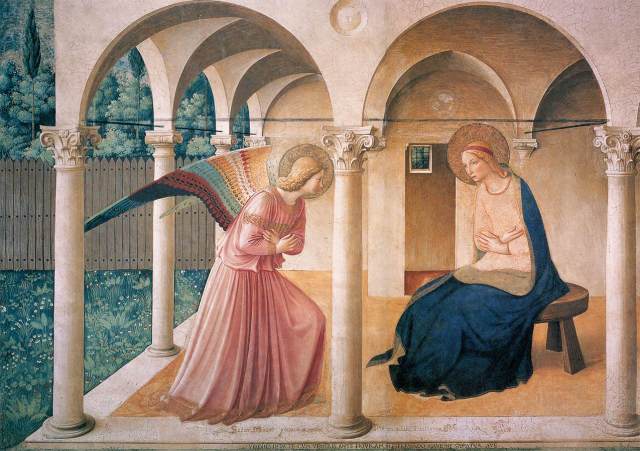
Fra_Angelico_-_The_Annunciation_-_WGA00555

The Annunciation

Then, during Jesus’ gestation period, signified by Pluto’s position in Jesus’ twelfth house, Joseph realized that Mary was five months pregnant, although they were only engaged, so he considered divorcing her quietly for her supposed adultery:

But after he had considered this, an angel of the Lord appeared to him in a dream and said, “Joseph, son of David, do not be afraid to take Mary home as your wife, because what is conceived in her is from the Holy Spirit. She will give birth to a son, and you are to give him the name Jesus, because he will save his people from their sins.” (Matthew 1:20-21)

On coming to the house, they saw the child with his mother Mary, and they bowed down and worshipped him. Then they opened their treasures and presented him with gifts of gold and of incense and of myrrh. And having been warned in a dream not to go back to Herod, they returned to their country by another route. (Matthew 2:11-12)

The next encounter happened soon after the departure of the Magi when Joseph was warned by an angel in a dream to flee to Egypt to escape Herod’s edict to kill all newborn infants under the age of two years.

When they had gone, an angel of the Lord appeared to Joseph in a dream. “Get up,” he said, “take the child and his mother and escape to Egypt. Stay there until I tell you, for Herod is going to search for the child to kill him.”

So he got up, took the child and his mother during the night and left for Egypt, where he stayed until the death of Herod. And so was fulfilled what the Lord had said through the prophet: “I called my son out of Egypt.” (Matthew 2:13-15)

Herod’s Revenge

Joseph's_Dream_in_the_Stable

Joseph’s Dream in the Stable

When Herod realized that he had been outwitted by the Magi, he was furious, and he gave orders to kill all the boys in Bethlehem and its vicinity who were two years and under, in accordance with the time he had learned from the Magi. Then what was said through the prophet Jeremiah was fulfilled:
“A voice was heard in Ramah,
Weeping and great mourning,
Rachel weeping for her children
And refusing to be comforted,
Because they were no more.”
(Matthew 2:16-18)

According to the Life*Time Astrology scale, this would have happened just after Jesus’ first birthday, signified by the position of Venus in his chart.

Guardian Angels

imagesAWLDA5BG

Guardian Angel

After Herod dies, an angel of the Lord appeared in a dream to Joseph in Egypt and said, “Get up, take the child and his mother and go to the land of Israel, for those who were trying to take the child’s life are dead.”(Matthew 2:19-20)

The position of the Sun in Jesus’ birth chart {in 1996} shows that this dream message happened when Jesus was three years old (evidently, Herod the Great dies some time before 11 April 4 BC, when Jesus was in his third year).

This was followed by yet another message when he was five years old, as signified by Mercury’s position:

So he got up, took the child and his mother and went to the land of Israel. But when he heard that Archelaus was reigning in Judea in place of his father Herod, he was afraid to go there. Having been warned in a dream, he withdrew to the district of Galilee, and he went and lived in a town called Nazareth. So was fulfilled what was said through the prophets: “He will be called a Nazarene.” (Matthew 2:21-23)

From Edgar Cayce’s Story of Jesus, Jeffrey Furst has documented a proof of this timing in a passage he quotes from the <a class=”external” style=”color:#002fb5;text-decoration:underline;padding-right:13px;background:url(‘http://static.wikinut.com/images/site/external.png&#8217;) 100% 50% no-repeat;” title=”Life Reading” href=”http://www.edgarcayce.org/are/edgarcayce.aspx?id=2578&#8243; target=”_blank” rel=”noopener”>Life Reading of a person who had accompanied the Holy Family in Egypt:

Thus the entity, Josie, was selected or chosen by those of the Brotherhood — sometimes called White Brotherhood in the present — as the handmaiden or companion of Mary, Jesus, and Joseph in their flight to Egypt…

This began on an evening, and the journey through portions of Palestine, from Nazareth to the borders of Egypt, was made only during the night, dwelling by the brooks or the portions where there were wells, in the upper portion of the Egyptian land to which they fled…close to what was then Alexandria.

The sojourn there was a period of some four years — four years, six months, three days.

But the entity, Josie, following the return, was active in all educational activities as well as in the care of the body and the attending to those things pertaining to the household duties with every developing child. (1010)

Unfortunately, the New Testament fails to give us any further angelic messages, so the “guardian angel” role has symbolically been taken over by a human.

Picture Credits

To be continued.

Linked pages: The Star of Bethlehem: Introduction (part 1)
The Star of Bethlehem: Introduction (part 2)
The Star of Bethlehem: Chapter 1 – Prologue
The Star of Bethlehem: Chapter 2 – Mercury: The Winged Star (part 1)

Picture credits:
The Annunciation courtesy of commons.wikimedia.org;
Joseph’s Dream in the Stable courtesy of commons.wikimedia.org;
Guardian Angel courtesy of http://www.catholicireland.net
Posted in manuscripts, spirituality | Tagged , , , , | 7 Comments

Star: 2 – Mercury: The Winged Star

And God said, “Let there be light”, and there was light. John Lennon, in the Beatles song, “The Word”, explains, ‘In the beginning, I misunderstood, but now I’ve got it, the Word is good.’

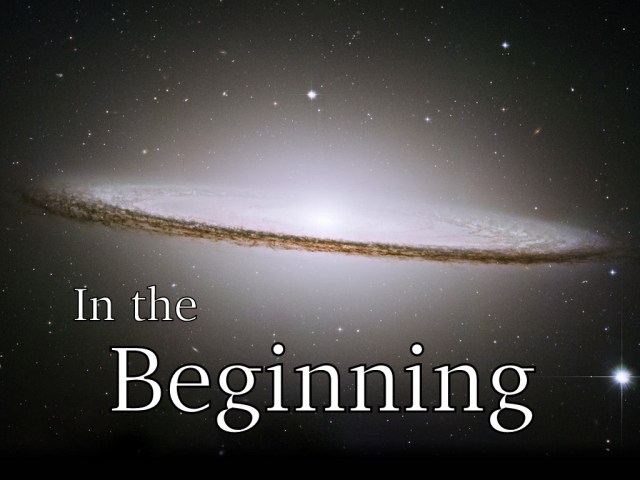
In the Beginning

Whenever we start at the ‘beginning’, we must bear in mind that before anything can become manifest, it must be conceptualized, it must be thought about. That is Mercury’s task.

In the beginning was the Word, and the Word was with God, and the Word was God. He was with God in the beginning. Through him all things were made; without him nothing was made that has been made. In him was life, and that life was the light of men. The light shines in the darkness, but the darkness has not overpowered it. (John 1:1-5)

Although a difficult passage to understand, the foregoing quotation is an echo of the opening phrase of the Old Testament, In the beginning, God created the heavens and the earth. According to H.P. Blavatsky, in Isis Unveiled, the first words B-Rasit should be translated as “In-Principle”, which opens up a whole panorama of thought, literally.

Her entry in the Theosophical Glossary is: Rasit – Wisdom. So the Bible could have opened with the words, “In Wisdom”. Moses, the author of the first five books of the Old Testament, may have been inviting those “who have ears to hear” to use understanding in order to ‘know’ what he meant. That first word, when substituted with numerical values for the letters, adds up to 803. Without the B (“in”), the value remaining for Rasit is 801 (total value 9 = wisdom). The number 8, which we shall discuss ‘in-depth’ later, is important to the whole story of Jesus’ life, but it is worth noting that Mercury is at 24° (8×3). {in 1996}

Isis Unveiled

in-the-beginning-logo

In the Beginning

Perhaps Madame Blavatsky can enlighten us a little with these words from Isis Unveiled:

The early Fathers of the Church…found a ready-made doctrine that had existed in every theogony for thousands of years before the Christian era. Their Trinity is but the trio of Sephiroth, the first three kabalistic lights of which Moses Nachmanides says, that “they have never been seen by any one; there is not any defect in them, nor any disunion.” The first eternal number is the Father, or the Chaldean primeval, invisible, and incomprehensible chaos, out of which preceded the Intelligible one. The Egyptian Phtah, or “the Principle of Light — not the light itself, and the Principle of Life, though himself no life.” The Wisdom by which the Father created the heavens is the Son, or the kabalistic androgynous Adam Kadmon. The Son is at once the male Ra, or Light of Wisdom, Prudence or Intelligence, Sephira, the female part of Himself; while from this dual being proceeds the third emanation, the Binah or Reason, the second Intelligence – the Holy Ghost of the Christians. Therefore, strictly speaking, there is a TETRAKTIS or quaternary, consisting of the Unintelligible First monad, and its triple emanation, which properly constitute our Trinity…

Wisdom, the first emanation of En-Soph; the Protogonos, the Hypostatis; the Adam Kadmon of the kabalist; the Brahma of the Hindu; the Logos of Plato, and the “Beginning” of St John — is the Rasit — of the Book of Genesis. If rightly interpreted it overturns, as we have remarked, the whole elaborate system of Christian theology, for it proves that behind the creative Deity, there was a HIGHER god; a planner, an architect; and that the former was but His executive agent — a simple POWER!

Let us look at two entries from the Theosophical Glossary which may shed some light on this difficult beginning:

Sephira — An emanation of Deity; the parent and synthesis of the ten Sephiroth, when she stands at the head of the Sephirothal Tree; in the Kabbalah, Sephira, or the “Sacred Aged”, is the divine Intelligence (the same as Sophia or Metis), the first emanation from the “Endless” or Ain-Suph {En-Soph}.

Sophia — Wisdom: the female Logos of the Gnostics; the Universal Mind; and the female Holy Ghost with others.

This implies that the Creator’s first Thought was feminine in nature, and that bright ‘idea’ must have struck a lightning bolt of Truth throughout creation.

Mercury

index

The God Mercury

The Essenes, the Jewish sect from whose midst Jesus may have come, had always addressed their creator as “Father-Mother God”. Now, we must do the same substitution of numbers for letters in John 1:1. The Greek phrase is Εν αρχη ην ο λογοξ 55+709+55+70+373=1264 (158 x 8); the word αρχη (arche) is the root word of archangel (principal messenger) and archaic (characteristic of an earlier period of a language); the word λογοξ (logos) is the basis of logic (principles of reasoning) and logbook (official record of trips made by an aircraft, etc.) — Chariots of the Gods, anyone?

According to Fred Getting’s Dictionary of Astrology, Archangels is the name given to the incorporeal beings of the eighth Hierarchy…the beings of the Sphere of Mercury. The Archangels are said to guide the spiritual destiny of groups of people, of nations, rather than individuals.

Mercury, according to Roman myth, was the winged messenger of the gods. He was also considered to be androgynous.

The Androgyne

yin-yang

The Yin-Yang Symbol

Androgyne — The term means ‘having characteristics of both sexes’, but in an astrological context this sense is often limited in application to the planet Mercury, which has the facility of receiving the color and sexuality of both ‘male’ and ‘female’ planets (such as Mars and Venus, respectively), through aspect to these. In an astrological context, ‘the Androgyne’ is Mercury.

In many ways, the Archangels can be equated with the ancient Hebrew tradition of the seven Elohim, who helped the Lord God create the earth and all that is within it. The prefix “el” of Elohim is reflected in the suffix “el” of the Archangels’ names, meaning ‘from the sky’. But according to Madame Blavatsky, the “el” should have been translated “al”, which implies that all these messengers/creators are actually ‘from the sun’.

The Archangels can also be seen as the Archetypes of Jungian Psychology and Major Arcana of Tarot card systems. In Astrology, the seven “sacred” planets are represented by the Elohim/Archangels as primary co-creators of mankind.

Picture Credits

To be continued.

Linked pages: The Star of Bethlehem: Introduction (part 1)
The Star of Bethlehem: Introduction (part 2)
The Star of Bethlehem: Chapter One – Prologue

Picture credits:
In the Beginning courtesy of d4nations.com;
The God Mercury courtesy of melvinartley.com;
The Yin-Yang Symbol courtesy of http://www.symbolisms.net

Posted in manuscripts, spirituality | Tagged , , , , | 9 Comments

The Star of Bethlehem: Chapter 1 – Prologue

We are now going to try to get the measure of the man, using his birth chart. In the words of George Harrison’s song, “My Sweet Lord”, ‘I really want to know you’.


A Description of Jesus

Twenty years ago {forty years now}, I came across the following quotation in Jeffrey Furst’s book, Edgar Cayce’s Story of Jesus.

Few people are aware that there is in existence today, in the Archives in Rome, a description of Jesus. It is contained in a report written nearly two thousand years ago, by a Roman, Publius Lentulus, to his Emperor, Tiberias. It reads thus:

“There has appeared in Palestine a man who is still living and whose power is extraordinary. He has the title give him of Great prophet; his disciples call him the Son of God. He raises the dead and heals all sorts of diseases. He is a tall, well-proportioned man, and there is an air of severity in his countenance which at once attracts the love and reverence of those who see him. His hair is the color of new wine from the roots to his ears, and thence to the shoulders it is curled and falls down to the lowest part of them. Upon the forehead, it parts in two after the manner of Nazarenes. His forehead is flat and fair, his face without blemish or defect, and adorned with a graceful expression. His nose and mouth are very well proportioned, his beard is thick and the color of his hair. His eyes are gray and extremely lively. In his reproofs, he is terrible, but in his exhortations and instructions, amiable and courteous. There is something wonderfully charming in this face with a mixture of gravity. He is never seen to laugh, but has been observed to weep. He is very straight in stature, his hands large and spreading, his arms are very beautiful. He talks little, but with a great quality and is the handsomest man in the world.”

The Secret Archives of the Vatican

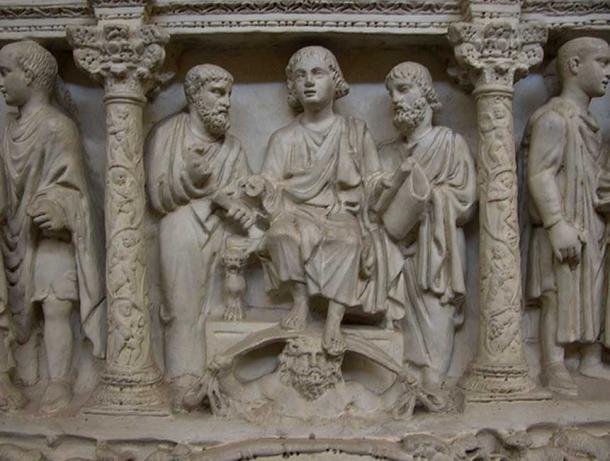
Jesus-on-Junius-Bassus

Sarcophagus of Junius Bassus

What I find so fascinating about this account is the way Jesus is portrayed — a tall, handsome, very masculine individual. It is almost as if we need him to be a “perfect” specimen in order to look up to him. But what if he were full of human foibles and blemished, or lacking in some way physically? Would we still admire him?

In contrast to the above, here is a small piece from The Secret Archives of the Vatican:

One of the earliest documents in the Secret Archives to come down to us in its physical form is an act of donation to the pope by a Romanized Goth, which escaped destruction because it was hidden in a very small church near Tivoli. Its date is 471, but its story begins in the previous century. In the year 359 there had died a great gentleman of a Rome that was going down to its tragic sunset: the consul Junius Bassus, prefect of the city. He was only forty-two years of age, and he was buried in a sarcophagus that is a masterpiece of the time. Now in the Vatican grotto, it is covered with bas-relief scenes from the scriptures; the central one shows Christ between the apostles Peter and Paul. At first one thinks that the scene has been misinterpreted and that it actually represents the boy Jesus in the Temple, for on it the Christ appears as a very young adolescent, a large fair child. Then one notices another scene, of the Palm Sunday episode; here again the Christ is shown as a young boy; and one realizes that the artist has seen him not as an historical figure but as the divine child of Diety.

Now, that’s justification for you. The author, Maria Luisa Ambrosini, is speculating about why Jesus is portrayed as a young boy. It never occurs to her that maybe he was actually small, not tall at all! Does this diminish him in our eyes?

The Gospel of Thomas

715ZEAMX1XL._SX283_BO1,204,203,200_

The Secret Books of the Egyptian Gnostics

In The Secret Books of the Egyptian Gnostics, Jean Doresse examines the passages from The Gospel of Thomas in which Jesus may have been describing his ‘less-than-perfect’ form:

’51. Jesus says: “From Adam to John the Baptist, among those who have been born of women, there is none greater than John the Baptist! But for fear that the eyes should be lost I have said: He who among you shall be the smallest shall know the Kingdom and be higher than John!”‘

Was he referring to himself? Commentators who are steeped in the classical image of Jesus think not, but I am not so sure. The other passage I wish to quote has an aside which suggests that Jesus himself was less than satisfied with his physical body:

’34. Jesus says: “If the flesh was produced for the sake of the spirit, it is a miracle. But if the spirit was produced for the sake of the body, it is a miracle of miracles.”

But for myself, I marvel at that because this great wealth has dwelt in this poverty.

Jesus’ Portrait

imagesB1V15BUV

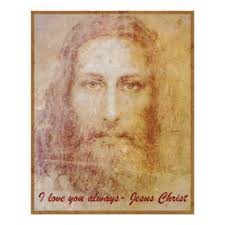
Jesus Christ Healing poster

Throughout this book, I shall be endeavoring to share the true measure of the man with you by quoting extensively from as many different sources as I can.

Also, I would ask that you read this book with an open mind. There are a great many things in this book which may cause consternation among those who could be best described as “There are none so blind as those who will not see”.

In the meantime, I hope this book will accurately complete the details of Jesus’ portrait and bring the purpose of his life closer to you, the reader.

So, let us begin this journey of discovery at the beginning, his birth.

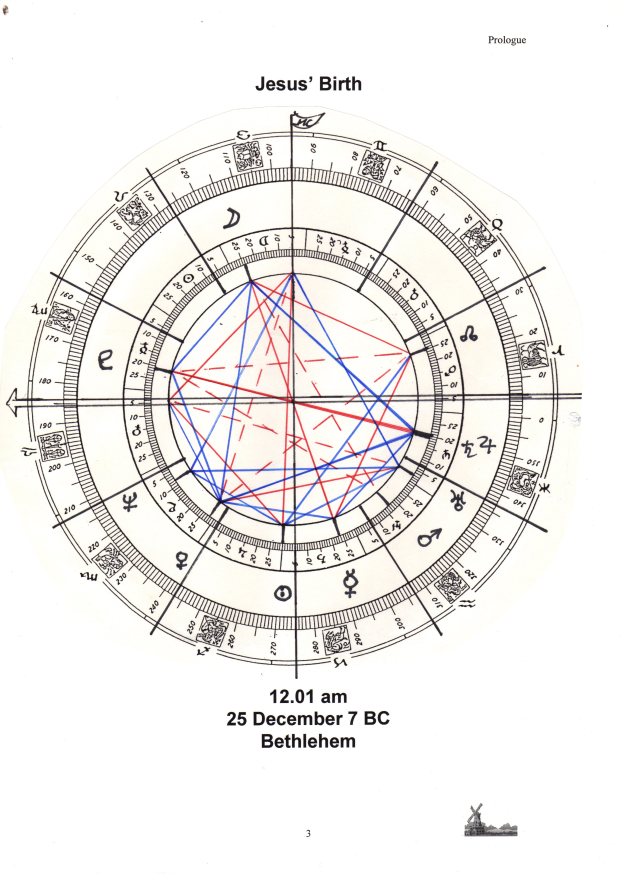
Jesus’ Birth Chart

nazareth2jesusofwrejc1

Jesus of Nazareth

For anyone wanting to replicate this chart, use the date and time of 6 January 6 BC @ 12:01 am local time (‘in the midnight hour’), then let the programme reset the date to the modern equivalent.

Sun – 13 Capricorn 48′
Moon – 16 Cancer 01′
North Node – 24 Aries 21′
Mercury – 29 Capricorn 24′
Venus – 27 Scorpio 28′
Mars – 17 Aquarius 36′
Jupiter – 19 Pisces 23′
Saturn – 17 Pisces 17′
Uranus – 03 Pisces 08′
Neptune – 07 Scorpio 00′
Pluto – 12 Virgo 14′

Ascendant – 11 Libra 01′
Midheaven – 11 Cancer 47′
2nd House cusp – 09 Scorpio 04′
3rd House cusp – 09 Sagittarius 41′
5th House cusp – 13 Aquarius 54′
6th House cusp – 14 Pisces 10′

2016 explanation: When I wrote this book in 1996, I hand calculated the positions of the planets based upon the concept that Jesus WAS born on 25 December 7 BC. My thinking was that the 10 days lost in the October 1582 conversion of the Julian calender to the Gregorian would somehow be constant over time. To see what the actual change was, go to this link.

2020 explanation: I have revised Jesus’ birth time to align it more correctly with Edgar Cayce’s explanation. It is now January 6, 6 BC, one minute after midnight old style, Julian calendar. The equivalent in the Gregorian calendar is two days earlier.

Due to my ‘miscalculations’, some of my numbers were slightly skewed. However, it was the image that resulted from those errors that made me choose the book title and main emphasis of this manuscript. See the next image for ‘proof’.

Picture Credits

img471

Jesus’ original birth chart

Can you see the Star pattern?

Linked pages: The Star of Bethlehem: Introduction (part 1)
The Star of Bethlehem: Introduction (part 2)

Picture credits:
Sarcophagus of Junius Bassus courtesy of http://www.flickr.com;
The Secret Books of the Egyptian Gnostics courtesy of http://www.amazon.com;
Jesus Christ Healing poster courtesy of http://www.zazzle.com

Posted in manuscripts, spirituality | Tagged , , , , | 22 Comments

The Star of Bethlehem: Introduction (part 2)

In the second half of the introduction, the “Golden Rule” is discussed in full. And in the words of John Lennon in the Beatles’ song, “All you need is love; love is all you need.”

The Golden Rule

To illustrate the fact that Jesus’ message wasn’t new, John Hick (in his book The Metaphor of God Incarnate) has documented the fact that ‘the golden rule’ was part of many belief systems of faith:

It is to be said that there are two main patterns of this transformation (from natural self-concern to a new centering in the Real). There are saints who withdraw from the world into prayer or meditation, and saints who seek to change the world — in the mediaeval period a contemplative Julian of Norwich and a political Joan of Arc, or in our own century a mystical Sri Ramakrishna and a political Mahatma Gandhi. In our present age of sociological consciousness, when we are aware that our inherited political and economic structures can be analyzed and purposefully changed, saintliness is more likely than in earlier times to take social and political forms. But, of whatever type, the saints are not a different species from the rest of us: they are simply much more advanced in the process of inner transformation.

The ethical aspect of this consists in observable modes of behaviour. But how do we identify the kind of behaviour which, to the degree that it characterizes a life, reflects a corresponding degree of reorientation to the divine Reality? Should we use Christian ethical criteria, or Buddhist, or Muslim…?

The answer, I suggest, is that, on the level of their most basic moral insights, the great traditions use a common criterion. For they agree in giving a central and normative role to the unselfish regard that we call love or compassion. This is commonly expressed in the principle of valuing others as we value ourselves, and treating them accordingly.

Thus in the ancient Hindu Mahabharata we read that ‘One should never do to another that which one would regard as injurious to oneself. This, in brief, is the rule of Righteousness’ (Anushana parva, 113.7).

Again, ‘He who…benefits persons of all orders, who is always devoted to the good of all beings, who does not feel aversion to anybody…succeeds in ascending to Heaven’ (Anushana parva, 145.24).

In the Buddhist Sutta Nipata we read, ‘As a mother cares for her son, all her days, so towards all living things a man’s mind should be all-embracing’ (149).

In the Jain scriptures we are told that one should go about ‘treating all creatures in the world as he himself would be treated’ (Kitanga Sutra, 1.ii.33).

Confucius, expounding humaneness (Jen), said, ‘Do not do to others what you would not like yourself’(Analects, xxi.2).

In a Taoist scripture we read that the good man will ‘regard {others’} gains as if they were his own, and their losses in the same way’ (Thai Shang, 3).

The Zoroastrian scriptures declare, ‘That nature only is good when it shall not do unto another whatever is not good for its own self’ (Dadistan-i-dinik, 94.5).

We are all familiar with Jesus’ teaching, ‘As you wish that men would do to you, do so to them’ (Luke 6:31).

In the Jewish Talmud we read, ‘What is hateful to yourself do not do to your fellow man. This is the whole of the Torah’ (Babylonian Talmud, Shabbath 31a).

And in the Hadith of Islam we read the prophet Muhammad’s words, ‘No man is a true believer unless he desires for his brother that which he desires for himself’ (Ibn Magja, Intro.9).

Clearly, if everyone acted on this basic principle, taught by all major faiths, there would be no injustice, no avoidable suffering, and the human family would everywhere live in peace.

We are all in this together

unnamed

Gaia

Now, I recognize the content of that final sentence as an ideal that we all carry with us, but is most perfectly expressed through the lives of individuals with either their Sun or Ascendant being in Libra. This will prove important when we begin to analyze Jesus’ birth chart. As I was reminded of recently during a particularly difficult time, “We are all in this together” (Bernie Sanders). We need to remind ourselves of that fact often, or else we begin to view life through our own ego’s point-of-view, forgetting our connections to others in this world.

However, another small statement in Hick’s book stands out for its simplicity and its truth (which I believe epitomizes Jesus’ life and is a major clue to our understanding of him):

Jesus himself seems to have been exceptionally sympathetic towards women.

Why should this be? It is the essential mystery of a belief system which for almost two thousand years has been exclusively the ‘right’ of men, with women taking a secondary, supportive and submissive role. And yet, if men continue to ignore the truth contained in the love and compassion of a mother, a sister, a lover or a daughter, they will destroy this world and all that depends upon her. She is our Great Mother, Earth, called Gaia by some. She loves and sustains us as a mother would her children, but all that Western man wants to do is subdue and control her, in much the same way that women have been subdued and controled for thousands of years.

Footnote

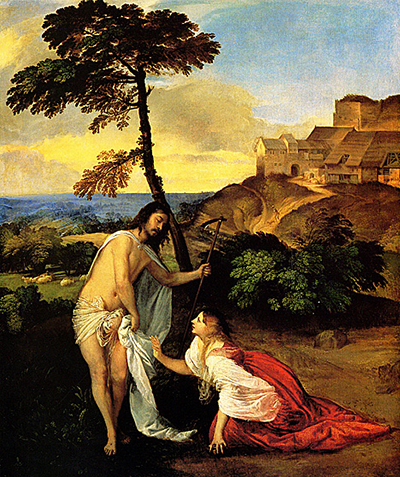
ChristandMaryMagdaleneTitian

Jesus and Mary Magdalene

From She For God: Into this world, where among Jew and Gentile alike women counted for little or nothing, Christ was born and grew up trained in the Mosaic Law with all the weight of its fierce and puritanical traditions. He began his short ministry and, from the little we know of it, his treatment of, and whole attitude towards, women was so immensely creative, revolutionary and dynamic that although the church, following a long way after in this respect, comprehended him not, neither did it wholly deny him. The Gospels remain. In them we read that Christ actually treated women as worthy of serious attention, worthy of argument, worthy of friendship, worthy of compassion, worthy of praise.

In St. Luke alone, seven specific miracles of healing were concerned with women. That Mary was commended for behaviours so utterly foreign to women’s supposed proper role as to leave her domestic tasks in order to listen to a Rabbi who was willing to teach her (in itself an offence against the Law) was of much greater significance than appeared on the surface. Jesus’ defence of Mary Magdalene must have astonished as well as appalled the men who heard it. It is quite likely true — although only mentioned in the Gnostic Gospel of Marceon — that one of the accusations brought against Jesus by the Sanhedrin was that he led women astray by teaching them. Women were not meant for such things.

As for his talking to the women of Samaria and the Syro-Phoenician women, perhaps the extreme unusualness of this behaviour accounts for the inclusion of such episodes in what is after all a very short and highly selective narrative. Most of all, to be treated as individuals in their own right would have astonished the women themselves. They came to realise that Jesus thought them to be of equal importance as men in the eyes of the Father, ‘joint heirs’ to his kingdom. In return they gave him devotion and faithfulness to the end, and it was to women that Jesus first revealed himself after the Crucifixion.

All four evangelists agree about this, which is a curious and interesting point, for the resurrection story, as has often been pointed out, has many discrepancies. No Jewish woman was considered reliable as a witness and indeed could not legally be accepted as such. Therefore, if a concerted account of the resurrection was being invented to convince the authorities, to insist that women were the first and thus the most dramatic witnesses to such an extraordinary event would have been enough to discredit it at once. Yet it is just this which is narrated by all the Gospels.

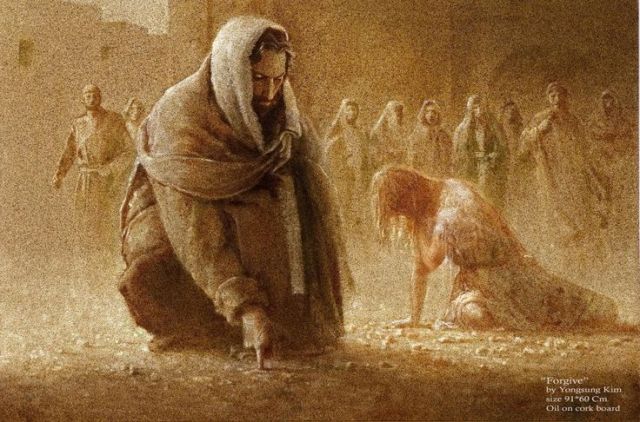
Writing on the Ground

dust

Jesus writes on the ground

According to Wellesley Tudor Pole in his book, Writing on the Ground, Jesus performed a higher purpose in “writing on the ground” while making the Pharisees see their own shortcomings during the forgiving of “the woman taken in adultery” scene in John 8:48:

My surmise is that his accomplishment as outlined above was unique in world history in method and operation up to the point at which he appeared among us. What happened would have destroyed his human form, had it not been that this form held in perfect balance and rapport the masculine and feminine qualities and instincts inherent in human nature. In other words, Jesus could act as a perfect lightning conductor, without causing any damage to his body or mind.

It is my belief that the ‘Second Coming of Christ’ actually involves an equal participation in life between the two sexes, with neither being superior nor inferior to the other. I therefore see Jesus’ life as a symbol of this balance, and I hope this book will demonstrate just how reconciled he was with God and man.

The Passover Plot

a3132eec122e3185934746f5651444341514141

The Passover Plot

While recently re-reading The Passover Plot, the book by Dr Hugh J Schonfield which initially started me on my journey of discovery about Jesus’ life in 1976, I came across the following passage about the awareness Jesus had about his mission as Messiah:

When the Nazoreans looked back on the dramatic climax of the life of the Messiah, as many of us still do through the libretto to Handel’s Oratorio, they were overwhelmingly impressed by the appositeness of so many passages to what had transpired. Having to establish both for themselves and for Jewish audiences that what had taken place was in accordance with the Scriptures, they were able to build up a formidable array of testimonies. In their zeal they even amplified and supplemented the account of his experiences, as certain texts appeared to require additional incidents which would fulfil them. Almost insensibly, teaching was converted into fact, and individuals could claim that they had heard such things from someone, who had heard them from one of the apostles. Thus the legend grew from story to testimony to embellished story. We have to be fully conscious of this process of gilding the lily in studying the Gospels and the early patristic literature.

The feat of Jesus was far more extraordinary, because he was looking forward into the unknown, seeking to determine the shape of things to come as a guide to his own actions. It was his achievement to have extracted from the Oracles so clear a picture, and to have so assured of its reliability, that he could follow it like a star which charted his course, and commit himself to certain, positive predictions of what would take place. The achievement was particularly remarkable because it transcended the relative vagueness of contemporary Messianism, and brought its ideas into a sharper and indeed a singular focus. There are strands of different colours held to mark the role of distinct messianic personalities, the Prophet like Moses, the Suffering Just One, the Son of David, the apocalyptic Son of Man. Jesus wove them into one.

And that last sentence, for me, makes the whole approach to Jesus’ life through an astrological analysis of his birth chart perfectly logical. As I shall discuss throughout this book, the separate energies which come “from” the planets are combined in Jesus in a truly remarkable and unique fashion. There are not many people who can claim to be the Messiah. Therefore, to me, he is and always will be, for eternity,

THE STAR OF BETHLEHEM.

Picture Credits

Linked page: The Star of Bethlehem: Introduction (part 1)

Picture credits:
Gaia courtesy of real-gaia.angelfire.com;
Jesus and Mary Magdalene courtesy of wikipedia;
Jesus writes on the ground courtesy of http://www.pinterest.com;
The Passover Plot courtesy of librarycat.org

Posted in manuscripts, spirituality | Tagged , , , , | 12 Comments

The Star of Bethlehem: Introduction

Almost twenty years ago, I wrote an “Astrological Portrait of Jesus of Nazareth”. This is the introductory chapter. In the words of Paul McCartney, ‘Venus and Mars are alright tonight.’

The ‘Point of Death’

While searching for a new approach to astrology, I came across this entry in the Dictionary of Astrology by Fred Gettings:

The ‘point of death’, which is not to be confused with the “Anaretic“, is one of the so-called Arabian PARS. If the degree of the Moon in a natal chart is revolved to the Ascendant, the cusp of the adjusted 8th house marks the death point.

Now, on its own, this little tidbit seems insignificant, but it did spur my thinking into pathways which led me to some interesting discoveries. But more on that later. At the time I read that, I only had one set of birth/death dates with which I could experiment: while preparing my manuscript for At This Point in Time, I calculated Jesus of Nazareth’s birth at 12:01 am local time on 25th of December 7 BC, and his crucifixion at 11:41 am local time on AD 7th April 30. So, when I compared the two charts, I began to see connections beyond the simple ‘point of death’. This book is the result of that journey of discovery.

Should there even be a birth chart for Jesus?

220px-Jerôme_Cardan
Girolamo Cardano

Now, I am very aware that erecting any chart to do with the life of Jesus is considered wrong by a great many Christians. In fact, A History of Astrology records that a certain Girolamo Cardano (1501-76), the physician, mathematician and astrologer from Milan, was imprisoned towards the end of his life for attempting to cast the horoscope of Christ.

But I think that the information gleaned from Jesus’ birth and crucifixion/death charts is too important to keep hidden away from public scrutiny, just because some people do not believe in astrology or cannot agree with its tenets. The 13th-century astrologer, Bonatti, claimed that astrologers knew a great deal more about the stars than theologians knew about God, that Abraham had taught astrology to the Egyptians, and Christ had used (or at least approved of using) astrology to choose propitious moments for certain tasks (“Are there not twelve hours in a day?” he had asked the disciples {John 11:9}, obviously meaning that one could choose a fortunate time within them).

But the Roman Catholic Church may have suppressed any reference to astrology, in order to prevent the ‘unwashed’ masses from learning the truth about Jesus and his plan of salvation for them.

Jung and the Lost Gospels

9780835640138
Jung and the Lost Gospels

What we know now about Jesus’ life and death has been altered out of recognition. Stephan A. Hoeller in his amazing book, Jung and the Lost Gospels, came to grips with the altering image we have of Jesus through the last two millennia by stating:

And where in all this is Jesus? He is still present, but he has been dethroned. The sevententh and eighteenth centuries use him as a sentimental object of maudlin devotion and little more. He becomes a sentimental comforter, a friend on whose shoulder the bereaved may cry and the downtrodden hope but never quite find complete consolation. What a far cry is this pale, sentimentalized image from the fierce defender of the outcasts of society who appears in the New Testament! And also, how far removed from the majestic, transcendental universal king of the Byzantine mosaics, not to mention the mysterious, ubiquitous well of the living waters that once flowed from the Gnostic figure of Christ in the first few centuries A.D.

The Gnostics, an oriental religious movement which played a part in early Christianity, spawning many sects, believed that when Jesus ascended into heaven after the crucifixion, he changed the influences and even the movement of the planets, and determined how they shaped a new soul, controlled the process of conception and the formation of the embryo in the womb, and every event of life from cradle to tomb. Their beliefs evolved from the Essenes’ and spawned a ‘heresy’ known as Catharism in the middle ages. In my opinion, their ‘truth’ is resurfacing at the present time as a ‘Return of the Christ’.

Hoeller continues: God is dead, religion is the opiate of the people, and Jesus does not exist. Or does he? Comparative mythologists appear on the scene who are not so sure. Behind the vague and uncertain historical data surrounding the figure of the founder of Christianity they begin to discover a powerful mythic reality no less impressive for being at least in part remote from physical history. The historical Jesus gives way to the Jesus of myth. Scholarship discovers that the image of the crucified Nazarene is intimately connected with a large number of savior gods of antiquity: Osiris, Horus, Tammuz, Mithra, Orpheus, and many others. Upon the heels of the mythologists appear the representatives of modern depth psychology, among them C.G. Jung…

By recognizing Jesus as the greatest and latest symbolic representative of the archetype of the Self, Jung has given us an invaluable tool to be utilized in the study of Christian origins and indeed all concerns and disciplines that address themselves to the religious problems of Western culture. Jung’s recognitions may also be taken as signs of hope, indicating that the era of negative and confused attitudes regarding this most significant archetype of our culture may be coming to an end.

The Metaphor of God Incarnate

The-Metaphor-of-God-Incarnate-Second-Edition
The Metaphor of God Incarnate

In his book, The Metaphor of God Incarnate, John Hick advances a couple of thought-provoking suggestions. I think they lend credence to my work:

But for the most modern Western Christians (including myself), it remains difficult to accept myth as myth. Returning to the crib, and the Christmas story as a whole, we know that it is historically unlikely that Jesus was born on 25 December (the date of a pre-Christian pagan winter festival which Christianity inherited), that the year of his birth was 1 CE (it was more probably about 5 BCE); unlikely that he was born in Bethlehem (which was probably adopted into the story to fulfill prophecy), that he had no human father (a mythic theme that became attached to a number of great figures in antiquity); and we have seen reasons to reject the dogma that he was God incarnate (a dogma that Jesus himself would probably have regarded as blasphemous). In view of all this, how does one participate in Christmas?

Either one opts out, on the grounds that the Christmas story is literally false; or one opts in, accepting the myth as evocative poetry, stirring the emotions, expanding the imagination, warming the heart — and all in the direction of an enhanced sense of the gracious, loving, benign character of the Ultimate in relationship to human life.

But it must be admitted that for many of us this remains difficult; and unless and until sensibilities change we shall have to live with this unresolved problem. It is particularly difficult for those who are called to lead the worship of the church, knowing that many in their congregation regard the mythic story as literally true. It must have been equally difficult a hundred years ago when reading, for example, the story of Adam and Eve as the scripture of the day, and understanding it as truth in mythic form, whilst knowing that many in the pews could only see it as literal history. The same words were being understood in different ways by different people.

And so it is today. ‘The Word was made flesh’ entails for some that Jesus, uniquely, had two natures, divine and human, and is accordingly to be worshiped as God; whilst it means for others, both that Jesus’ life embodied a love that is a reflection of divine love, and that the ideal of humanity living in response to God was, to a startling extent, embodied, incarnated, in his life, so that we may take him as our lord, guru, spiritual leader.

The Purpose of Jesus’ Death

7124703-jesus-christ-on-the-cross-with-clouds
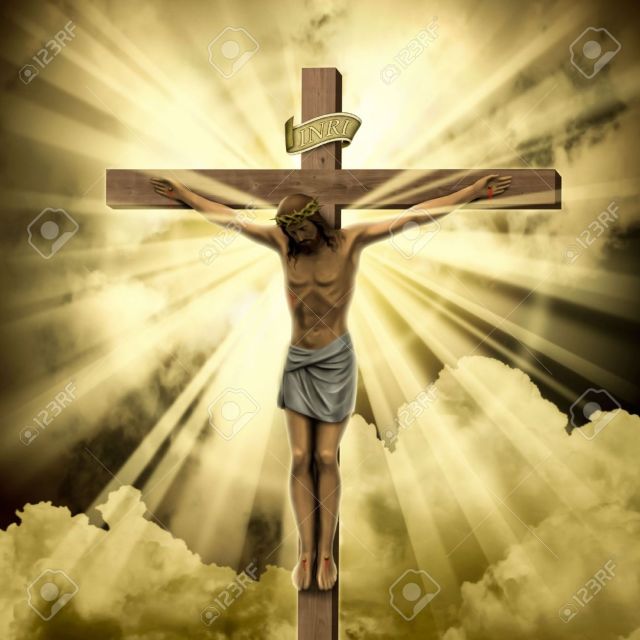
Jesus Christ on the Cross with Clouds

I totally agree with the sentiment of John Hick’s thoughts, but not with the facts, as I will demonstrate throughout this book that we can know when Jesus was actually born and what that meant to him then, and what that means to us now. For one thing, his death’s purpose was not atonement alone but something more significant:

Jesus’ death has indeed played no small part in this influence {for salvific transformation}. Although the meaning of that death was pictured during most of the first Christian millennium in the bizarre ransom imagery, and during most of the second millennium in terms of morally questionable satisfaction and penal-substitution theories, the cross has continued throughout as our central Christian symbol because it stirs deeper and more complex emotions than are captured by any of these official doctrines.

It is for many people a self-evident intuition that an authentic religious leader is willing, if necessary, to be martyred by those who reject the challenging truths that he or she embodies. It is indeed because true prophets and gurus embody, or live out, or incarnate, their teachings that to oppose the message is to oppose the messenger; and the most emphatic form of rejection is by inflicting death.

To illustrate this from recent history, in the moral and political conflicts of India and the United States there was a certain tragic appropriateness in the fact that Mahatma Gandhi and Martin Luther King, teaching the universal requirement of love and justice, were assassinated by fanatics motivated by religious and racial prejudice. There is likewise a tragic appropriateness in the death of Jesus. He taught the way of life of God’s kingdom and the imminent coming of that kingdom on earth. This was to the ruling Roman power a potential incitement to rise up against it in the name of God, as was to happen in 66-70 and again in 135 CE.

He also prophesied the destruction of the Jerusalem temple, thus deeply antagonizing its priestly guardians, who collaborated in his arrest and trial. But these historical factors were soon submerged in the Christian consciousness by a religious interpretation of the crucifixion. The acceptance of Jesus’ death as having a positive meaning inevitably evoked, in the thought-world of that time, the universal language of sacrifice. In the Judaism of Jesus’ period a sacrifice made as a sin offering to God involved the shedding of blood as a giving of the life essence.

However, as a cumulative result of the teaching of Jesus, as well as of Hosea and Amos before him and many others after him, can we not now see that the sacrifice of animal or human blood pointed, in a crude and inadequate way, to the much deeper sacrifice of the ego point of view in becoming a channel of divine grace on earth?

The real meaning of Jesus’ death was not that his blood was shed — indeed crucifixion did not involve a great deal of bloodshed — but that he gave himself utterly to God in faith and trust. His cross was thus a powerful manifestation and continuing symbol of the divine kingdom in this present world, as a way of life in which one turns the other cheek, forgives one’s enemies ‘unto seventy times seven’, trusts God even in the darkness of pain, horror and tragedy, and is continually raised again to the new life of faith.

I think that puts this whole concept of ego denial into perspective.

Picture credits

To be continued…

Picture credits:
Girolamo Cardano courtesy of wikipedia;
Jung and the Lost Gospels courtesy of http://www.amazon.it;
The Metaphor of God Incarnate courtesy of http://www.amazon.com;
Jesus Christ on the Cross with Clouds courtesy of http://www.123rf.com

Posted in manuscripts, spirituality | Tagged , , , , | 21 Comments

My Journey, as told on WordPress

As one nears the end of one’s life, a review of the past can have a liberating effect. Here’s a summary of my story.

My Mother

Mom

I was born after my mother had an affair. She was a married woman, separated from her first husband. As I was the only family that she now had (at the time), she decided to raise me on her own. That caused her a lot of stigma, hard work and lean times. But we survived.

A Mother’s Letter to her Son

My Father

Ewart Miller

My father was a confirmed bachelor. Raised as a preacher’s kid, he went on to study medicine at the University of Toronto. I believe he left after his first year. He then did military duty for WWII, and stayed on in Europe for a while after it ended to produce a monthly publication. He was always literate. His first book of poetry Over the Wheel was self-produced. I have passed on two copies to my children, and still have one in my possession.

His eternal shame, it seems, was that he got a married woman pregnant. I was his dirty little secret. He went to his grave without any of his family knowing. We met once.

Family Reunion

The Third Part of the Triangle: me

Christopher and Columbus

Not having a father around for the first five years of my life, left me feeling unworthy. If he loved me, he would have been there, wouldn’t he? This gave rise to ‘night terrors’ as a child. I was sure that I wouldn’t survive my childhood. But somehow I did.

Childhood

New Family

Chris, Jean and Anne

In 1955, Mom married Rus. Almost immediately our lives changed: as I’d been born and raised in Toronto, it was a shock to find that we had moved to the countryside. Gone was the city hustle and bustle; now all I heard was the wind in the trees, and the lowing of the cattle in the fields.

Within 18 months, Mom gave birth to my sister Anne. So now I was someone’s older brother. That was different. I had to become responsible. I also started echoing my father’s childhood: a preacher’s kid.

Who Am I?: my search for a family name

Growing Up

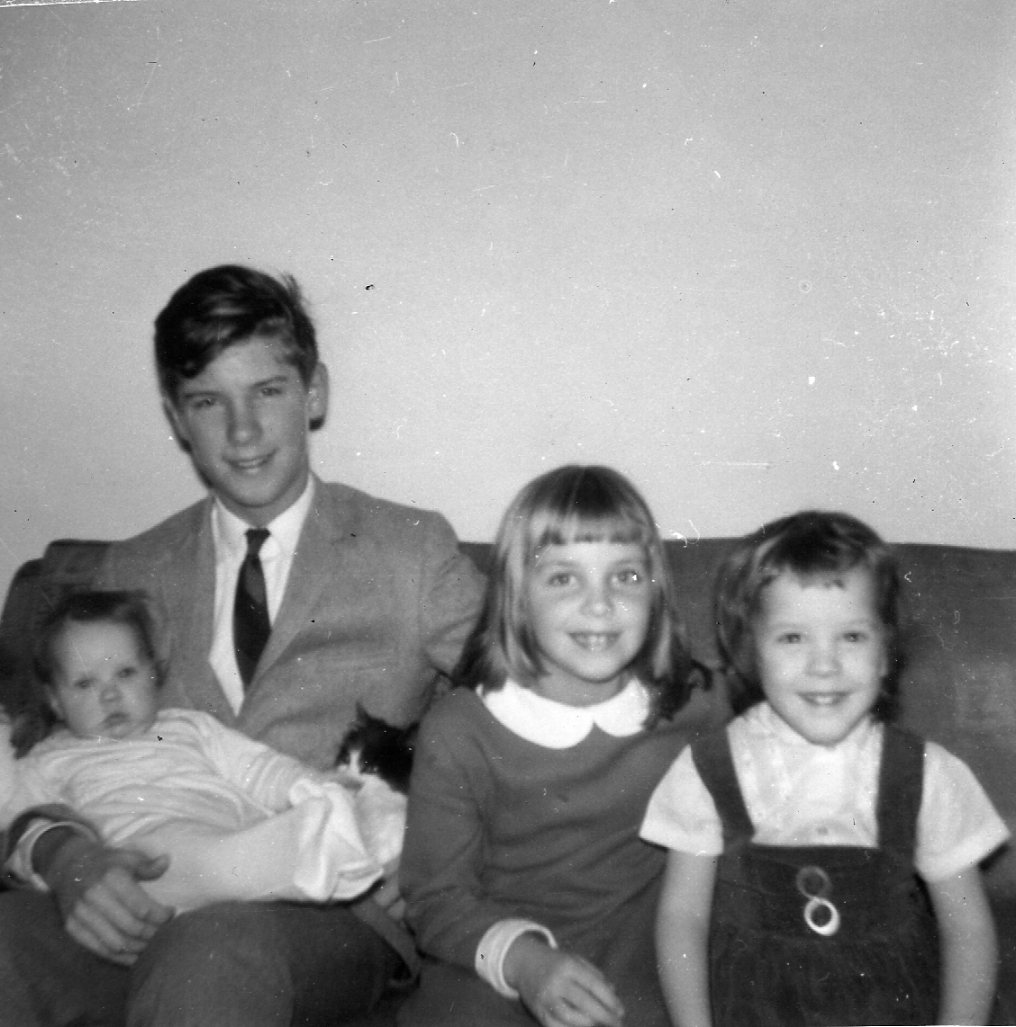
My sisters and me

From then on, life became a series of births (and one stillbirth) of my siblings. My next sister was Rachel, a feisty little thing (she was premature) and my new comrade in arms.
She came after our brother (Stephen) had been stillborn, so she proved more precious to me. I suspect that death truly enters into one’s consciousness at age nine or ten.

Three years later, our final sister, Elizabeth, arrived to complete our growing family. I was now the on-tap babysitter.

What’s in a (baby’s) Name?

First Marriage

Valentine's Day wedding 1970
Valentine’s Wedding

I married young, by today’s standards. In our day, it was completely normal, and expected. Judi and I had been dating three years. We tied the knot on Valentine’s Day 1970.

By this time, I had been writing poetry for about five years, so it won’t come as a surprise that I wrote some for my first wife, too, while we were dating.

Rainy Day

First Child: Derek

Father and Son, June 1972

There is nothing that sobers a person up faster than becoming a parent for the first time. Not that I drank at the time: I was tee-total until 1975.

Derek arrived one early morning in late April of 1972. Immediately he was put under a heat lamp in an incubator, because he was jaundiced. (I don’t think that description will ever go away.) Judi took it very badly. I saw that the strong woman I married had a weak spot for the life of her son. That changed our family dynamic, permanently.

Mrs Green, Medium

Separation, then Divorce

Jim Miller

I was getting restless. I guess I didn’t expect to find married life so stifling. I wanted to explore the world, I wanted to travel, I wanted to move. But first I needed to find my father.

Just before my 25th birthday, I got in touch with my father, who now went by the name of James Miller. He agreed to meet me, and when he was next in Barrie, I jumped at the chance to see him face-to-face. Over wiener schnitzel we discussed my life, my ambitions and my poetry. It was then and there that I decided to separate from Judi. Unfortunately, I would be leaving Derek behind, too.

Who Am I? My father’s son

New Marriage

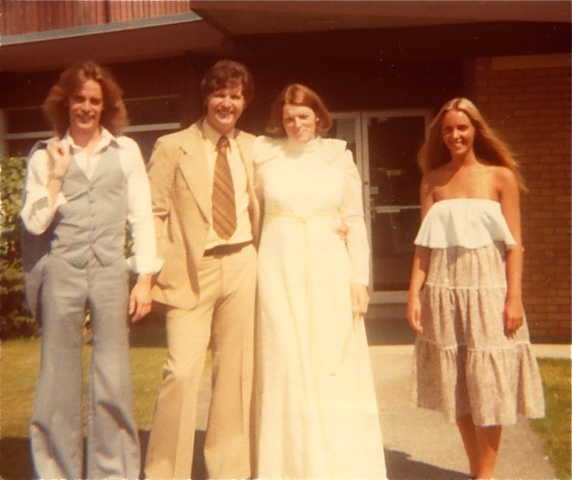
Wedding Party 15 Jul 1978
Wedding Party July 78

Within three years, I had married again, this time in Vancouver, BC, to my second wife Suzann. A lot of angst was involved, I can assure you. I was concerned that I’d made such a hash of the first marriage, that I was scared that I would ruin the second one, too.

However, Suzann had a child from an earlier relationship, and that bundle of joy became the blessing in disguise. I would eventally adopt Amy after her sister was born.

My Daughter Rosanna is Born

Rosanna age 4

What can I say? I was smitten at first sight. I resolved to buy a camera and record Rosanna’s life from that moment on.

One sequence, not shown here, involved a series of photographs that I took of Rosanna on our bed: she started out smiling, but, by the tenth shot, she was crying. I titled the sequence “Anatomy of a Cry”. I suspect she got tired of seeing that ‘black object’ (my camera) in front of my face.

However, as always occurs, when a new baby is born, the older child starts to dominate the relationship, leading to slammed doors later in their teenaged lives.

Sisters

My Spiritual Journey Begins

898f56ce-cf94-40eb-b795-f08b54fe9ef4

A Few Moments
.

We moved to England. Suzann and the girls went at the end of September 1984. I followed in February 1985. This would prove to be the catalyst of change for me. It also heralded some changes for Suzann, too.

I have outlined in various posts my spiritual journey, but the beginning was the ‘dream’ that Suzann had months before we moved.

The Book of Life: an Akashic Record?

The Turning Point

Rosanna, Derek and Amy

The years rolled along, quickly, as they do when you get older. My children have now grown up, started having families of their own, and got on with their lives.

In the meantime, I had separated from Suzann, started living with Dianne, and totally screwed up my life. Unfortunately, this led to a point where I contemplated ending it.

The Day I Contemplated Suicide

Back to Canada and my New Wife

Susan and Chris

I muddled on through until finally in 2007, I resolved to return to my native country. In doing so, I met up with my very first girlfriend, Susan, who let me move in with her, and her two Jack Russells, Cheeko and Cloe.

My Wife

We married in 2010. And I can honestly say that I have never been happier in my life. This all goes to prove that one should never give up.

Picture credits: all photos are from my personal collection.

Posted in family, personal | Tagged , , , , | 6 Comments

Walk With Me

Most of the time, I have written sonnets and other recognizable poetic formats. Here’s one that is different in the fact that it was written more simply, but with great emotion.

Walk With Me

Into-the-light2

Into The Light

Walk with me in the meadow of my mind
And take your shelter in my loving arms:
You have shown me that life is good and kind
By giving gently of your peaceful charms.

So many times I’ve found myself quite lost
Wandering neglected in a dense fog:
Like a sailor upon the tempest tossed
I’ve slipped beneath the waves, a sunken log.

But you reached down to save my sinking soul
And brought me back into the bright sun’s light:
Now I have but one significant goal
To keep you within my spirit’s true sight.

Never leave my side for another’s love,
I couldn’t bear to lose a heart like yours:
For, sure as I am of Someone above,
None else holds the key to my ailment’s cures.

My darling, my once-in-a-lifetime find,
Come with me to my country’s fields and farms:
Walk with me in the meadow of my mind
And take your shelter in my loving arms.

Picture credit: Into The Light courtesy of thinktheology.com

Posted in manuscripts, poetry | Tagged , , , | Leave a comment

Background Noise: sounds used to sell?

Have you noticed, lately, how much music is being played while discussions are taking place on television? Is it just me, or does this bother you, too?

The Voice

The Voice (Australia)

This year, while watching the American version of The Voice, I noticed a disturbing trend: during the previews of the contestants, music was playing in the background, constantly. The contestants would be talking, discussing different aspects of their lives, but sometimes the music got in the way of what they were saying, at least for me.

Why? Did the producers think that the only way to hold the attention of their audience was to provide them with a musical soundtrack?

Was this a new phenomenon? Or had I just woken up to the fact that it was going on?

It suddenly became even more conspicuous during the announcements of the winners. Then the sounds of the crowd were mixed with a musical background in order to build the suspense.

NFL

National Football League

Being at an NFL Super Bowl game must be one of the greatest thrills of a football fan. However, when you’re at the stadium, the sounds of the crowd would be exciting.

At the five minute mark of the following clip of Super Bowl XLIX, you can hear the announcer calling the play, but the sounds of the crowd start to infringe on his words.

Could it be that the stadium experience is what they were trying to achieve by using open microphones?

IBM

No, not that IBM: Instrumental Background Music. Here is a clip that demonstrates music being used as a background for videos.

It is a common business practice to have background music in commercials, especially those ubiquitous car and truck ads. Somehow, while listening to the music, it is assumed we will absorb the words and pictures without censorship, in other words, we’ll swallow the message ‘hook, line and sinker’.

So, if that is what the point of the background noise, are we being fed subliminal messages ‘out in the open’, as it were? I think so.

Conclusion

I re-watched the announcement of the winner of this year’s The Voice competition in the USA. The sound coming through my computer speakers seemed a lot clearer than through my TV. That got me to thinking: were the sound settings on my TV incorrect in some way?

So I checked them and found that the equalizer was set at “Movie”. I experimented with the rest and then chose “Voice” which increased the middle range and decreased the upper and lower ends of the sound spectrum. Now I can hear the words being spoken, even with the background sounds.

In the end, The Voice was the hint I needed. The subliminal message got through…

Picture credits: all pictures are courtesy of Wikipedia.

Posted in paranoia, showbusiness | Tagged , , , , | 1 Comment

Christmas Wishes

After all these years, I decided it was time to write my wife a poem. I hope you like it.

For My Wife, Susan

Susan Miller

Come Christmas Day, the year’s events complete
Her journey, from the previous time of joy.
Remarkable as it may seem to a boy,
I feel the light of her soul and a heat
So strong that the coldest heart, hands and feet
Melt into the comfort of corduroy
And the day becomes like a shiny toy,
Sitting in front of the hearth: can’t be beat

Would that I could say what’s within my heart:
I see such love that life takes on a hue
So clear, that nothing can cloud my reason.
How much is too much on her loving part?
Even the animals around us view
Susan, as the joy of this Yule season.

Picture credit: from our own collection.

Warm Warm

Posted in manuscripts, poetry | Tagged , , | Leave a comment

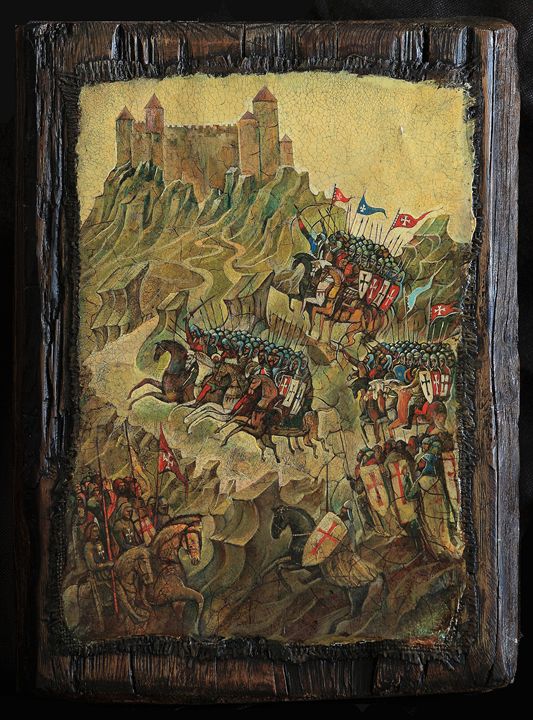
Montsegur: the Cathars’ last stand?

When the Cathars were eliminated in 1244, the Catholic world breathed a sigh of relief. But were they really wiped out, or did they just retire to the spiritual realms in order to return again in the 20th Century?

The Heresy

Siege of Montsegur

In the beginning, as in any birth, there was One cell. But in order for it to grow, it had to split into Two. That, in the minds of those that we now call Cathars, was where the Universe became a Dualist creation.

The term ‘dualism’ has a variety of uses in the history of thought. In general, the idea is that, for some particular domain, there are two fundamental kinds or categories of things or principles. In theology, for example a ‘dualist’ is someone who believes that Good and Evil—or God and the Devil—are independent and more or less equal forces in the world. Dualism contrasts with monism, which is the theory that there is only one fundamental kind, category of thing or principle; and, rather less commonly, with pluralism, which is the view that there are many kinds or categories. (Stanford Encyclopedia of Philosophy)

Most people will be in two minds about this. We were taught in Sunday School that there is only one God. But then, at the same time, we were reminded to be on the look-out for the Devil’s handiwork. What’s a person to think?


The Gnostics

The early Christians were originally a confused lot. Their Messiah, Jeshua ben Joseph was clearly a charismatic fellow. His ‘Father in Heaven’ was a loving individual, so unlike the jealous God of their forefathers, Jehovah. Some of the early believers were Gnostics, which means ‘those who know’.

In Gnosticism, the world of the demiurge is represented by the lower world, which is associated with matter, flesh, time and more particularly an imperfect, ephemeral world. The world of God is represented by the upper world, and is associated with the soul and perfection. The world of God is eternal and not part of the physical. It is impalpable, and timeless. To rise to God, the Gnostic must reach the knowledge, which mixes philosophy, metaphysics, curiosity, culture, knowledge, and the secrets of history and the universe. (Wikipedia)

By the time that the early Christian Church began to organize itself, it was felt that Gnosticism had no role to play in its hierarchy.


The Cathars

Montsegur - March 1993

In the Languedoc region of the South of France, in the late 12th and early 13th Centuries, a group of individuals began a way of life that seemed to be at odds with those of Medieval times.

Catharism had its roots in the Paulician movement in Armenia and the Bogomils of Bulgaria, which took influences from the Paulicians. Though the term “Cathar” (/ˈkæθɑːr/) has been used for centuries to identify the movement, whether the movement identified itself with this name is debatable. In Cathar texts, the terms “Good Men” (Bons Hommes) or “Good Christians” are the common terms of self-identification.

The idea of two gods or principles, one being good, the other evil, was central to Cathar beliefs. The good god was the God of the New Testament and the creator of the spiritual realm, as opposed to the bad god, whom many Cathars identified as Satan, creator of the physical world of the Old Testament. All visible matter, including the human body, was created by Satan; it was therefore tainted with sin.

This was the antithesis to the monotheistic Catholic Church, whose fundamental principle was that there was only one God who created all things visible and invisible. Cathars thought human spirits were the genderless spirits of angels trapped within the physical creation of Satan, cursed to be reincarnated until the Cathar faithful achieved salvation through a ritual called the consolamentum. (Wikipedia)

The Roman Catholic Church went on a Crusade to eradicate the ‘false’ thinking of these people. The Cathars preferred to die, rather than accept the terms of their surrender. Their last stand was at Montsegur.


The Secret Doctrine

Symbol of Earth

In 1888, Madame Helena Blavatsky published a major work in two volumes called, The Secret Doctrine. In it she revealed esoteric thinking and occult ideas to the modern world.

At this stage of the re-awakening of the Universe, the sacred symbolism represents it as a perfect circle with the (root) point in the Centre. This sign was universal, therefore we find it in the Kabala also. The Western Kabala, however, now in the hands of Christian mystics, ignores it altogether, though it is plainly shown in the Zohar. These sectarians begin at the end, and show as the symbol of pregenetic Kosmos this sign , calling it “the Union of the Rose and Cross,” the great mystery of occult generation, from whence the name — Rosicrucians (Rose Cross)! (The Secret Doctrine Proem)

In Astrology, Earth is represented by the equal-armed cross (see illustration).


Nag Hammadi Library

The discovery of a collection of Gnostic texts near the Egyptian town of Nag Hammadi in 1945 brought the beliefs of those early Christians back into the consciousness of the modern world.

The contents of the codices were written in the Coptic language, though the works were probably all translations from Greek. The best-known of these works is probably the Gospel of Thomas, of which the Nag Hammadi codices contain the only complete text. After the discovery, scholars recognized that fragments of these sayings attributed to Jesus appeared in manuscripts discovered at Oxyrhynchus in 1898, and matching quotations were recognized in other early Christian sources. Subsequently, a 1st or 2nd century date of composition, circa 80 AD or earlier, has been proposed for the lost Greek originals of the Gospel of Thomas. The buried manuscripts date from the third and fourth centuries. (Wikipedia)

The Gospel of Thomas has Jesus’ sayings in a form that seems more mysterious than those sayings that the writers of the four Gospels quoted. But then, could he really have just come out and said it without hiding the truth?

“Behold, I show you a mystery: we shall not all sleep, but we shall all be changed, in a moment, in the twinkling of an eye, at the last trump; for the trumpet shall sound, and the dead shall be raised incorruptible, and we shall be changed; for this corruptible must put on incorruption, and this mortal must put on immortality.” (1 Corinthians 15:51-53 KJV)


The Cathars and Reincarnation

In 1970 Dr Arthur Guirdham wrote a book about a patient of his who remembered him as a Cathar priest, Roger de Grisolles.

This is what Roger J Woolger, Ph. D., wrote on his webpage at www.innervisions.com :

Dr. Guirdham, a practicing psychiatrist, recounts in his book how a certain woman patient came to him with a series of dreams of thirteenth-century France. The dreams had very precise historical details in them which were later verified by French experts on Cathar history. Guirdham himself began to get parallel dreams and concluded eventually that he and his patient had been lovers in the horrible milieu of the Cathar persecution and had died fiery deaths together.

To a psychoanalyst in training it all sounded like what we call in the trade “transference” and “countertransference.” Transference is the patient’s unconscious emotional involvement with the therapist, and countertransference is the therapist’s reciprocal feelings, if they exist. In a good analysis, the therapist’s job is to spot when this is happening in both himself and the client. If the therapist misses it, they both get sucked into an elaborate folie à deux – a shared delusion.

Then Dr Woolger goes on to explain how he himself had a similar reincarnational experience, only this time as a ‘rough-and-ready’ character who was recruited to fight for the other side by the Holy Inquisition. Is that why he was originally antagonistic to Dr Guirdham’s story?


Fountain International

Torquay Fountain

In September 1981, Colin Bloy decided to create a new group, which would have no affiliations with any religious groups, and would be made up of individuals coming together to help heal their communities.

This is the beginning of Chapter 16 in my book, At This Point in Time:

Where two or three are gathered together, the power of loving thought increases. The key to releasing this loving, healing power is the focal point of the community. If several individuals are concentrating their thoughts on their focal point for a few moments of every day, the accumulation of healing energy can spill out onto the surrounding area and beyond, if and when it is required, just like a fountain.

The first Fountain group, established in Brighton in 1981 by Colin Bloy, had as its focal point the Old Steine Fountain . Its purpose was to counteract the problems that Brighton was having with the weekend bikers, who invaded their beautiful seaside resort and left destruction in their wake.

Colin Bloy discovered, by dowsing before and after their meditations, that the energy lines (sometimes known as ley lines) near the fountain had increased the natural energy of the area. Within a short time the problems with the bikers lessened, and over the years completely disappeared. Naturally, the police thought that it was due to their efficient work, but the Fountaineers knew what really happened.

Since then many, many Fountain groups have sprung up, all over the world, associating together under the banner of Fountain International. All of this just goes to prove that we are all in this together, and if all of us contribute to the health of the planet, all of us will benefit.

In my mind, the basis for the Fountain International work harkens back to the Cathars of the 13th Century. Negativity needs to be balanced, and only people meditating together can help heal Earth. If you want more information click on this link.

We are all in this together.

Post Script

Queribus

Further research has revealed that the final stand of the Cathars was actually at Queribus in 1255. Then they went underground and disappeared from the world stage.

Posted in history, spirituality | Tagged , , , , , , , | 5 Comments