I knew it could be good and, yes, it was!
Nothing else matters now that it is known
Just how wonderful our union has shown
Us being together: Why? Just because!
So, what’s so new about that? What’s the great
Thrill? Spending time alone with you was bold!
Of all the things I’ll review when I’m old,
Nothing will match this night, well worth the wait!
Either Reality has changed to Dream’s
Night fantasy, or Imagination
Invented the strangest situation
Going, ‘cause I still can’t fathom its schemes…
How DID I win your love from time long past? Truly, this one being called “us” will last.
Picture credit: Exclamation Point courtesy of sn8r8-digdug.rhcloud.com
Why are you wracked with painful doubt?
Is this the way you handle strife?
What can I do to throw it out: Dump children and estranged wife?
The questions fly both thick and fast
About the way I feel for you:
Are you afraid it just won’t last,
And that I won’t be yours or true?
Your faith needs strength to see you clear,
To keep your head above the waves:
You need to know that I’ll be here
To help you walk amongst Life’s graves.
I am your friend, your love, your life,
Your peaceful shelter from the storm.
I want you as my mate, my wife
To give our soul its perfect form.
Picture credit: Questions courtesy of saphanatutorial.com
Everyone faces this point in their life: there is no way forward; the outlook is bleak; thoughts are black; is there any way out? In a moment of weakness, death looks like the only option. The date was 10 December 1995. This is the turning point in my story.
The Background
Two years before to the day, I had walked away from my marriage to my second wife, Suzann. She didn’t deserve it. In hindsight, I can see I was being selfish. My two daughters were now effectively fatherless.
In the meantime, I had moved in with another woman. Now I found myself responsible for two households. As I was not earning enough to take care of even one household, this was an imposssibility. Needless to say, something had to give.
The Crunch
Well, as things progressed, the situation went from impossible to insane. I will skip the details, to protect the feelings of those involved. However, I found myself facing permanent unemployment, bankruptcy, and divorce. I couldn’t see ANY future where I could succeed in life.
As ‘luck’ would have it, I had an argument with my partner. She stopped listening, looking and speaking to me. I felt totally bereft. When she tried going upstairs to get away from our conflict, I pulled her back down. She landed with a thump on the bottom step.
I decided to go for a walk.
Oddicombe Beach
Oddicombe Beach
Not far from our home in Torquay is a stretch of beach known as Oddicombe. It is isolated and difficult to get to, especially in the dark. Needless to say, that is where I headed to clear my head.
Once I got there, in the dark, I looked out at the water which stretches out as far as the eye can see (in daylight). I started to think about my hopeless situation. The water seemed to be saying with its gently lapping waves: ‘Come on in, the water’s fine.’
I stepped forward to the edge of the shore…
The Turning Point
At that moment, I pictured my partner in my mind. I put myself in her place, hearing the news of my demise. I saw in an instant how unfair that would be to her. She didn’t deserve that. She didn’t even know I was contemplating suicide.
I then thought I should call her on the ‘phone and explain my predicament. Then I remembered that I had left my wallet and change at home. I couldn’t call her to say goodbye! Oh shit! Now what?
I had no choice: I had to walk back home…
The Moment of Truth Chart
The Moment of Truth chart
As others, who are Astrologers, will be able to explain, this chart shows another Perfect Storm, similar to the one that caused Robin Williams to take his life. Because it is my story, I feel reluctant to discuss the intricate aspects. But I will point out the main triggers.
There is a double Yod (Finger of God) involving Transit Venus, Natal Pluto, Transit Saturn and Natal Neptune. This gives the event a fated feel. The resolution may have been the Inconjunct involving Transit Pluto (on the cusp of my Natal 12th House, the House of Insanity) and my un-aspected Natal Uranus. That gave me the chance to change my mind.
The Transit Sun Conjunct my Natal Ascendant made this day ‘touchy’, to say the least. It was the same that day two years previous. It stimulates the ‘something has to be done’ feeling inside.
But the real saving grace in this chart is the Transit Moon Conjunct the Transit Ascendant on the cusp of my Natal 8th House (the House of Death). As the Moon crossed the Ascendant, the moment passed…
Conclusion
It has now been almost 20 years since that fateful night. My life has turned around. I am now happily married to my third wife, Susan. We are in our happy retirement. There is a lesson in here somewhere.
So, if you are facing certain disaster and there is nowhere to turn, remember that ‘this too shall pass’.
As preposterous as it sounds, Neale Donald Walsch sat down one day in 1992 and wrote out some questions that he wanted to ask God. To his surprise, he got some answers.
Meet Neale Donald Walsch
Neale Donald Walsch
According to the information on the book’s dust jacket, “Neale Donald Walsch lives with his wife, Nancy, at a retreat site they have founded in the woodlands of southern Oregon. Together they have formed ReCreation, an organization whose goal is to give people back to themselves. Walsch is continually touring the country, answering requests for lectures, and hosting workshops to support and spread the messages contained in Conversations with God.”
“I have heard the crying of your heart. I have seen the searching of your soul. I know how deeply you have desired the Truth. In pain have you called out for it, and in joy. Unendingly have you beseeched Me. Show Myself. Explain Myself. Reveal Myself.
“I am doing so here. In terms so plain, you cannot misunderstand. In language so simple, you cannot be confused. In vocabulary so common, you cannot get lost in the verbiage.” (from the back cover)
Would that we all could have a conversation as clear as this.
From the Introduction, Walsch adds “My life would have probably been easier if I had kept all of this quiet. Yet that wasn’t the reason it happened to me. And whatever inconveniences the book may cause me (such as being called a blasphemer, a fraud, a hypocrite for not having lived these truths in the past, or — perhaps worse — a holy man), it is not possible for me to stop the process now. Nor do I wish to. I have had my chances to step away from this whole thing, and I haven’t taken them. I’ve decided to stick with what my instincts are telling me, rather than what much of the world will tell me, about the material here.”
Ten Commitments
Walsch began this section (near the middle of his book in Chapter 5) with a discussion over the best spiritual path to follow in order to ‘find God’, as many might call it. God’s answer began with this idea: “Every heart which earnestly asks, Which is the path to God? is shown. Each is given a heartfelt Truth. Come to Me along the path of your heart, not through the journey of your mind. You will never find Me in your mind. In order to truly know God, you have to be out of your mind.”
I will limit the quotations from this book to one that appears on pages 96 and 97 of the book. We all know the Ten Commandments off by heart. In the spirit of understanding, God said:
“And I came to Moses, even as I have come to you now, with a divine covenant — an everlasting promise — a sure and certain commitment. ‘How can I be sure?’ Moses asked plaintively. ‘Because I have told you so,’ I said.‘You have the Word of God.’
“And the Word of God was not a commandment, but a covenant. These, then are the…
“TEN COMMITMENTS
“You shall know that you have taken the path to God, and you shall know that you have found God, for there will be these signs, these indications, these changes in you:
1. You shall love God with all your heart, all your mind, all your soul. And there shall be no other God set before Me. No longer will you worship human love, or success, money, or power, nor any symbol thereof. You will set aside these things as a child sets aside toys. Not because they are unworthy, but because you have outgrown them.
“And, you shall know you have taken the path to God because:
2. You shall not use the name of God in vain. Nor will you call upon Me for frivolous things. You will understand the power of words, and of thoughts, and you would not think of invoking the name of God in an unGodly manner. You shall not use My name in vain because you cannot. For My name — the Great ‘I Am’ — is never used in vain (that is, without result), nor can it ever be. And when you have found God, you shall know this.
“And, I shall give you these other signs as well:
3. You shall remember to keep a day for Me, and you shall call it holy. This, so that you do not long stay in your illusion, but cause yourself to remember who and what you are. And then shall you call every day the Sabbath, and every moment holy.
“4. You shall honor your mother and your father — and you will know that you are the Son of God when you honor your Father/Mother God in all that you say or do or think. And even as you so honor the Mother/Father God, and your father and mother on Earth (for they have given you life), so, too, will you honor everyone.
“5. You know you have found God when you observe that you will not murder (that is, wilfully kill, without cause). For while you will understand that you cannot end another’s life in any event (all life is eternal), you will not choose to terminate any particular incarnation, nor change any life energy from one form to another, without the most sacred justification. Your new reverence for life will cause you to honor all life forms — including plants, trees and animals — and to impact them only when it is for the highest good.
“And these others signs will I send you also, that you may know you are on the path:
6. You will not defile the purity of love with dishonesty or deceit, for this is adulterous. I promise you, when you have found God, you shall not commit this adultery.
“7. You will not take a thing that is not your own, nor cheat, nor connive, nor harm another to have any thing, for this would be to steal. I promise you, when you have found God, you shall not steal.
“Nor shall you…
8. Say a thing that is not true, and thus bear false witness.
“Nor shall you…
9. Covet your neighbor’s spouse, for why would you want your neighbor’s spouse when you know all others are your spouse?
“10. Covet your neighbor’s goods, for why would you want your neighbor’s goods when you know that all goods can be yours, and all your goods belong to the world?
“You will know that you have found the path to God when you see these signs. For I promise that no one who truly seeks God shall any longer do these things. It would be impossible to continue such behaviors.
“These are your freedoms, not your restrictions. These are my commitments, not my commandments. For God does not order about what God has created — God merely tells God’s children: this is how you will know that you are coming home.”
Conclusions
Ten Commandments
It has been very difficult to reconcile our experience of the God of the Old Testament with Jesus’ Father in the New Testament. They seemed to be like night and day to our understanding. Now it feels like the ‘two are now One’ again. To say that this book is filled with Wisdom of many varieties is an understatement; the Word of God may have a new example for all of us to read. See if you agree.
If anything, this book has helped me to come back to my own Truth: I am a Child of the Universe.
And if you think that all of this ‘finding God’ business is only serious and hard work, here is a quote from the Introduction — God’s words written by Neale Donald Walsch, like all the rest:
“I talk to everyone. All the time. The question is not to whom do I talk, but who listens?”
Photo credits: Neale Donald Walsch courtesy of wikipedia
Conversation with God cover courtesy of amazon.com
Ten Commandments courtesy of quietmike.org
In 1970, Jane Roberts allowed a disincarnate being to dictate his book through her. This being was known as Seth. What Seth said in his book is as relevant today as it was in their day.
Meet Jane Roberts
Jane Roberts
Wikipediawrites that Jane Roberts “was an American author, poet, self-proclaimed psychic and spirit medium, who claimed to channel an energy personality who called himself ‘Seth’. Her publication of the Seth texts, known as the ‘Seth Material’, established her as one of the preeminent figures in the world of paranormal phenomena.”
In early 1964, at the age of 34, she begans to channel an entity who called himself “Seth”. The process itself was closely akin to leaving her body, as in astral projection, while Seth took over. “Roberts described the process of writing the Seth books as entering a trance state. She said Seth would assume control of her body and speak through her, while her husband wrote down the words she spoke. They referred to such episodes as ‘readings’ or ‘sessions‘.”
The book’s dictation began on January 21st, 1970 at 9:10 pm.
Meet Seth
According to seth-speaks.com, “Seth is a multidimensional personality, of great humour and wisdom, who was channeled by psychic Jane Roberts in the early sixties.”
Having read a great many of the Seth books, it was with fondness that I revisited this book.
Seth Speaks
As this is of particular interest to me, let me quote from Seth Speaks about Death.
“Now, you may or may not be greeted by friends or relatives immediately following death. This is a personal matter, as always. Overall, you may be far more interested in people that you have known in past lives than those close to you in the present one, for example.
“Your true feeling toward relatives who are also dead will be known to you and to them. There is no hypocrisy. You do not pretend to love a parent who did little to earn your respect or love. Telepathy operates without distortion in this after-death period, so you must deal with the true relationships that exist between yourself and all relatives and friends who await you.
“You may find that someone you considered merely an enemy actually deserved your love and respect, for example, and you will then treat him accordingly. Your own motives will be crystal clear. You will react to this clearness, however, in your own way. You will not be automatically wise if you were not so before, but neither will there be a way to hide from your own feelings, emotions, or motives. Whether or not you accept inferior motives in yourself or learn from them is still up to you. The opportunities for growth and development are very rich, however, and the learning methods at your disposal very effective.
“You examine the fabric of the existence you have left, and you learn to understand how your experiences were the result of your own thoughts and emotions and how these affected others. Until this examination is through, you are not yet aware of the larger portions of your own identity. When you realize the significance and meaning of the life you have just left, then you are ready for conscious knowledge of your other existences.
“You become aware, then, of an expanded awareness. What you are begins to include what you have been in other lives, and you begin to make plans for your next physical existence, if you decide upon one. You can instead enter another level of reality, and then return to a physical existence if you choose.”
I feel this passage very closely follows the same reasoning that we found in “Journey of Souls” and “Destiny of Souls” by Michael Newton*.
Reincarnation
Seth Speaks cover
Here is an excerpt from his chapter on Reincarnational Relationships:
“Throughout your reincarnational existences you expand your consciousness, your ideas, your perceptions, your values. You break away from self-adopted restrictions, and you grow spiritually as you learn to step aside from limiting conceptions and dogmas.
“Your rate of learning depends entirely upon you, however. Limited, dogmatic, or rigid concepts of good and evil can hold you back. Too narrow ideas of the nature of existence can follow you through several lives if you do not choose to be spiritually and psychically flexible.
“These rigid ideas can indeed act as leashes, so that you are forced to circle like a tied puppy dog about a very small radius. In such cases, through perhaps a group of existences, you will find yourself battling against ideas of good and evil, running about in a circle of confusion, doubt, and anxiety.
“Your friends and acquaintances will be concerned with the same problems, for you will draw to yourself those with the same concerns. I am telling you again, therefore, that many of your ideas of good and evil are highly distortive, and shadow all understanding you have of the nature of reality.
“If you form a guilt in your mind, then it is a reality for you, and you must work it out. But many of you form guilts for which there is no adequate cause, and you saddle yourselves with these guilts without reason. In your dimension of activity there appears to be a wild assortment of evils. Let me tell you that he who hates an evil merely creates another one.”
This sounds very much like the ideas put forth in “A Course of Miracles” which was being written through a similar process during this same time period.
Conclusion
I, for one, feel dubious about channeled books, because what gets written is so wrapped up with the medium’s own thought processes and understanding. However, it would seem that some truths are entirely self-evident when you read them, and that is why I believe this book is a very worthwhile read to whomever is searching for their soul.I hope you can enjoy it, too.
The last time this configuration took place in the night sky was in 1982. A lot has happened since then. The next time it will happen is 2033. A lot more can happen in the next 18 years.
There are those that wonder if this event is an omen signaling the ‘end of times’. I think it would be more likely to be a harbinger of change.
According to the Dictionary of Astrology a lunar eclipse is “when the orb of the Earth interposes itself between the light of the Sun and the Moon… The Moon is usually itself visible, but with the appearance of a dark object against a dimly illumined backdrop of sky.
“Experience has shown that eclipse leaves a sort of ‘degree of influence’ which is only made operational later by transits or progressions. The ancient astrological rule held that the effect of a lunar eclipse would last the equivalent of one month for every hour of eclipse, timed from the beginning of the occulation.
“Esoteric astrology insists that lunar eclipses mark the entry of evil forces into the sphere of the Earth.”
What makes this lunar eclipse different is that the Moon is at its closest point with Earth, making it a ‘Supermoon’. This coincidence means that the Moon will appear red in the sky tonight, perhaps signifying something occult.
There are two T-Squares featured in this chart: Mars Opposition Neptune both Squared by Saturn; and Moon Opposition Mercury both Squared by Pluto.
Mars Opposition Neptune can indicate a lack of self-confidence and a low sense of self-esteem. Some people with this aspect decide that the only way they can accomplish anything is to do it on the sly. Dishonesty is a possibility with this configuration.
With Mars Square Saturn, life seems hard and unloving. Anger and irritation are often a problem with this aspect, because the action of Saturn inhibits the action of Mars.
Moon Square Saturn can be quite difficult at times. It feels like life itself prevents anyone from expressing their emotions.
Mercury Opposition Uranus can make individuals feel quite restless and even nervous at times.
Mercury Square Pluto causes attraction to hidden matters, which may lead to an interest in the occult.
Uranus Square Pluto was one of the aspects behind the Great Depression, and it signified a time of great upheaval and change.
Putting all these thoughts together seems to point to a time of revolution.
Conclusion
Here in Canada we will be having a federal election on October 19th. Reading between the lines (and also on the interest and in the press) it would appear that nine years of Conservative repression of Canada will come to an end. We shall see.
When I was a child growing up in Muskoka, I had the best time of my life. This book can still transport me back to that time and that place.
Meet the Author
Muskoka Holiday cover
According to the information on the dust jacket of this book, “Joyce Boyle was born in Toronto where she has spent nearly all her life. She is a distinguished graduate of the University of Toronto and for some time has been on the teaching staff of Forest Hill Village School.
“She has written three books for pre-school and kindergarten children as well as Muskoka Holiday, and The Stone Cottage Mystery which…is for somewhat older children.”
Left Behind
Muskoka Holiday illustration
“When twelve-year-old Gail Proctor found herself stranded in a strange town one afternoon in July, she had no idea how she could get back to the summer cottage where her mother and father awaited her return on the little steamer Mildred. Only the memory of her father’s wise advice to ‘keep cool and think’ if faced with an emergency helped her to remain steady and clear-headed in spite of her panicky feelings.”
That is the start of an adventure in the Muskoka summerland, and of the growth of a friendship that brought to Gail happiness, self-confidence, and the opportunity to demonstrate to herself that she possed the ability to act with coolness and courage in a crisis.
I was about twelve when I read this book, and because the opening scenes were set in the town of Port Carling, which is situated across Lake Rosseau from Windermere, where I lived for four years, I could relate to the whole story, even though it was gender-specific to girls.
Nothing Happens
Skunk
In this chapter, Gail relates a very close call with nature.
“Gail went on to tell about the rest of the trip, about the cove in which they landed, about the friend whom the Barrs visited.
“‘She was a very understanding person,’ said Gail. ‘She took us to the loveliest place in the woods where the trees made a sort of playhouse for the children. We had a wonderful morning. I kept Janet in sight all the time, of course. You know how she loves to run away and hide. I was so busy watching her, it was some time before I realized that I hadn’t seen Lou for several minutes. I called her name, and she answered from farther back in the woods. She didn’t seem to want to come to us, so I took Janet’s hand and together we went to find her. “‘There she was, sitting under a tree. She had something in her arms and she was petting it and half singing to it. Do you remember how gentle she is with animals? She never squeezes them too tight nor pulls at them the way so many children do. I wasn’t really afraid she would be hurt by the strange cat she was holding until I got a good look at it. Then I nearly fainted. It wasn’t a cat, it was a skunk! A real live skunk!‘”
I can so relate to that, having done much the same when I was an eight-year-old living in Hillside, just north of Huntsville (near Algonquin Park). As a city kid, I didn’t know that a baby skunk wasn’t a kitten. Fortunately, I only got sprayed on my hand when I petted it. Needless to say, I wasn’t the most popular person at church later that same day.
Reviews
“Her descriptions of the caves, coves, secret lakes and glens discovered by the youngsters will delight her young readers…the story moves smoothly and excitedly and when one closes the book it is with the feeling that one would greatly enjoy further acquaintance with the two charming young ladies.”Victoria Daily Colonist
“The author obviously understands young girls and has a flair for natural dialogue…” Hamilton Spectator
I rated this book with five stars on Goodreads, and would definitely recommend it as summer reading for your pre-teens. They will get lost in the woods for a while, but will come through the adventure, older and wiser.
In 1984, my wife had a lucid dream that she shared with me upon waking. Since then, I’ve found echoes of her dream in others’ published works. This is what it seems to mean to me.
Balancing Book
On the 8th of July 1984, my then wife, Suzann, had a dream which she described as more real than usual. When she began to relate the dream to me, I set my memory recording ability to start.
She told me that she found herself in a library with two male guides: one was tall and fair looking; the other was shorter and swarthy. She said their names were Jay and Kay.
They were discussing with her the upcoming event in her life of moving back to England (which she was to do with our two girls in the autumn of that same year). To show her what was going to happen, they handed her a book. She didn’t want to open it, but they insisted. The page she opened to had video screens of differing sizes. Instead of just viewing a picture in any of them, they contained moving images. The purpose of this preview was to prepare her for the fact that she and I would go our separate ways, somewhere down the road. This disturbed her, hence the ability to remember the sequence. When she handed the book back to them, she noted that there were the numbers 215 on the spine.
Further discussion with Jay and Kay led them to warn her that every time she tried to resist the upcoming changes, they would make her pass out, demonstrating to her what that would be like. Then she woke up back in our bed in North Vancouver, BC.
Knowing that something unusual had taken place, I got up and wrote the following poem, to incorporate the salient points of her dream.
Balancing Book *
Little by little, the picture turns bright: Into her focus, the words come alive; Before her eyes, the numbers two-one-five Read out “Special Edition” to her sight, As she, not feeling pure, not feeling right, Returns the slim volume to the archive Instead of seeing that she could arrive At a beginning, worthy of the Light. Nodding approval, the Librarian Lends her the story to read it again, Indicating that she’s prepared, with faith, Before the Fence, the Bridge, the Styx or Wraith. Return in six months for another tome And dream of this place as your other home.
Sonnet XIII
At the time, I only got one message from her dream: that we were going to be splitting up. But I wasn’t sure if that meant I wasn’t moving to England, later, as we planned, or whether I would follow through on our plan and the split would happen subsequently.
* Why I should have called this poem Balancing Book sometimes eludes me. As was my method in those days, while receiving the 32 Sonnets that became Spiritus Sanctus, I started with a fourteen letter word or phrase to use as the acrostic for the beginning of each line of the poem. That acrostic was Librarian Libra. Neither Suzann nor I are Librans, so why that phrase? I suspect I was just being clever, as usual, by making a pun. But once I used Libra, the Scales (or Balance) would automatically follow in my mind. And that brings us to the point of the life review after death: how did we measure up to the plan that we’d set for ourselves; has the Karmic debt been increased or decreased? The fact that this Sonnet is number 13 might be a clue…
It also turns out that the Ascendant of our Wedding was Libra Rising!
Transformation: The Breakthrough
Transformation: The Breakthroughby Whitley Strieber Copyright 1988 by Wilson & Neff, Inc. (Pages 218-222 describing the events of December 26, 1985)
We moved again, and this time I entered a profoundly different situation. No longer could I see normally. There was a glittering blackness before me. I could still feel Sadie in my arms, and I was very glad for her companionship.
The next thing I knew I was standing in a room. It was an ordinary room. I was in front of a big, plainly designed desk. Behind it was a wall of bookcases stacked with books. There was a volume of Bruce Catton’s work on the Civil War, a biography of Madame de Stael, a number of vaguely familiar novels of forties and fifties vintage, a volume of Kafka, some books on mathematics, and, pulled partway out of a shelf as if to draw attention to it, Thomas Wolfe’s You Can’t Go Home Again.
In this room with me were four other beings. The visitor who had come to get me was standing behind me. Sitting behind the desk was what looked to me like a man with a very, very long face, round, black eyes, and a ridiculous excuse for a curly black toupee on his head. He was wearing a green plaid flannel shirt and leaning so far back in his chair that I could see he had on baggy khaki pants and a wide belt. He looked like something from another world wearing the clothes of the forties.
Standing to my left was a tall man in a tan jumpsuit with many pockets and flaps on it. He was very blond and had a rather flat face. He was easily six foot six and might have been taller. Behind him was an ordinary wooden door. I got the impression that it was not intended that I go through that door. I do not wish to suggest that there was anything menacing about this man. On the contrary, when our eyes met his expression was gentle and touching and full of pity. He reminded me of a son looking with forlorn love at his senile parents. I have since had other encounters with similar tall, fair beings.
Immediately to my right there was a woman. She appeared to be entirely normal, about five feet five, and she was wearing a blue jumpsuit under a white body-length apron. She had a small black case in her left hand. Her hair was brown and pulled back into a bun behind her head. I was no more than a foot from her. When I turned to her we were face-to-face. I looked directly into her eyes and saw there concern, a little pity, and considerable wariness. I was also aware of the presence of what it seems best to describe as an acute sense of attention or concentration. Something about this young woman communicated a startling consciousness. She had fair skin and regular features. Overall, she was conventionally pleasant-looking. I could easily recognize her today if I saw her in the street.
The being behind me thrust a stool under me and I sat down rather abruptly.
The one at the desk asked, speaking in normal English, “Why did you bring the cat?”
Sadie, in my arms, was looking around. Her eyes were wide.
“I’m reality-testing,” I replied.
There followed a scene of the most frank and total confusion that I have ever witnessed. They literally looked at each other as if I were completely crazy. At this point I noticed a change in the ambience of the room. It was like a sort of mental pressure being exerted on me. It became very powerful. It seemed to be something that would compel me to speak the truth. I suddenly felt a need to really explain that cat!
“I’ve made the cats a part of the family,” I heard myself saying. It felt like this was a deep, deep truth. “They have to be taken when we’re taken. They have to participate in the life of the family. It’s their right.”
The one behind the desk glared at me. “We’ll have to put the cat to sleep.”
Now I felt a sense of being a co-conspirator, and I was aware that I had felt this way with the visitors before, but I had no idea when this might have been. I replied, “We can’t do that. It’s my son’s cat. How will I explain it to him?”
There was a short silence. Finally the one behind the desk said, “No, put to sleep for now.”
At that the young woman beside me stepped forward, removing from her case a small object made of what looked like two triangular pieces of brass with rounded edges. She placed a flat side of this against Sadie’s thigh and the cat at once sank into unconsciousness. Her breast heaved twice and then she was more than asleep, she was still as death.
I understood perfectly well that they could bring her back to life. At that moment I remembered having seen this done to people many dozens of times.
The one who seemed to be doing all the talking asked me, “What can we do to help you?”
The sensation of my mind being under pressure got stronger. It was as if I had been entered by an overwhelmingly powerful force that would not allow me to say anything except the absolute, deepest truth. It felt like an actual, physical pressure, as if some disembodied awareness had gone inside me and there acquired mass, form, and force.
I could have asked for some physical proof of the visitors’ existence. I could have asked them to enter my world with me instead of hanging back in this half-reality. But I did not care about those things, not down deep. At the deepest level of myself I knew at that moment exactly what I wanted and needed. If a coherent and useful relationship was ever to develop between me and the visitors, I had to reduce my fear.
I replied, “You could help me fear you less.”
There was a long, silent moment. Then an answer seemed to emerge from all of them. “We will try, but it will be very hard.”
After that the young woman stepped behind me and applied her little brass device to my neck for a moment. The next morning there was a small raised knot with a red spot where she had touched me. The next thing I knew I was being taken by the being who had come to get me in the first place to a small, dark room. As she maneuvered me along, again pushing me from behind, I could sense that she took an almost proprietary interest in me. I’d had the feeling earlier that she was rather pleased about something. I’d glimpsed a sort of crooked smile on her face as I sat down in the chair.
She suddenly seemed little and vulnerable and old and I felt a cherishing feeling toward her. No longer did she seem all-powerful. I could imagine carrying her in my arms.
From behind me there was what I can only describe as a sardonic snort full of power and derision. I was with a proud old warrior.
I recalled that Robert Monroe had said in his book that one could ask spirits for things. One could demand that only what was most needed be given. One could insist that no harm be done.
My mind went back to the extraordinary dream I’d had a few weeks before, of the beautiful star approaching the strange, mystic sea.
At that moment we arrived back at the house and I had a glimpse of it twirling around below me, looking like a toy in the night, and then we were suddenly on the deck, the two of us and Sadie in my arms.
Something happened to me at that point, but all I can remember is a jumble of disconnected images…
Journey of Souls
Journey of Souls by Michael Newton, Ph.D. Copyright 1996 by Michael Newton (Fifth Revised Edition) (Pages 93-94 Case 16 dialog under hypnosis)
Dr, N: Your family group sounds very distinctive. Now would you explain to me what you and your friends actually do in this library setting?
S: I go to my table and we all look at the books.
Dr. N: Books? What sort of books?
S: The life books.
Dr. N: Describe them as best you can for me.
S: They are picture books – thick white edges – two or three inches thick – quite large…
Dr. N: Open one of the life books for me and explain what you and your friends at the table see.
S: (pause, while the subject’s hands come together and move apart as though she were opening a book) There is no writing. Everything we see is in live pictures.
Dr. N: Action pictures – different than photographs?
S: Yes, they are multi-dimensional. They move…shift…from a center of…crystal… which changes with reflected light.
Dr.N: So, the pictures are not flat, the moving light waves have depth?
S: That’s right, they are alive.
Dr. N: Tell me how you and your friends use the books?
S: Well, at first it’s always out of focus when the book is opened. Then we think of what we want, the crystal turns from dark to light and…gets into alignment. Then we can see…in miniature…our past lives and the alternatives.
Dr. N: How is time treated in these books?
S: By frames…pages…time is condensed by the life books.
Conclusions
The other book that expands on the Life Books is Michael Newton’s Destiny of Souls. However, I won’t continue with the quotations, but will expand on my thoughts instead.
What struck me about Suzann’s dream was the otherworldly character of the setting and the people there. For years I thought that it could qualify as a lucid dream, meaning that she’d had an out-of-body experience and was allowed to remember it. But then Communion by Whitley Strieber was published, and I realized that it could have been a CE3 (close encounter of the 3rd kind). But then I had to wait for Breakthrough to demonstrate a very strong echo to her dream, including the strange beings in their forties clothes. Suzann called her men Jay and Kay, so I used to think of them as the initials J (for Jesus) and K (for Krishna). She said they were her guides, and during meditation she would be instructed by them to change aspects of her life, like getting rid of all her other clothes and only wearing white. After a while I began to tire of hearing about what they next instructed her to do. (There is a possibility that these exchanges were intended to facilitate our splitting apart.) In the end, the alien connection, as suggested by the dream, got taken up by our eldest daughter Amy as a real possibility.
Now, all these years later, I was lent a book (Journey of Souls) which suggested that the original OOB (out-of-body) scenario might have been the right one after all. What makes it click for me is the Life Book imagery. When Suzann first described what the book was like, I had a flash-forward to the present and how a tablet would work. But in those days there was no internet service, so where the image came from, I have no idea. (In the Harry Potter movies, they used a similar idea of have newspaper photographs turn into videos when you watched them.) But mostly, what clinched it for me was the fact that when Suzann first looked at the picture book, the image was out-of-focus, just like the subject in Case 16 noted. It seems that a similar device is used for viewing one’s next life before reincarnating. That strikes a chord with me.
Finally, the power to put someone to sleep, as evidenced in the Breakthrough passage, seemed to be a little far-fetched at the time of Suzann’s dream. But then, we began living apart, after I finally joined her and the girls in England in 1986. At first, I think Suzann enjoyed the freedom of my living in Berkshire during the week, and having me visit on the weekends in Torquay. We did that from October 1986 to November 1990. However, towards the latter part of 1988, early 1989, Suzann started fainting frequently, sometimes while she was walking down the pavement in the middle of town. Most frightening.
However, I remembered how she’d been warned that they would do that to her if she resisted the up-coming changes. I moved to Torquay finally in late 1990, and started my Hypnotherapy clinic. The periods of unconsciousness continued. I then joined Fountain International, and between 1991 and 1993, we muddled on with our lives. Finally in 1993, I joined a construction company in Torquay and nothing was the same after that. Suzann tried going to Canada to live, but her mother sent her back to England. Then I moved out in December 1993, just before Christmas.
Suzann’s fainting still happened for a few more years. She even had a lump/bump removed from behind her right ear, I seem to recall. But that didn’t stop the episodes. Then finally, she divorced me in early 1996, and that seemed to stop it.
So what can one make of this all? To me, there seemed to be a plan that Suzann had a part in making happen. After all, I wouldn’t have moved to England, except for marrying her. Then, whatever happened once I got there was my destiny…
Have you ever misplaced your cell phone and wondered how to find it easily? Hamish Miller’s little book on dowsing will give you the tools to do so.
Meet Hamish Miller
Hamish Miller
Hamish Miller was one of the guiding lights of Fountain International, a group I was connected with in the 1990’s.
Hamish Miller, one of Britain’s best known, most highly respected and certainly best-loved dowsers, has died at his home near Lelant in Cornwall aged 82, writes Nigel Twinn.
He was born in Bo’ness, Scotland, in 1927, the son of a dentist. In the 1940s, he attended St Andrew’s and Edinburgh Universities and subsequently started his own furniture manufacturing company in Sussex. By the early 1980s, he had become a highly successful businessman, but in 1982 he suffered complications during a major abdominal operation and effectively died on the operating table. The near death experience, with which he later came to terms, changed the course of his life radically and irrevocably.
He left behind the world of commerce and engaged a completely different outlook, with far-sighted goals and values. One aspect of this new life was to make him a household name, with an international reputation – it was his involvement with the niche world of dowsing.
Hamish joined the British Society of Dowsers in 1983, and rapidly became a stalwart member and regular lecturer. He was fulsome in his support for the organisation and was actively involved in its annual conferences right up to 2010.
Originally inspired by the equally legendary Fountain Group founder, Colin Bloy, and by the clairvoyant and healer Michael Colmer, Hamish made a series of groundbreaking dowsing discoveries during the 1980s and 1990s, which are described in his collaborative works, The Sun and the Serpent, The Dance of the Dragon and In Search of the Southern Serpent. These books captured the imagination of a whole new generation of practitioners. (West Briton obituary Feb 4 2010)
Introduction
Dowsing cover
By the time Hamish died on January 25 2010, he had revolutionized the way dowsers were viewed. He had taken them from the medieval “Water Witches” to the modern “Earth Energy analysts”. The following excerpt comes from the flyleaf of the 2004 publication of his book Dowsing, originally published in 2002 as The Definitive Wee Book on Dowsing:
“Dowsing is one of the most ancient and peculiar arts or sciences known to man. Widely used for millennia to find water, it is today employed by builders, plumbers, and electricians the world over. In ancient times it was an invaluable tool for locating minerals and metals in the earth, and it briefly became a mainstream science in the eighteenth century before frustrated scientists, unable to prove its efficacy, expelled it from the arena of respectability. Today dowsing remains one of the most widely used paranormal skills, and yet little is understood about it. This book, by a master dowser, tells the story of dowsing and its principles, offering instructions for making dowsing instruments, locating water, and dowsing your home.”
Tools: as long as they work
In this section of the book, Hamish explains that almost anything can be used for dowsing, including your hands.
“There are almost as many variations of tools as there are competent dowsers. Some are ingenious and some downright hilarious. A Californian one made from bent wire in the form of a continuous Greek Key pattern was five feet long and had to have a piece of broderie anglaise on the end.”
“Some practiced dowsers use their hands, with fingers moving in unison like a bunch of little L rods, or with their thumbs thrumming on forefingers. New materials such as carbon fiber have allowed dowsers to create imaginative, lightweight, sensitive, and discreet tools to help them in their searches.”
Using the Tools: a simple start
Illustration from book
Hamish’s instructions are simple and down to earth. This section of the book gives the steps for using the tools.
“The first essential is to establish a reliable yes or no.”
“Using two rods, hold them in your hands about fifteen inches apart. They often cross for yes and open out for no. Once they’ve decided, they don’t usually mess about like pendulums.” (In my experience, I’ve only had the crossing rods, never the opening out: does this mean that my rods only answer in the negative?)
“A single rod gives a strong result. Hold it in front of you in your working hand, moving it slowly forward as you ask the question. If it turns the answer is yes, if nothing happens the answer is no.”
Practice: next steps forward
They say practice makes perfect, and this is especially true with dowsing.
“Try dowsing separate glasses of bottled water, tap water, and red wine, asking if they are okay to drink. Now try it with water from the drain. Check the red wine to see if a few more would do you any harm.” (Hamish’s humour is evident here.) “Dowse to see if the cheese you’ve left in the fridge is all right for you and your family to eat. If not, would it be good for the cat?”
“The answers will be yes or no but shouldn’t be acted on until you have a lot of faith in your dowsing ability. Use your chosen weapon to find out if it’s going to rain when you go shopping. Will everyone be happier if you go and visit your mother-in-law? Should you just drop everything and go to Ibiza?”
“Above all, practice your new talent even though you do get wet between shops.”
Beyond the Veil: quo vadis
Hamish at work
The purpose of this little book was to help others work with Earth’s energies. This is really the whole point to dowsing, in my opinion.
“In dowsing we have a tool that stimulates senses beyond the usual five. It is one way of letting us recognize the limitations of our present perceptions. With the realization that the social, spiritual, and moral restrictions that have historically controlled our thought patterns can be questioned, modified, or lifted comes the freedom to make our own decisions about the lifestyle we would like to follow. Each of us needs the courage to accept responsibility for the results of our decisions.”
“We can all do it if we work together with love, care, and concern for the Earth in all its manifestations.”
I couldn’t have expressed that any better, myself.
Conclusion
You can obtain Hamish’s book from Walker & Company, New York. I would recommend that you do, especially if you have always wanted to try dowsing. The last word comes directly from Hamish in the following video:
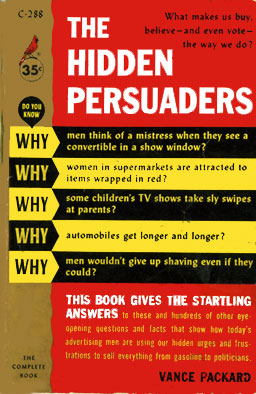
Have you ever wondered how marketing companies come up with their advertising campaigns? As consumers, we are a mess of contradictions; Motivational Research sorted us out years ago.
Meet Vance Packard
The Hidden Persuaders
According to Wikipedia, Vance Packard “was born in Granville Summit, Pennsylvania, to Philip J. Packard and Mabel Case Packard. Between 1920-32 he attended local public schools in State College, Pennsylvania, where his father managed a dairy farm owned by the Pennsylvania State College (later Penn State University). In 1932 he entered Penn State, majoring in English. He graduated in 1936, and worked briefly for the local newspaper, the Centre Daily Times. He earned his master’s degree at the Columbia University Graduate School of Journalism in 1937. That year, he joined the Boston Daily Record as a staff reporter and a year later, he married Virginia Matthews.
“About 1940, he became a reporter for the Associated Press and in 1942, joined the staff of The American Magazine as a section editor, later becoming a staff writer. The American Magazine closed in July, 1956, and Packard moved over to Collier’s where he worked as a writer. Collier’s, too, closed by the end of 1956, allowing Packard to devote his full attention to writing books. In 1957, The Hidden Persuaders was published and received national attention. The book launched Packard’s career as a social critic and full-time lecturer and book author. In 1961 he was named a Distinguished Alumnus of Penn State University. He died in 1996 at the Martha’s Vineyard Hospital in Massachusetts.”
Motivational Research
In 1957, Packard published a book about M.R. (Motivational Research). He wrote it using anecdotal passages, and although not a scholarly presentation, it proved to be a very popular book: popular with everyone but the people behind the use of M.R. to sell us the ‘package’.
In the mid-50’s merchandisers began to get concerned that the buying public were feeling a bit jaded about their advertising slogans. In fact, the resistance was becoming so strong, that it soon became apparent that production would quickly outstrip sales, and that wasn’t a good thing for a growing economy.
Packard’s book concentrated on Ernest Dichter and his methods.
‘Ernest Dichter (14 August 1907 – 21 November 1991) was an Austrian-American psychologist and marketing expert known as the “father of motivational research.” Dichter pioneered the application of Freudian psychoanalytic concepts and techniques to business — in particular to the study of consumer behavior in the marketplace. Ideas he established were a significant influence on the practices of the advertising industry in the twentieth century. Dichter promised the “mobilisation and manipulation of human needs as they exist in the consumer”. As America entered the 1950s, the decade of heightened commodity fetishism, Dichter offered consumers moral permission to embrace sex and consumption, and forged a philosophy of corporate hedonism, which he thought would make people immune to dangerous totalitarian ideas. According to a New York Times article in 1998, he “was the first to coin the term focus group and to stress the importance of image and persuasion in advertising”. In Vance Packard’s book on Dichter and his practices, he recalls meeting Dichter in his castle and finding children watching televisions while resident psychologists, crouching behind special screens secretly filmed and studied their every action so that they could inform advertisers how to manipulate their unconscious minds. Dichter called such focus groups his “living laboratory”. One such session led to the invention of the Barbie Doll: “What they wanted was someone sexy looking, someone that they wanted to grow up to be like,” Dichter reported, “Long legs, big breasts, glamorous.” To Packard, Dichter’s gothic mansion was a sinister factory that manufactured and implanted self-destructive desires.’ (Wikipedia)
The Marlboro Man
Marlboro Man
Cigarette smoking was a case in point: it wasn’t good for you, but you could be persuaded to keep it up, in spite of the health risks.
Dr. Dichter brooded a great deal over this old-fashioned Puritanism of the average America who “uses all types of soft drinks, cigarettes, liquor, and what not … yet at the same time seems to be consistently worried about what he is doing.” As a result of his brooding and probing Dr. Dichter arrived at this general conclusion: “Every time you sell a self-indulgent product . . . you have to assuage his guilt feelings . . . offer absolution.”
The smoking of cigarettes for many people had become deeply enmeshed in such guilt feelings. The feelings had been generated in part presumably because the smoking habit had been sternly repressed in their childhood, and partly from their very genuine suspicion that cigarettes were coffin nails. The cancer scare of the early fifties was just the final prod that sent sales skidding.
Some cigarette producers, including Philip Morris, tried to get the smoking public to use cigarette filters, but that proved a hard sell because President Roosevelt use to be photographed with one clinched between his teeth, and that turned people off.
The investigators found about a dozen reasons why many people continue to smoke despite their guilt feelings about the habit: they smoke to relieve tension, to express sociability, as a reward for effort, as an aid to poise, as an aid in anticipating stress, as proof of daring, as proof of conformity, because it is an accustomed ritual, and so on. They found that many people like to have a cigarette in their fingers when they enter a roomful of people as it makes them seem less nervous, more sophisticated.
Perhaps the major discovery of the investigators, however, is that Americans smoke to prove they are people of virile maturity. They see smoking as proving their vigor, potency. The report explains: “This is a psychological satisfaction sufficient to overcome health fears, to withstand moral censure, ridicule, or even the paradoxical weakness of ‘enslavement to habit.’”
A spectacular transvestism in the opposite direction was carried out in 1956 by Marlboro cigarettes, which used to be lipstick red and ivory tipped, designed primarily for women. Marlboro felt a little unhappy about its sexual designation because men smokers still outnumbered women two to one. When the cancer scare drove millions of men to show interest in filter tips, the Marlboro people decided to do a sexual flip-flop and go after the men, while holding onto as many women as they could. Their first move was to have Louis Cheskin, of the Color Research Institute, design a more masculine package. He did, in bold red and white. But that was only one of several significant changes. The Marlboro ads began featuring rugged, virile-looking men deep in work. To get the virile look desired the company used many non-professional models for the pictures (sailors, cowboys, and, reportedly, some men who worked at the company’s ad agency.) And the headlines of the ads began talking of Marlboro’s “man-sized flavor.”
The Marlboro Man was born.
The Car
It didn’t take the M.R. people long to sort out what car buyers were doing with their purchases. (Remember, this was in the 50’s when big cars were the main focus.)
People who want to seem conservative, to tell the world they are very serious and responsible, tend to buy Plymouth, Dodge, DeSoto, Packard, four-door sedans, dark colors, minimum accessories and gadgets.
People who want to seem sociable and up-to-date but in a middle-of-the-road sort of way tend to favor Chevrolet, Pontiac, Buick, Chrysler, two-door coupés, light colors, moderate accessories and gadgets.
People who want to express showiness, to assert their individualism and modernity, tend to buy Ford, Mercury, Oldsmobile, Lincoln, hardtops, two tones, bright shades and hues, a range of extras, gadgets, fads.
People who need to express unusual status or individual needs favor Cadillac (ostentation, high status), Studebaker, Hudson, Nash, Willys, convertibles (impulsiveness), very bright colors, red, yellow, white, latest gadgets and accessories.
The following video is proof of the snobbery involved between the top and the bottom of the car owner hierarchy.
Our Hidden Needs
Why do we buy some products and not others? It turns out that the reasons are usually hidden from our conscious minds. The Motivational Researchers sought to find out what they were.
In searching for extra psychological values that they could add to products to give them a more potent appeal, the depth merchandisers came upon many gratifying clues by studying our subconscious needs, yearnings, and cravings. Once the need was identified, and certified to be compelling, they began building the promise of its fulfillment into their sales presentations of such unlikely products as air conditioners, cake mixes, and motorboats. Here we will explore some of the more picturesque applications in merchandising eight of our hidden needs.
Selling emotional security
Selling reassurance of worth
Selling ego-gratification
Selling creative outlets
Selling love objects
Selling sense of power
Selling a sense of roots
Selling immortality
Packard gives great examples of each of this needs.
Sex
Well, you knew it had to be here, didn’t you?
The potency of sex as a sales promoter was not, of course, an original discovery of the depth merchandisers. Sex images have long been cherished by ad men purely as eye stoppers. But with the depth approach, sex began taking on some interesting twists, ramifications, and subtleties. Penetration to deeper levels of consciousness was sought. Simple cheesecake and get-your-man themes of old, while used for routine selling, were regarded as limited-penetration weapons.
So sex-for-sex-sake proved to be only a lead-in to the differences in the way men and women shop.
On May 18, 1956, The New York Times printed a remarkable interview with a young man named Gerald Stahl, executive vice-president of the Package Designers Council. He stated: “Psychiatrists say that people have so much to choose from that they want help—they will like the package that hypnotizes them into picking it.” He urged food packers to put more hypnosis into their package designing, so that the housewife will stick out her hand for it rather than one of many rivals.
Mr. Stahl has found that it takes the average woman exactly twenty seconds to cover an aisle in a supermarket if she doesn’t tarry; so a good package design should hypnotize the woman like a flashlight waved in front of her eyes. Some colors such as red and yellow are helpful in creating hypnotic effects. Just putting the name and maker of the product on the box is old-fashioned and, he says, has absolutely no effect on the mid-century woman. She can’t read anything, really, until she has picked the box up in her hands. To get the woman to reach and get the package in her hands designers, he explained, are now using “symbols that have a dreamlike quality.” To cite examples of dreamlike quality, he mentioned the mouth-watering frosted cakes that decorate the packages of cake mixes, sizzling steaks, mushrooms frying in butter. The idea is to sell the sizzle rather than the meat. Such illustrations make the woman’s imagination leap ahead to the end product. By 1956 package designers had even produced a box that, when the entranced shopper picked it up and began fingering it, would give a soft sales talk, or stress the brand name. The talk is on a strip that starts broadcasting when a shopper’s finger rubs it.
Social Classes
In the 1950’s, people were aware of class differences, even though the American ethic said that they were of One Nation.
Warner laid down his concept of a layered America as a society of six classes. These classes, he felt, were distinct, and in each class you got a uniformity of behavior that was fairly predictable. He defined his social classes not only in terms of wealth and power but in terms of people’s consumption and sociability habits. This broader approach to differentiation has received support from other perceptive observers of American society. Russell Lynes, the Harper’s editor and writer, in his famous dissection of upper brows, lower brows, and middle brows, used the tossed salad as a more reliable indicator of a person’s status brow-wise than the size of his bank account. And David Riesman in his now classic The Lonely Crowd makes the point we are seeing the emergence of a new social system with criteria of status that were not considered in traditional systems of class structure.
Warner’s six classes shape up roughly as follows, in terms of typical constituents:
1.The upper upper—old-line aristocrats in a community.
2.The lower upper—the new rich.
3.The upper middle—professionals, executives, owners of some of the larger businesses in a community.
4.The lower middle—white-collar workers, tradesman, a few skilled workers.
5.The upper lower—mostly skilled and semiskilled.
6.The lower lower—laborers and unassimilated foreign groups.
Status Symbols
Das Kapital One
Cars were not the only status symbols: houses, clothing, food, entertainment were also part of the mix. But how to sell you what you probably didn’t know you wanted?
The depth probers studying the most effective ways to sell status symbols to American strivers concluded that most of us are vulnerable to one of three merchandising strategies.
One is to offer bigness. Millions of Americans were believed to equate, subconsciously, biggest with best, best at least at making a big impression. A kitchen-range maker found himself in trouble because he accepted as fact the explanation many people gave for preferring a large kitchen range rather than a smaller one of equal efficiency. The customers had explained, almost unanimously, that they had bought the bigger stove in order to have more work space. With this in mind the company put engineers to work, and they brought out a moderate-sized stove with all working elements engineered more compactly to permit an unusually large work space. The stove was a dud. Salesmen couldn’t move it off the floor. The firm called in a Connecticut market-research firm with staff psychologists who examined the problem and concluded: “People are willing to pay a great deal more for a little space they don’t really use because what they are interested in is not so much the space itself as the expensive appearance of a large range.”
A second way merchandisers found they could sell us their products as status symbols was through the price tag. By seemingly inverse logic, many discovered they could increase their sales by raising their price tag, in the topsy-turvy merchandising battle of the mid-fifties.
This battle for the Biggest Price Tag was waged with particular vehemence in the car field where, Tide magazine observed, “the almost insane drive by the consumer for a social prestige car has kept auto makers racing to produce the most luxurious vehicle.” As Ford Motor Company prepared to unveil its Continental with an up-to-$10,000 price tag insiders explained that the real goal was, for prestige purposes, to get a higher-priced car in the Ford line than General Motors had in the Cadillac. It would serve as a “rolling institution” and its prestige would rub off on the lowlier Ford makes. Tide summed this up by saying that “at $10,000 the Mark II Continental Is Ford’s Challenge to G.M’s Caddy, Top U.S. Prestige Car.” The problem was not to outsell the Caddy but to top it in elegant overtones. There were rumors that “applicants” for the car would have to submit applications and be screened for financial status and social standing. The Ford people never confirmed this, but they did suggest that the Lincoln dealers would be selective in determining who would get the car in each community and who wouldn’t. After the car went on sale reports from dealers stated that 90 percent of the people buying paid spot cash. (Cadillac responded to the challenge in 1957 by bringing out a $12,500 car.)
The third strategy that merchandisers found was effective in selling products as status symbols was to persuade personages of indisputably high status to invite the rest of us to join them in enjoying the product. The testimonial can be a mighty effective selling device, Printer’s Ink pointed out, cynics to the contrary. This is particularly true where the celebrity has some plausible ground for being interested in the product. Testimonials by celebrities were not a new discovery, but in the early fifties they were placed on a systematic basis. The man who did it was Jules Alberti, a dapper man who set up Endorsements, Inc., after World War II on a $500 investment. At first the ad agencies shunned the idea of being so forthright about procuring testimonials, but soon the logic of the service he was offering proved overwhelming, and by 1956 he was grossing nearly a million dollars a year and four hundred ad agencies had used his good offices in lining up endorsements, all of which, he insists, are true. In 1956 he said that testimonials should be written either by the celebrity himself or have the help of a top-flight copy writer who really believes what he is saying. Mr. Alberti complained that too few ad men really believed what they wrote any more and asked how men who let cynicism and disbelief creep into their thinking could produce really persuasive and believable copy. Professor Smith mentioned that many people nowadays express skepticism about testimonials but added that although people consciously deny being impressed by testimonials there is a strong suspicion that unconsciously they are impressed with them.
“What’s in your wallet?”
The Boston Tea Party
So what’s wrong with a simple cup of tea? Too weak for real men? The M.R. people have a solution for that, too.
In his explorations Dr. Dichter concluded that there was still another handicap that should be faced. That was an awkward fact of history—the Boston Tea Party. He purported to find, in tracking down tea’s difficulties, that Americans had been subconsciously resistant to tea ever since that night nearly two centuries ago when colonial patriots in a burst of exuberance tossed a cargo of British tea into the Boston harbor. The continued, admiring gloating over this act of rebellion in American schoolrooms, he concluded, has over the centuries imbued young Americans with an anti-tea attitude. Dr. Dichter advised tea people that a part of their corrective campaign ought to start right in American classrooms and with the writers of American histories. Americans should be taught, he said, that the Boston Tea Party was not a protest against tea but rather a dramatic expression of the importance of tea in the life of Americans in revolutionary times. At first thought this thesis may sound preposterously farfetched. A study of colonial life in pre-Revolutionary days does reveal, however, that American consuming habits were closely tied to tea and that many women in particular felt they couldn’t live without it.
The problem of straightening Americans out on the real meaning of the Boston Tea Party was admittedly a long-term project, but there were some things tea merchants could do right away, Dr. Dichter felt, to get out of their downward spiral. He urged the Tea Council to put some muscle in the tea mage, make it more of a virile brew and get it out of the current image as a gentle medicinal sauce for ladies and sissies to sip. The insipid colors in ads were soon replaced by brilliant masculine reds, and the old promise of being a pickup for tired nerves was replaced, in the words of writer in The Reporter magazine, by “sounds like a police sergeant clearing his throat—‘Make it heft, hot and hearty . . . Take tea and see.’ . . . Consumers were led to feel that tea-drinking is no more unmanly than felling an oak or killing a moose.” Heft, obviously hot men were shown drinking iced tea right out of a pitcher.
By all accounts I’ve seen, tea sales began rising with the pounding home to Americans of this new image. The figures vary, but in test areas sales rose as much as 25 percent, and the most conservative estimate I’ve seen is that tea sales rose 13 percent during the two years following the introduction of this new personality for tea. Per capita consumption by 1957 was up close to a pound a year.
My Conclusion
So, quite a journey, eh? Here we thought that we were immune to manipulation by advertisers. They’ve been at it for almost 60 years, and it doesn’t show any signs of abating.
If you wish to know first hand what these practitioners of the Hidden Persuasion are up to, I can heartily suggest that you get a copy of this book and read it for yourself.
Picture credits: Book cover courtesy of Wkipedia Marlboro Man courtesy of Philip Morris Das Kapital One courtesy of ThePeoplesCube.com