I went rooting through my library, yesterday, for a entry about Mary Magdalene in the above-noted book. I had previously written about this book, here. When I came to the chapter called “The Life of Jesus” I found the confirmation I was seeking: Gladys Davis’ cousin Mildred was the reincarnation of Mary Magdalene. But then I read further and came across this:
Jesus’ raising of Lazarus, according to the Source, was the event that completely convinced Ruth and Philoas of His identity as the Messiah. According to Cayce, Lazarus had died of typhoid fever before Jesus raised him from the dead. One of the things that impressed onlookers most, when Jesus arrived four days after Lazarus’s death, was that “He wept with those of His friends, in the face of criticism [for coming late and] in the company of the great and near great.” This experience, Cayce said, “brought about change, which made for a new life, a new understanding, a new conception of . . . God among the children of men.”
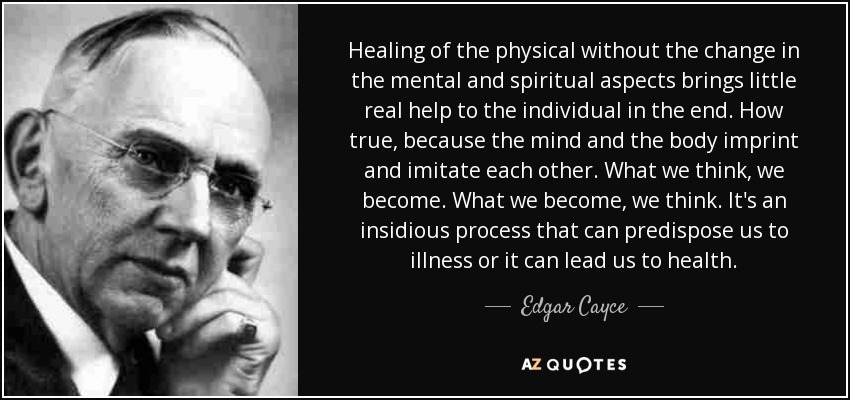
Cayce confirmed that the raising of Lazarus was also the last straw in the minds of high priests who then began to plot His death in earnest. Like so many figures in the New Testament, no mention is made as to what finally became of Lazarus, although it does state that the high priests plotted his death, too. What is most interesting to note is that Lazarus, like nearly every person identified in the life readings as being healed by Jesus, allegedly developed healing abilities in that lifetime, and also in later incarnations. The man who had been Lazarus was said by the Source to be reborn in 1875 as Fredoon Birdi, in Puna, India, to Persian parents. Biographical sources independent of the life readings support such a claim: Dr. Fredoon Birdi, born in Puna, India, was a well-respected naturopathic healer in St. Petersburg, Florida.
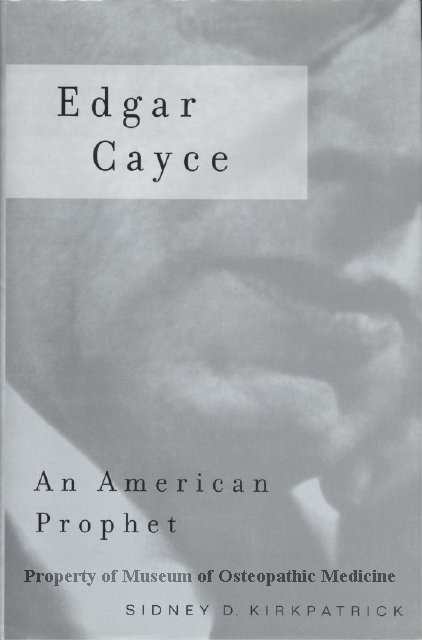
Edgar Caye: An American Prophet (pages 336-7)
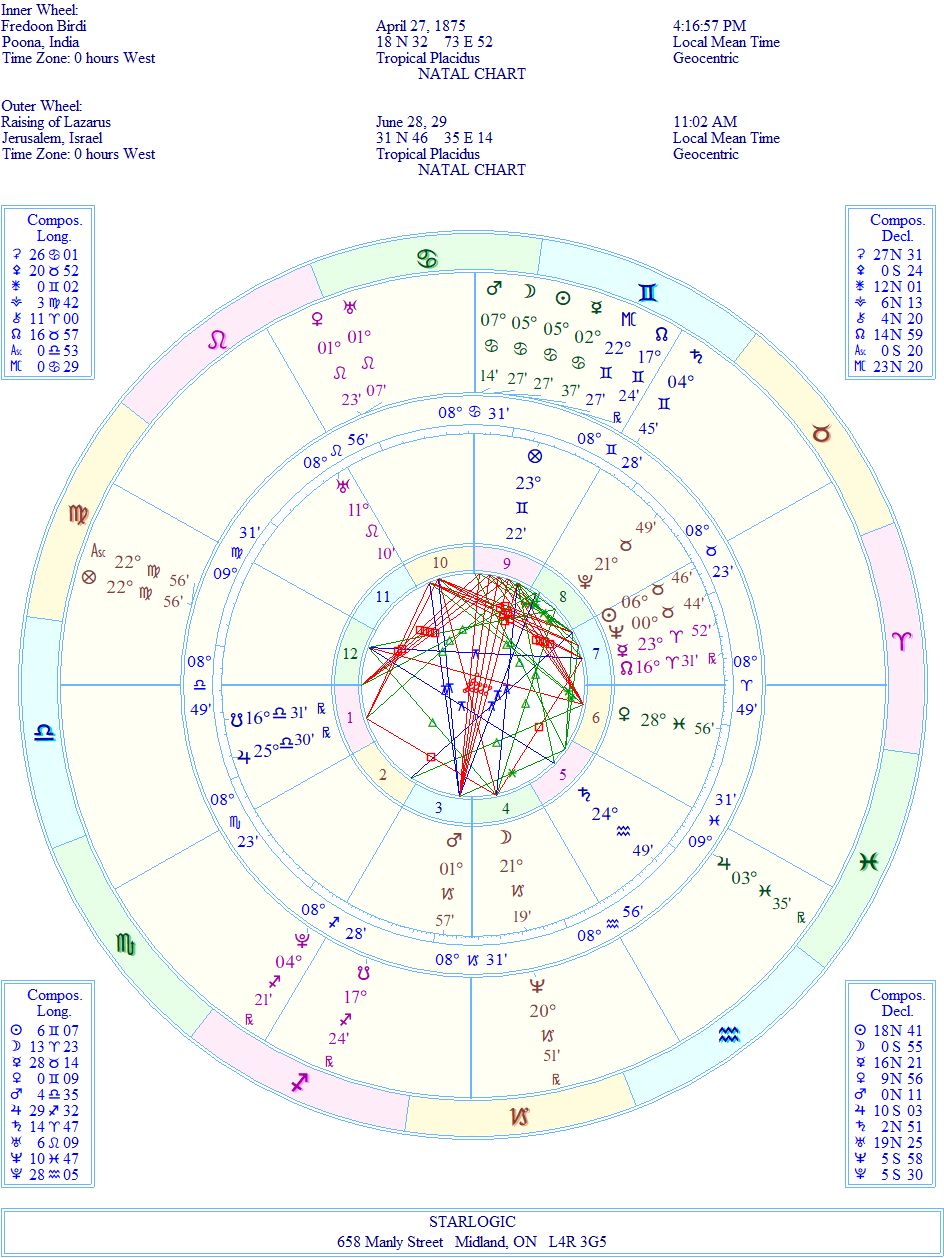
The proof is in the pudding, they say. Since I have no idea what time of day Dr. Birdi was born, I let it be randomized (meaning, the time I did the chart). The chart for the raising of Lazarus represents the ending of the ‘old’ and the beginning of the ‘new’. By comparing these charts, I am hoping to show that there is a proof of sorts for Jesus’ miracle and reincarnation, at the same time.
Since Lazarus’ coming back to life is a new birth, I am hoping to see some links between that event and Dr. Birdi’s birth. And there are a couple of direct ‘hits’: Birdi’s Part of Fortune is conjunct the Midheaven of Lazarus’ chart @ 22-23 Gemini; and Birdi’s Moon is conjunct Lazarus’ Neptune @ 21 Capricorn.
Between the two charts are Yod’s pointing at Birdi’s Mars and Lazarus’ Ascendant/Part of Fortune. (It should be remembered that Lazarus was raised when the Sun and Moon were exactly conjunct @ 5 Cancer.) I wouldn’t say this is definite ‘proof’ but I feel more certain that the Source has more insight into karma and reincarnation than, say, Rudolf Steiner.
But, I always take great comfort from the fact that Jesus’ life on earth was more than a figment of some Jewish writer‘s imagination in the late 1st century. It would be more accurate to say that Jesus’ story was hijacked to serve the Roman Empire. Thank you Jesus! Thank you Lord!
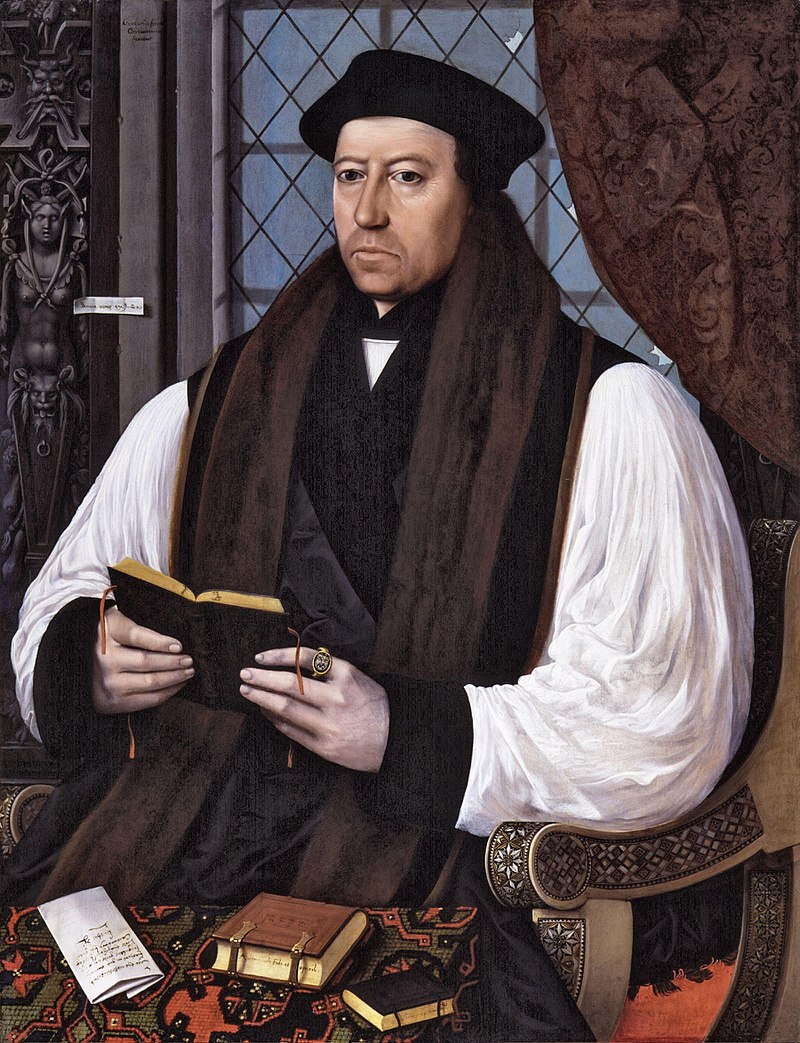
This is the final one of the four men named Thomas who lived during Henry VIII’s reign, and had something to do with the creation of the Church of England. Thomas and Henry, eh? Echoes of Henry II and Thomas Becket. (Also where the term, “Every Tom, Dick and Harry” comes from.)
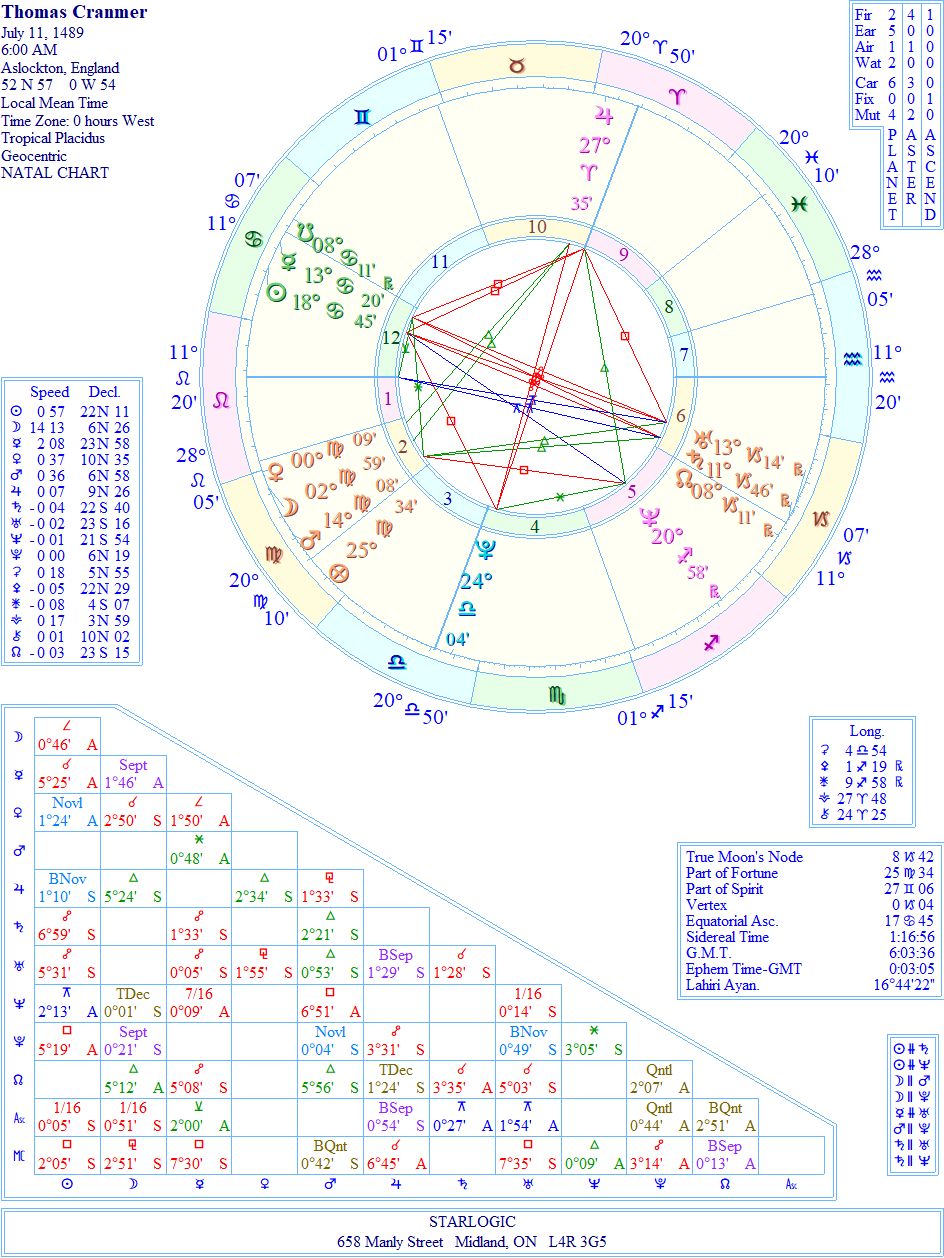
I rectified the timing of his birth chart to show the age (12) when Cranmer’s father (Saturn) died, followed by his entry into the newly created Jesus College, Cambridge (Uranus) at age 14. I think we’re on solid ground. Note the two inconjuncts pointing to his Ascendant @ 11 Leo. Interesting.
Saturn Conjunct Uranus
This aspect occurs only once every forty-five years. It signifies a heavy internal tension that can have both creative and difficult results. At its most difficult, it may make you feel restless and irritable, not knowing whether to go forward or backward. This in turn creates tension, and you try to get away from whatever is causing the conflict. If this process goes too far, you may suddenly make a rash and impulsive move simply to get away from the tension by any means at all. When you are older, you may suddenly break away from a relationship or quit your job or suddenly have an emotional outburst with little or no warning to those around you. You find it difficult to release tension slowly, which would be the better way.
On the other hand, if you keep this tension within reasonable limits, it can make you very alert and attentive to any task that you are involved in. And because you can hold in your tenseness, you can persist in the face of difficulty longer than most people and thereby get a lot done. Just be sure you know when the tension has built up enough and do no hold it in until the pressure becomes unbearable.
Also you are able o maintain a balance between caution and change in your life. You can go through very major changes in a careful and orderly manner without blowing everything apart, as long as you don’t wait too long to do so. The changes that you bring about in this manner are more lasting than those that are done with less care.
(To me, Cranmer represents the impulse for change, with an eye to maintain the status quo as long as it is practically possible: a perfect blending of Saturn and Uranus.)
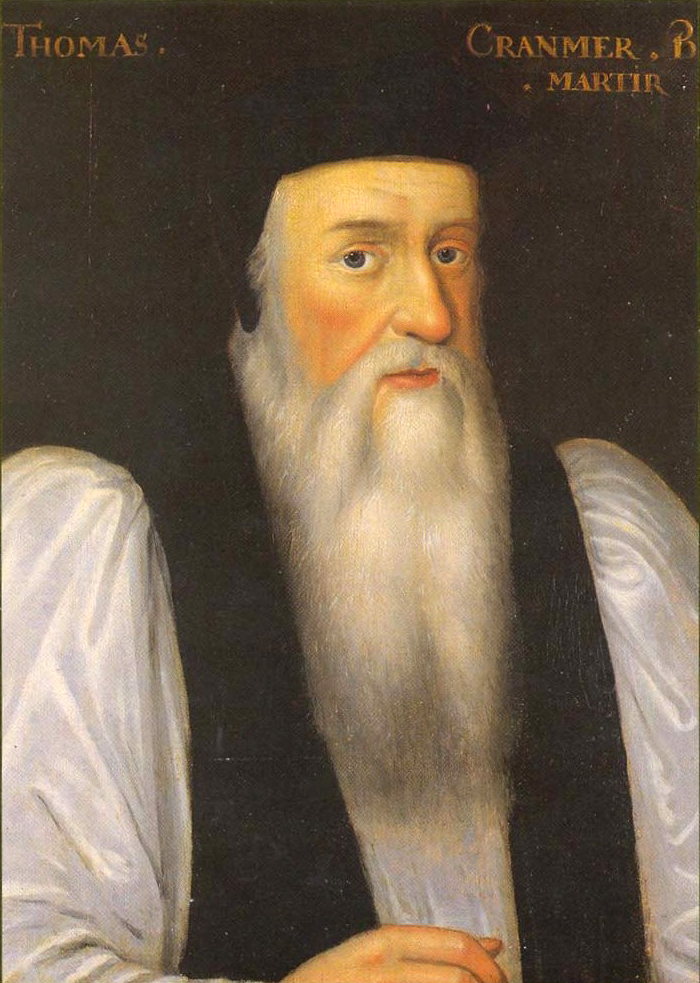
Portrait of Cranmer painted by an unknown artist after Henry VIII’s death. It was said that his beard signified his mourning of the king and his rejection of the old Church
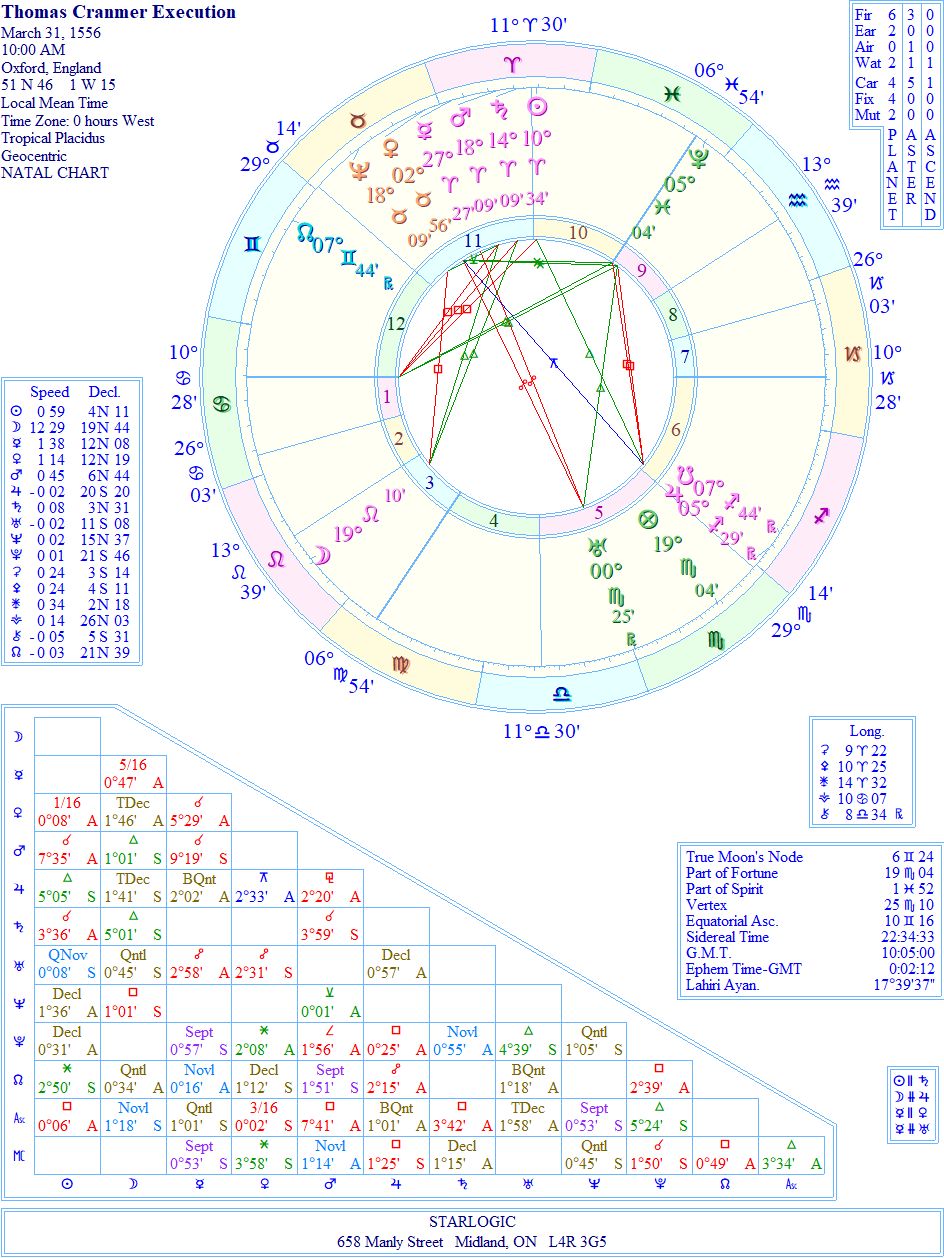
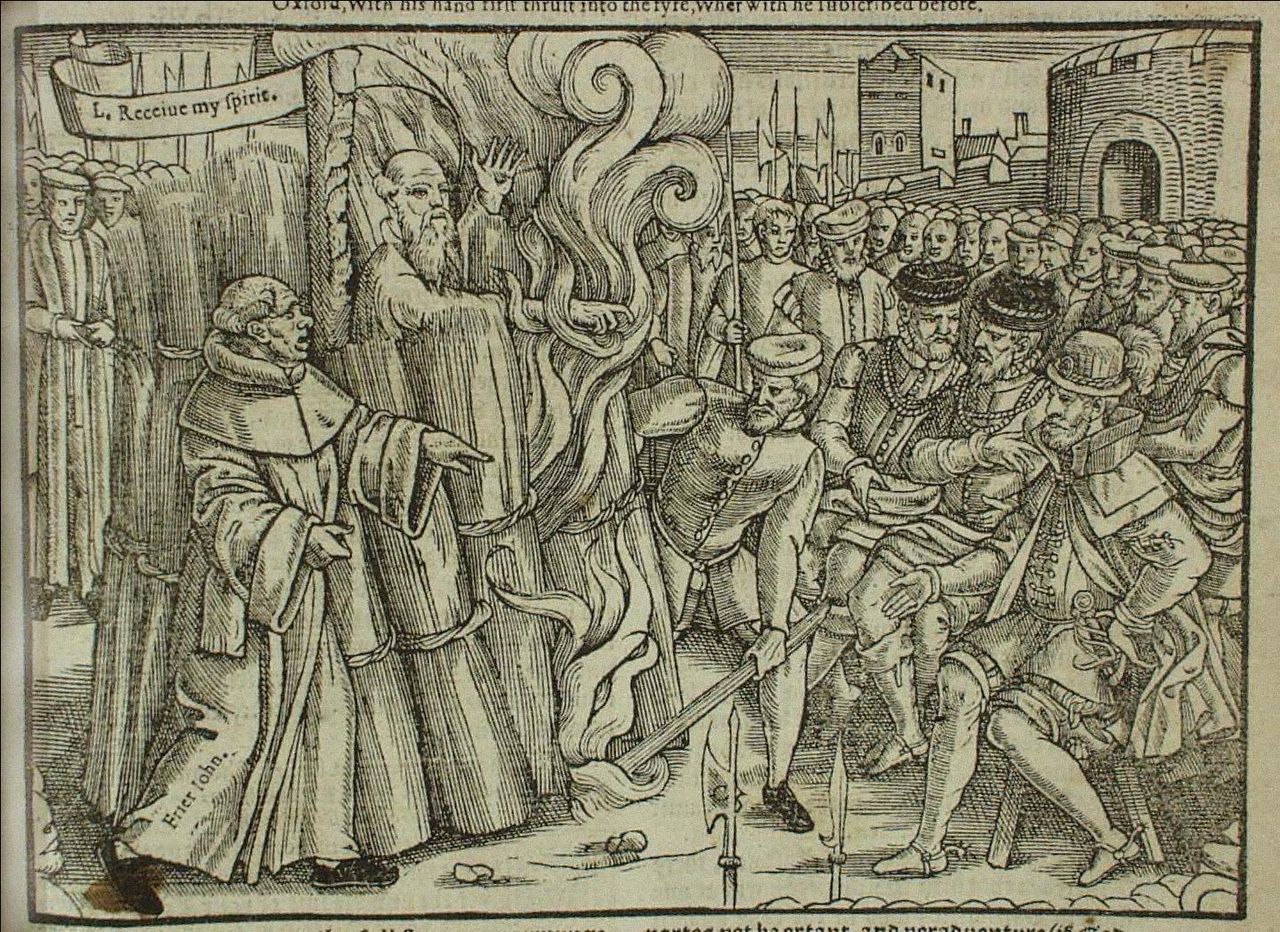
When in the service of your King, it is sometimes better to die before his demise than to live beyond his reign. By the time Mary I took over the English throne, Cranmer was in deep doo-doo. She wanted England to return to its Roman Catholic past, and he was Archbishop of Canterbury (head of the Church of England), effectively standing in her way. There was nowhere to go but into the fire.
I do not know exactly when Cranmer was burned that fateful day in March, 1556, but by setting the clock a 10:00 am, we can get a glimpse of the circumstances of his death. Pluto is conjunct the Midheaven in Pisces; and the Sun, Mars and Saturn (11th house) are conjunct in Aries (death by Fire). The Moon at 19 Leo in the 3rd house probably represents Mary in this chart. He thrust his writing hand into the fire first as punishment for causing any harm when he signed his renunciation of beliefs.
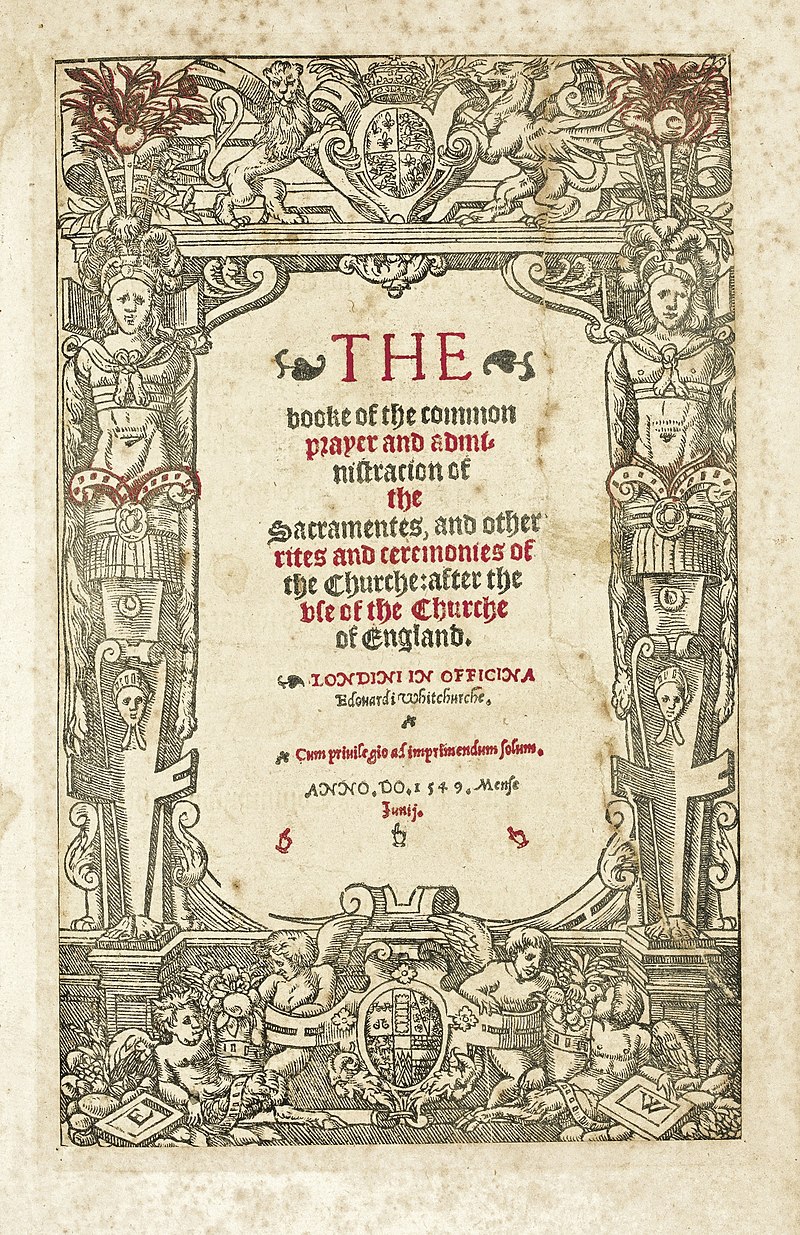
His legacy lives on, in spite of his recanting of all heretical acts. The Book of Common Prayer is deemed to be written by him.
It is difficult to ascertain how much of the Prayer Book is Cranmer’s personal composition. Generations of liturgical scholars have been able to track down the sources that he used, including the Sarum Rite, writings from Hermann von Wied, and several Lutheran sources including Osiander and Justus Jonas. More problematic is determining how Cranmer worked on the book and with whom he worked. Despite the lack of knowledge of who might have helped him, he is given the credit for the editorship and the overall structure of the book.
Wikipedia
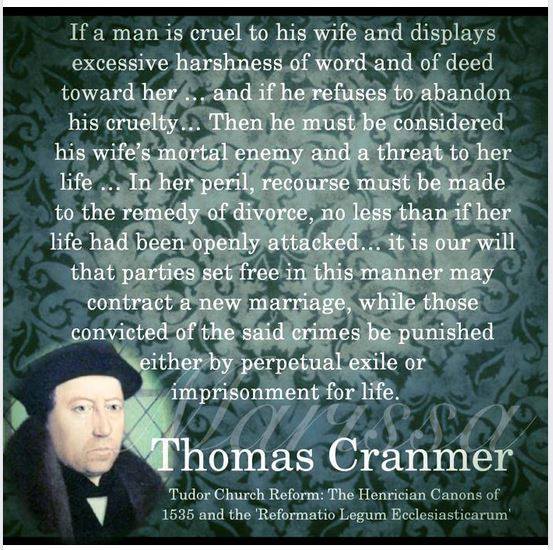
One Last Quote to Demonstrate How Ahead of His Time He Was:
These two shots were taken with my mobile phone. This last one was taken with my Nikon Coolpix L340 camera a shot time later… Can you see the sundog clearly now?
Thomas Cromwell (January 1, 1485? – July 28, 1540)
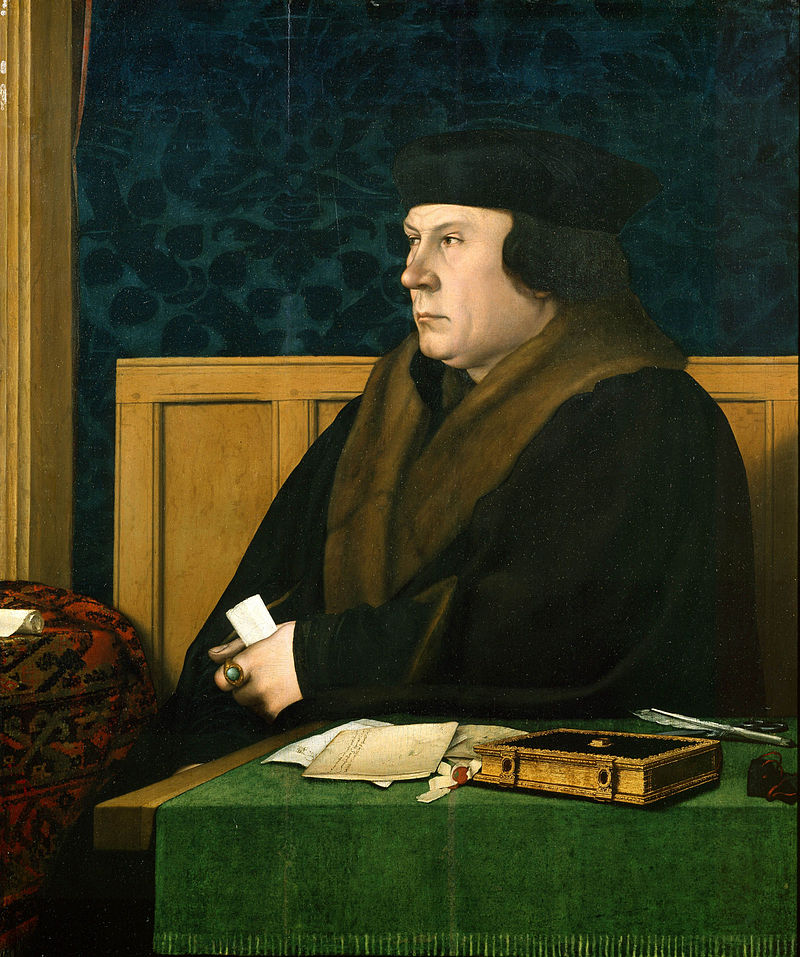
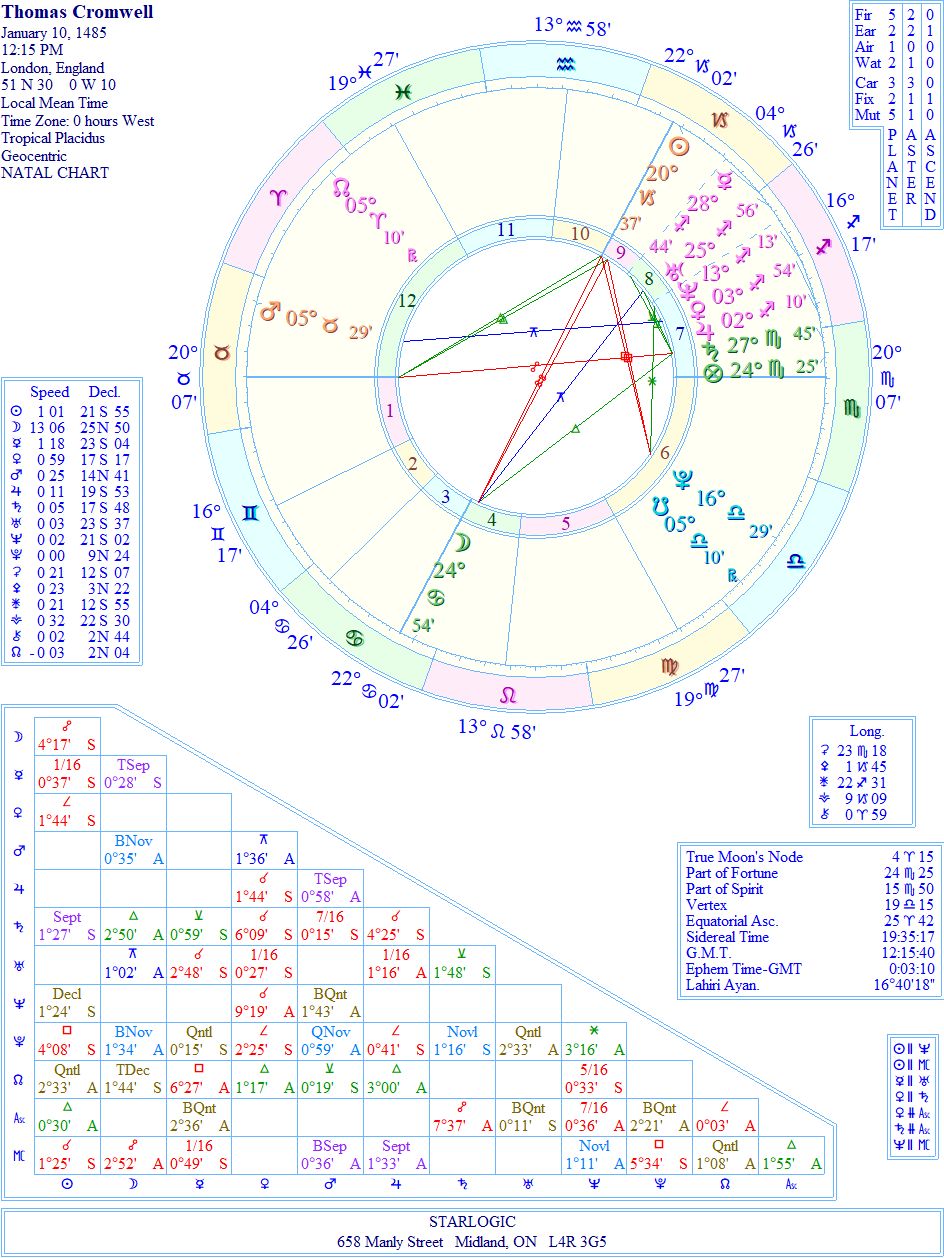
(Why are they all shown holding a piece of paper in one hand?) I was hesitating to write about this ‘architect’ of the Anglican Church, mainly because no one knows his exact birth date; the year is known, but the rest is fuzzy. One astrology site decided that January 1st would do, since no one really looks at these charts as being real, anyway. I’ve gone with that date, just to demonstrate how wrong is can be.
The chart was originally set @ 8:00 am, but that made a nonsense of timing, so I rectified it to 12:15 pm so that his marriage (Venus) at age 30 would be highlighted. Even if the date was wrong, we still get a glimpse of Cromwell’s lucky streak, starting with Saturn in Scorpio (7th house) through to the Sun in Capricorn (conjunct the 9th house cusp). He had a ‘good innings’.
“Cromwell successfully overcame the shadow cast over his career by Wolsey’s downfall. By November 1529, he had secured a seat in Parliament as a member for Taunton and was reported to be in favour with the King. Early in this short session of Parliament (November to December 1529) Cromwell involved himself with legislation to restrict absentee clergy from collecting stipends from multiple parishes (“clerical farming”) and to abolish the power of Rome to award dispensations for the practice.
“At some point during the closing weeks of 1530, the King appointed him to the Privy Council. Cromwell held numerous offices during his career in the King’s service, including:
Thomas Cromwell, c. 1532–3, attributed to Hans Holbein the Younger
Commissioner for the Subsidy, London 1524, Kent 1534, for printing of the Bible 1539, for sale of crown lands 1539, 1540
Master of King’s Jewel House jointly with Sir John Williams 14 April 1532, c. 1533–1540
Clerk of the Hanaper 16 July 1532, jointly with Ralph Sadler Apr. 1535–1540
Chancellor of the Exchequer 12 April 1533 – 1540
Recorder, Bristol 1533–1540
Steward, Westminster Abbey 12 September 1533, jointly with Robert Wroth 14 February 1534 – May 1535
Lordships of Edmonton and Sayesbery, Middlesex May 1535, of Havering-atte-Bower, Essex December 1537 manor of Writtle, Essex June 1536, Honour of Rayleigh, Essex September 1539
Surveyor of the King’s Woods, jointly with Sir William Paulet by 1533
Principal Secretary c. April 1534 – April 1540
Master of the Rolls 8 October 1534 – 10 July 1536
Constable jointly with Richard Williams (alias Cromwell) of Hertford Castle, Hertfordshire 1534–1540, Berkeley Castle, Gloucestershire 1535–d., sole, Leeds Castle, Kent 4 January 1539 – 1540
Visitor-General of the Monasteries 21 January 1535
Steward, Duchy of Lancaster, Essex, Hertfordshire and Middlesex 12 May 1535 – 1540
Steward of Savoy Manor May 1535 – 1540
Chancellor, High Steward and Visitor, Cambridge University 1535–1540
Commissioner for the Peace, Bristol, Kent, Middlesex, Surrey 1535–1540, Essex 1536–1540, Derbyshire, Westmorland 1537–1540, all counties 1538–1540
Prebendary of Salisbury, May 1536 – 1540
Receiver of Petitions in the Lords, Parliament of 1536
Trier, Parliament of 1539
Lord Privy Seal, 2 July 1536 – 1540
Vicar General and Vicegerent of the King in spirituals, 18 July 1536
Dean of Wells, 1537–1540
Warden and Chief Justice in Eyre, North of Trent, 30 December 1537 – 1540
Governor of the Isle of Wight, 2 November 1538 – 1540
Great Chamberlain, 17 April 1540
as well as numerous minor offices.” (Royal Favourite from Wikipedia)
With all that was going on, I wonder how he managed to keep his head on straight; no, wait, he lost it in the end.
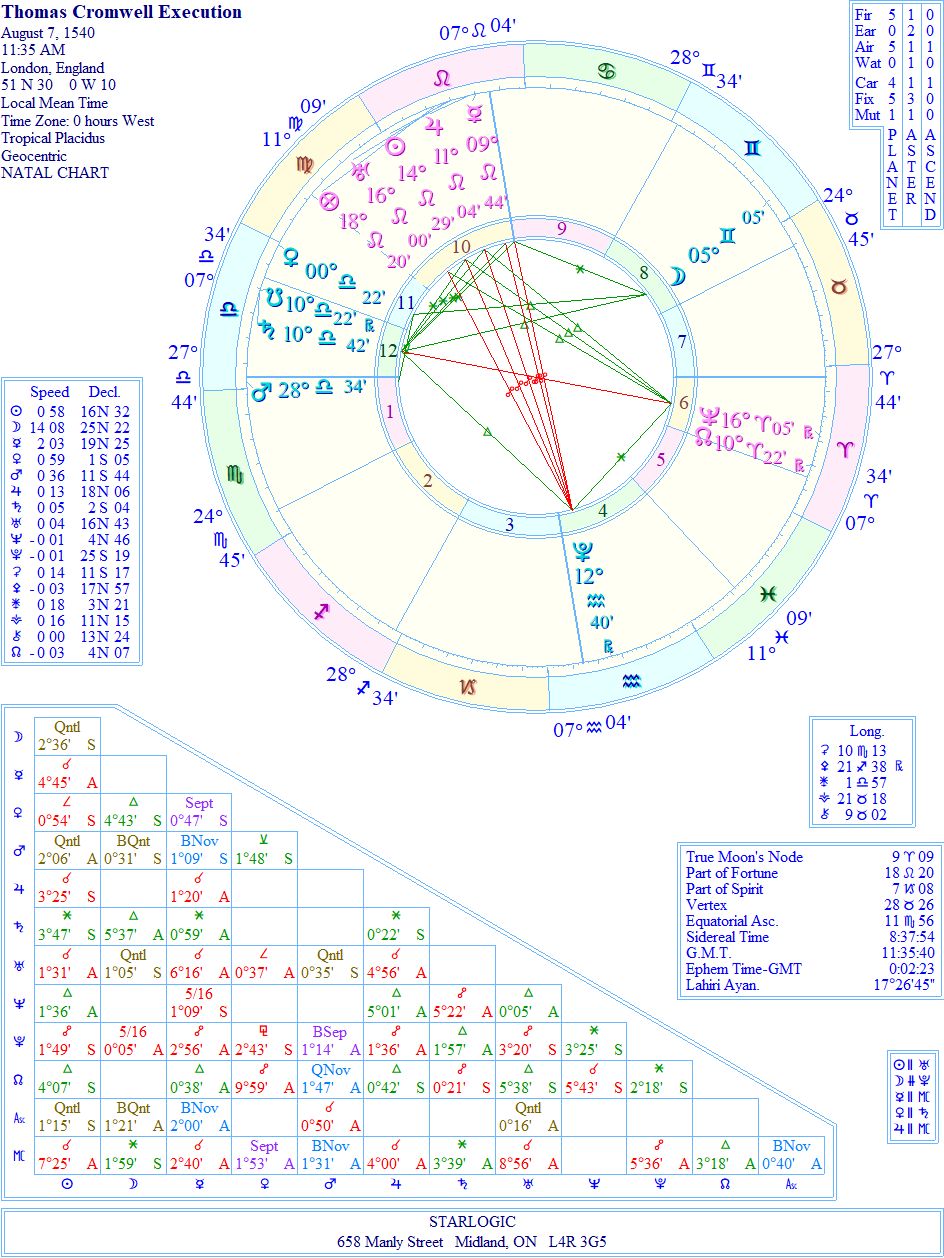
Of the two charts, this is the only one that we can be fairly certain of its accuracy. Usually, executions happen early in the morning, sometime after dawn. But, just for fun, I thought that Mars would be on the horizon (i.e. conjunct the Ascendant), so I moved the clock to 11:35 am local time.
Notice how Pluto in Aquarius is in opposition to the Midheaven, Mercury, Jupiter, the Sun, and Uranus, all in Leo. The system was stacked against him, he didn’t stand a chance in hell. It has been noted that later, Henry VIII regretted losing such a valuable member of his government.
“Cromwell was condemned to death without trial, lost all his titles and property and was publicly beheaded on Tower Hill on 28 July 1540, on the same day as the King’s marriage to Catherine Howard. Cromwell made a prayer and speech on the scaffold, professing to die, ‘in the traditional faith’ [Catholic] and denying that he had aided heretics. This was a necessary disavowal, to protect his family. The circumstances of his execution are a source of debate: whilst some accounts state that the executioner had great difficulty severing the head, others claim that this is apocryphal and that it took only one blow. Afterwards, his head was set on a spike on London Bridge.
“Hall said of Cromwell’s downfall,
Many lamented but more rejoiced, and specially such as either had been religious men, or favoured religious persons; for they banqueted and triumphed together that night, many wishing that that day had been seven years before; and some fearing lest he should escape, although he were imprisoned, could not be merry. Others who knew nothing but truth by him both lamented him and heartily prayed for him. But this is true that of certain of the clergy he was detestably hated, & specially of such as had borne swynge [beaten hard], and by his means was put from it; for in deed he was a man that in all his doings seemed not to favour any kind of Popery, nor could not abide the snoffyng pride of some prelates, which undoubtedly, whatsoever else was the cause of his death, did shorten his life and procured the end that he was brought unto.
“Henry came to regret Cromwell’s killing and later accused his ministers of bringing about Cromwell’s downfall by ‘pretexts’ and ‘false accusations’. On 3 March 1541, the French Ambassador, Charles de Marillac, reported in a letter that the King was now said to be lamenting that,
under pretext of some slight offences which he had committed, they had brought several accusations against him, on the strength of which he had put to death the most faithful servant he ever had.
Site of the ancient scaffold at Tower Hill where Cromwell was executed by decapitation
Plaque at the ancient scaffold site on Tower Hill commemorating Thomas Cromwell and others executed at the site
“There remains an element of what G. R. Elton describes as ‘mystery’ about Cromwell’s demise. In April 1540, just three months before he went to the block, he was created Earl of Essex and Lord Great Chamberlain. The arbitrary and unpredictable streak in the King’s personality, which more than once exercised influence during his reign, had surfaced again and washed Cromwell away in its wake.
“During Cromwell’s years in power, he skilfully managed Crown finances and extended royal authority. In 1536, he established the Court of Augmentations to handle the massive windfall to the royal coffers from the Dissolution of the Monasteries. Two other important financial institutions, the Court of Wards and the Court of First Fruits and Tenths, owed their existence to him, although they were not set up until after his death. He strengthened royal authority in the north of England, through reform of the Council of the North, extended royal power and introduced Protestantism in Ireland, and was the architect of the Laws in Wales Acts 1535 and 1542, which promoted stability and gained acceptance for the royal supremacy in Wales. He also introduced important social and economic reforms in England in the 1530s, including action against enclosures, the promotion of English cloth exports and the poor relief legislation of 1536.” (Wikipedia)
Did he deserve the ending that he got? Probably not. But when one raises one’s head above the parapet, someone else is always willing to take a shot at it. Perhaps Cromwell was just too successful, and envy brought him down. At any rate, he engineered the start of the Church of England, to accommodate his King’s wish to sire an heir to the British throne.
Maybe he should have stayed out of the King’s bedroom (and perhaps his family, too).
Remember when this whole thing started? (Who can forget, obviously?) The idea of a vaccine to fight this ‘invisible’ killer was projected into 2021. The universal shutdown of society worldwide was only just beginning. Even wearing masks was considered a slim aid to safety. Now we know so much more.
But do we really? The second wave seems to be waning, and yet, the mutations and variants are keeping us on our collective toes. Dire warnings are still coming from the medical experts: don’t let up now, or else. Or else, what? Death; overwhelming our hospitals; accidentally killing our family? All of the above? Where is our saviour? There are now three, maybe four vaccines which will protect us all, but their supply has been outstripped by demand. Wow! What a way to make everyone want to get vaccinated, as soon as possible. Even the previously reluctant skeptics are changing their minds.
I am not suggesting for one minute that this is ‘fake news’, but I am always suspicious when I feel like we’re being manipulated into one course of action. The message is: we can’t return to normal without it.
But maybe we’ll end up having to have an annual dose (like we do with the ‘flu shot).
It was an inspired bit of theatre: having a stained glass window displaying six symbols of the world’s main religions. No doubt the producers wanted to be inclusive of all faiths when they decided to let this image be shown. Did you ever wonder why? I think they didn’t want to offend any of their fan base.
But in doing so, I’m sure that the dominant religious groups in the United States felt that the Christian Cross should have been enough. But ‘life after death’ is a strange sort of beast, because long before Christianity, pagans believed in the idea of Summerland. Purgatory, the Catholic version of the between state, seems a barbaric concept when compared to the pastoral scenes of an idyllic afterlife.
The final season of Lost explored the idea that we all meet again at the end of our lives. But it takes time for us to remember who we were in the past. That is the very fabric of reincarnation. You couldn’t have been shown a better example. And the fact that Jack was being helped to understand that he was dead makes this episode so emotional. Who better than his dead father, Christian, to show up on the day?
Jack’s eye opened the first episode and his eye closed the final one. The story was all about Jack.
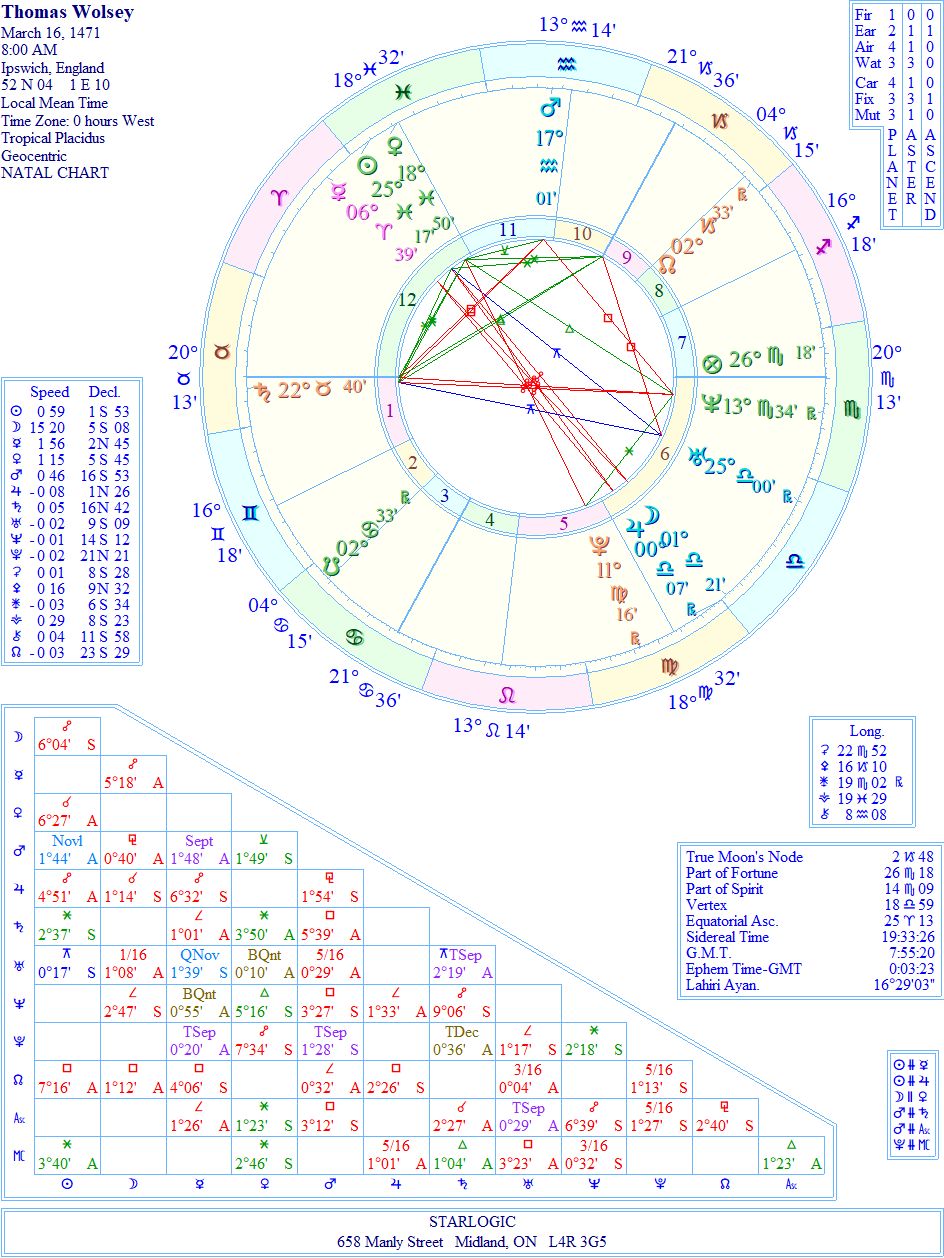
I cannot say for sure who really was the villain of the piece, but Cardinal Wolsey comes close to the top of my list of the usual suspects.
Thomas Wolsey (c. March 1473 – 29 November 1530) was an English archbishop, statesman and a cardinal of the Catholic Church. When Henry VIII became King of England in 1509, Wolsey became the King’s almoner. Wolsey’s affairs prospered, and by 1514 he had become the controlling figure in virtually all matters of state. He also held important ecclesiastical appointments. These included the Archbishopric of York—the second most important role in the English church—and acting as papal legate. His appointment as a cardinal by Pope Leo X in 1515 gave him precedence over all other English clergy.
The highest political position Wolsey attained was Lord Chancellor, the King’s chief adviser (formally, as his successor and disciple Thomas Cromwell was not). In that position, he enjoyed great freedom and was often depicted as an alter rex (other king). After failing to negotiate an annulment of Henry’s marriage to Catherine of Aragon, Wolsey fell out of favour and was stripped of his government titles. He retreated to York to fulfil his ecclesiastical duties as archbishop, a position he nominally held but had neglected during his years in government. He was recalled to London to answer to charges of treason—charges Henry commonly used against ministers who fell out of his favour—but died on the way from natural causes.
This is the chart that I found on astrotheme.com and it has some ‘problems’, the least being the year. When biographies give an approximate birth year, it is usually because the person had been coy about what age they really were. I did the same once, saying that I was born in 1948, so that I could start work as an usher at the Roxy Theatre in Barrie when I was really just 14. When I reapplied for my Social Insurance Card years later, I gave my real birth year as 1950 and had to prove it with a birth certificate.
But for our purposes, I’m going to go with the details as provided, including a possibly late time of 8 am for his birth. Nevertheless, there are some interesting aspects: Saturn and the Ascendant conjunct in Taurus; the Moon and Jupiter conjunct in Libra; and one Yod, pointing at Uranus, also in Libra.
Sun Inconjunct Uranus
As with many other inconjuncts, astrologers have found that if you suppress your need and desire for freedom in your life, this energy may be expressed through illness or accident. While you are young, you may have accidents because you suddenly make unpredictable, rash movements. Later in life this aspect can signify cardiac problems, but only if you suppress your natural need for self-expression.
Saturn Inconjunct Uranus
If either of these planets is near conjunction or opposition with the Ascendant or Midheaven, this aspect indicates a serious tension in your life between freedom and restriction. Many people have this conflict, but in your case the tensions may be so severe that you express them physically as muscle tension and possibly nervousness. You feel that somehow you must keep everything in your life under tight control, that if you let go, the whole structure will fall apart. In a very real and direct sense, even while you are young, you mus learn to relax.
I have no doubts about the timing of Wolsey’s death chart, so combining it with his birth chart allows us to see if the birth aspects are further accentuated/exacerbated by the planetary aspects of his death chart.
And they are. That original Yod pointing at Uranus is now moved slightly, pointing at Jupiter @ 20 Libra, this time supported by Wolsey’s natal Venus @ 18 Pisces, and his natal Ascendant @ 20 Taurus. And his ‘fatal’ Ascendant @ 10 Leo is in wide opposition to his natal Mars @ 17 Aquarius. Isn’t this position of Mars where I came into writing about Jesus’ birth chart?
The ‘point of death’, which is not to be confused with the “Anaretic“, is one of the so-called Arabian PARS. If the degree of the Moon in a natal chart is revolved to the Ascendant, the cusp of the adjusted 8th house marks the death point.
Dictionary of Astrology by Fred Gettings
In my original birth chart for Jesus, that position was 17 Aquarius and marked by Mars. Interesting.
Just before his death he reputedly spoke these words:
I see the matter against me how it is framed. But if I had served God as diligently as I have done the King, he would not have given me over in my grey hairs.
We watched this film last night on Netflix. I knew the title had some spiritual significance.
Alice is a reclusive writer, resigned to a solitary life on the seaside cliffs of Southern England while World War II rages across the channel. When she opens her front door one day to find she’s to adopt a young London evacuee named Frank, she’s resistant. It’s not long, however, before the two realize they have more in common in their pasts than Alice had assumed. Gemma Arterton, Gugu Mbatha-Raw and Tom Courtenay star in this intensely emotional story of love’s endurance in trying times.
Well, not exactly “adopt”, more like “foster”. But, let’s not quibble over semantics.
The story hinges on the research Alice was undergoing to show how mirages of far-off images can be seen above the waters of the English Channel. She was writing a thesis about it. Until Jack shows up.
Then they experience the phenomenon together, seeing Dover Castle on the hill, near where they live. This has been noted before:
Doctor Vince, on August 6, 1806, at 7 P. M., saw from Ramsgate, England, at which place only the tops of Dover Castle towers are usually visible, the whole of the castle. It appeared as though lifted up and bodily placed’ on the near side of the intervening hill. So perfect was this illusion that the hill itself actually could not be seen through the figure.
Los Angeles Herald Volume 34, Number 293, 21 July 1907
These images are known as Fata Morgana. Here’s one from 1871:
Rochester Mirage
This is important, because, on the day that Alice was told that Frank’s father had been killed in the war, Frank experienced his father trying to contact him from The Summerland. This was before anyone told him. Later, he saw an image of his father on top of a cloud, waving to him.
Scientifically, this can be explained (away) as ‘just’ refracting rays of sunlight, but to a young boy this would count for nothing. His father was saying hello from the ‘other side’ and that was enough for him.
Now I am going to try as best I can to tell you what my particular piece of Heaven is like. I cannot describe the piece of Heaven where your loved ones dwell, because I do not know it. There are so many outside my band who have got difference experience and have a different place to describe, who have a different work to do and who are living different lives. I wonder how you would describe the place where you live to somebody who had never been on the Earth? Well, I will go on and try and describe to you the place that I live in.
As you know, I have a particular work to do. I am in contact with thousands of people on the Earth-plane, and I have more than one million guides working for me, and with me. So perhaps my description is rather different from the descriptions you would hear from other spirits: I will be as brief as I can. I have seven still waters, and they are like seven large lakes, one above the other. I suppose there is about a mile between each of them. And all around them are green swards. These green swards are like and yet not like anything on the Earth. They are like the softest of green grass. If you trod over them they would take your footprints for a few seconds and then spring back into their ordinary shape again. If grass was made out of silk and was very green, more green than the greenest green you have ever seen, that would be like the green sward. It seems to have light in it. It is the only way I can describe it. […] The green sward sparkles with light and the waters are still. They are still and they are blue. There is a lake in Italy that is still and of the most beautiful blue. I know that lake. Well, the still waters are very like it, only still brighter and more blue than that. The Mediterranean blue? — no. Much more beautiful than that. They are round in shape. You often read about the ‘waters of life’, and ‘life-giving water’. Well, the green sward receives life from the still waters. They do not only just supply life to the green sward, they do much more than that. Then if you have eyes to see, you see millions and millions of little lights, almost like the light of glow-worms, and varying in size.
Well, now we will leave that place for a minute, and come to a very large, long narrow building. It is built mostly of white marble, and it is in the form of a Cross. If you were to enter the building, you would have to open the door, because if you were in that sphere that building would be solid for you, just as all those things are solid to us. If you pass into that building you will see row upon row of what you would think were dead bodies; that is what they look like, rather marble in colour. Some are very beautiful, some of them you would find distorted, some are ugly. Some of them look as if they are in pain; some look quite joyful; others looked shocked. They are newly dead. And you would see perhaps five or six hundred or even one thousand white-robed figures walking about in that place. And then again, if you had eyes to see you would see colours emanating from those bodies. Some are very grey, some are blue; some have a little gold in them, some are speckled. They are all different. And you would find that the white-robed figures were doing something to them, they would be making healing passes over these bodies. Some are working on the head, some on the feet and some on other parts of the body. As they work you see the colours vibrate until they become stable. When the colours have become perfectly stable, you would see two other figures with purple robes enter and take up this body and bring it outside, with a white-robed figure at the head whose robe was more shining than the others. They take the body, and lay it on the green sward and you see, as it were, a little light travelling towards the body. That light is the spirit. Then the soul-body and the spirit are re-united and walk away. “He shall resore my soul”. The soul has been restored to its spirit. That is one corner of Heaven.
Now let us walk on and away from that building. I know if you were there you would want to stay, because it is so interesting: it is so wonderful. It is permeated with love, and I can see you — as I have seen many others that have been through — raise your eyes to the Heaven above you and just say these words, “God is good”. Yes. You may not have believed much in God before, but you do really see God at work in that part of Heaven. When you have passed out of that building, you can see in the distance people passing backwards and forwards. And it all seems to be vibrating; it all seems to be very much alive. You can see great fields of flowers; and if you asked your guide: “What is that place in the distance very much higher up?” — he would say: “That is the Summerland, the Heaven of the children. That is the Heaven of the babies and the little ones”. And, of course, it would be full of love, it would be joyful and happy. There would be a tremendous amount of movement, and if you are privileged to see, you would see, not green swards but lilies being rocked, as it were, by an etheric billow. And if you looked closely you would find babies lying in the rocking lilies. I wonder if you have reflected on why the lily is such as Heavenly thing? Well, how is it that it is looked upon as being a flower to put on Altars, at all religious ceremonies, at funerals, at weddings, and at christenings? There must be a reason why the lily has that precious quality. Well, the reason is that the Summerland has fields and fields of lilies. hey are rather like your arum lilies, no, not quite like them, there are different kinds used for different purposes. And out of the lily a spirit baby takes life. Oh, it sounds very fantastic, I know. It sounds quite impossible, but it is true.
That is only one little bit of the Summerland. You will see spirit-mothers, and some of you people, I expect, will be spirit-mothers some time. There are spirit-mothers watching among the lilies; and you see other children dancing, and you see them in processions, in their white frocks. Oh yes, they wear frocks in Heaven. And it is a joyful place. And the hands of many of those little children are often stretched forth to the Earth, “for of such is the Kingdom of Heaven”. (pages 78-81)