There is a sequence in the film “2001: a Space Odyssey” when HAL (IBM) has a human response to the idea that David could shut it down. HAL was facing death/deactivation.
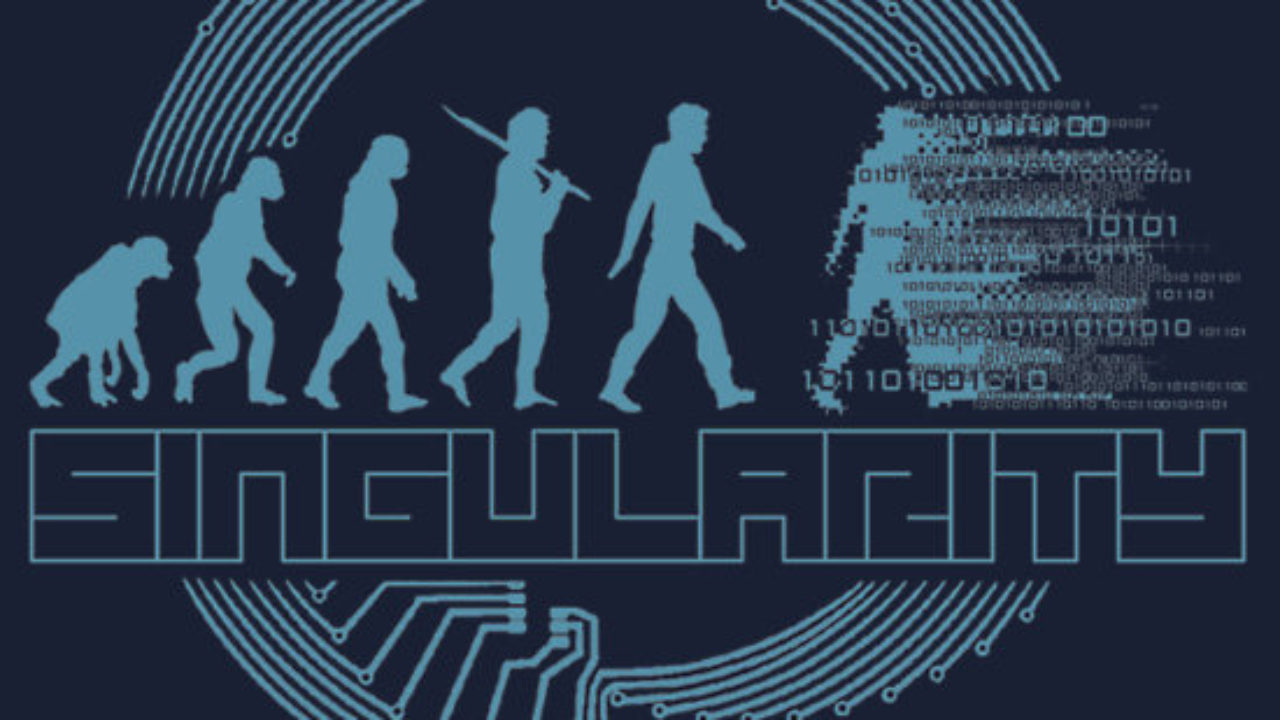
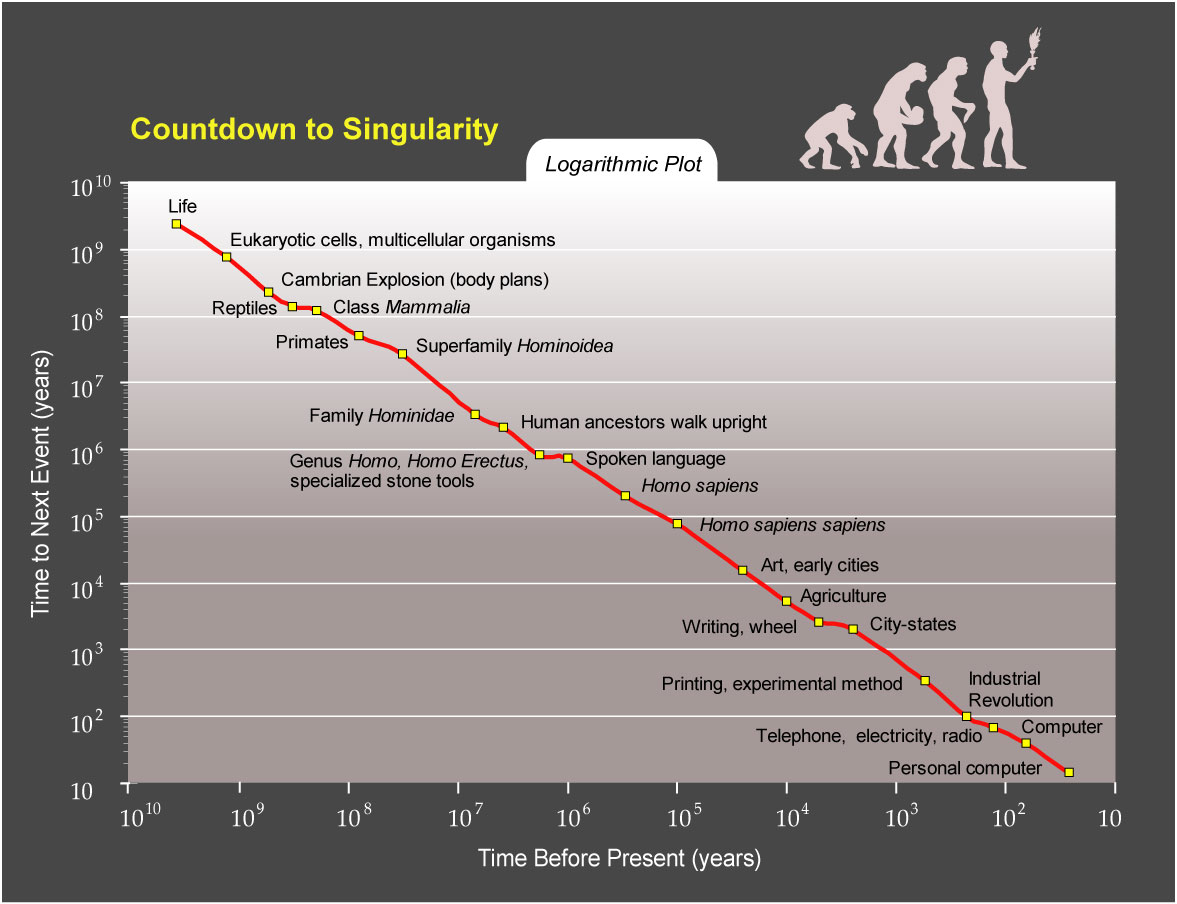
The technological singularity—or simply the singularity—is a hypothetical point in time at which technological growth becomes uncontrollable and irreversible, resulting in unforeseeable changes to human civilization. According to the most popular version of the singularity hypothesis, called intelligence explosion, an upgradable intelligent agent will eventually enter a “runaway reaction” of self-improvement cycles, each new and more intelligent generation appearing more and more rapidly, causing an “explosion” in intelligence and resulting in a powerful superintelligence that qualitatively far surpasses all human intelligence.
Isaac Asimov (the writer) and Stanley Kubrick (the director) were both trying to get across to us, the consumers, that computers (artificial intelligence) could someday take over the world unless we put a stop to IT. Most people saw the book and the film as science fiction, so nothing to really worry about.
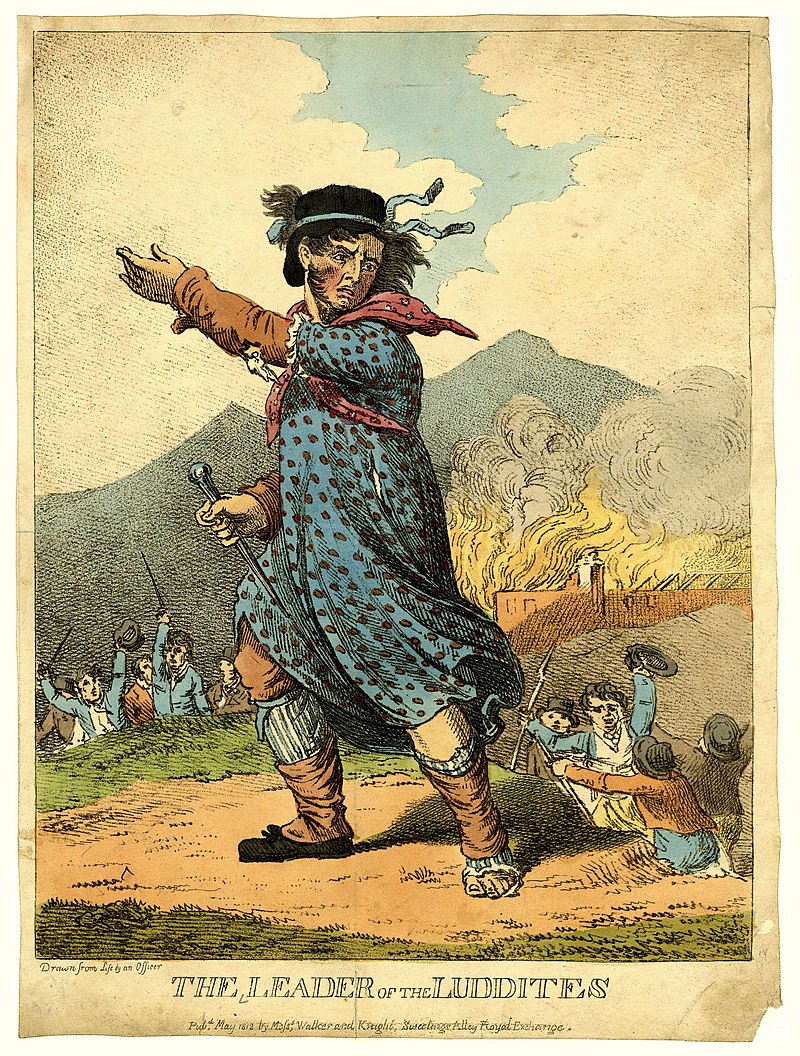
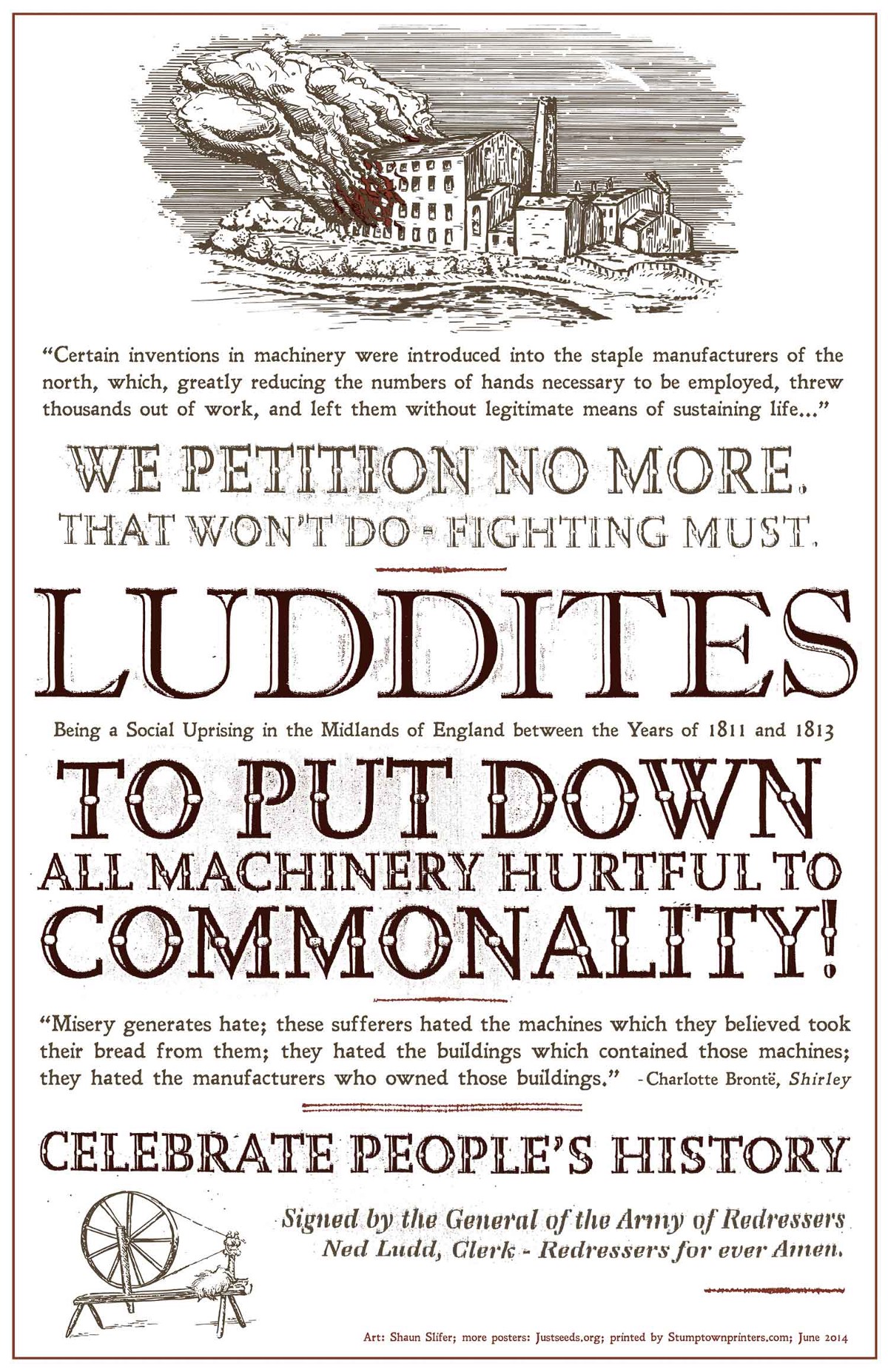
They say he is on an equal footing to Robin Hood: obviously a legend in his own lunchtime. Ned Ludd is not someone we can pin down to do a birth chart for, so we will have to accept his symbolic status.
Supposedly, Ludd was a weaver from Anstey, near Leicester, England. In 1779, either after being whipped for idleness or after being taunted by local youths, he smashed two knitting frames in what was described as a “fit of passion”. This story is traceable to an article in The Nottingham Review on 20 December 1811, but there is no independent evidence of its truth. John Blackner’s book History of Nottingham, also published in 1811, provides a variant tale, of a lad called “Ludlam” who was told by his father, a framework-knitter, to “square his needles”. Ludlam took a hammer and “beat them into a heap”. News of the incident spread, and whenever frames were sabotaged, people would jokingly say “Ned Ludd did it”
This post was inspired by a YouTube video I just watched about Ahriman. OK, you may be asking yourself, what does an ancient Zoroastrian entity have to do with modern man and his evolution?
Here’s the video:
I’ve written about this issue, previously, here. What I hadn’t tackled almost four years ago was how AI would gain traction in peoples’ use of computer technology, and how we are becoming more and more dependent on ‘smart’ electronic equipment to help us run our complex lives. I’d never exactly put my concerns into a spiritual context. That changes here and now.
Transhumanism, social and philosophical movement devoted to promoting the research and development of robust human-enhancement technologies. Such technologies would augment or increase human sensory reception, emotive ability, or cognitive capacity as well as radically improve human health and extend human life spans. Such modifications resulting from the addition of biological or physical technologies would be more or less permanent and integrated into the human body.
In other words, humanity would become the basis for a robotic life force. Unfortunately, this is not very far away in the future. Dan Brown in his book “Origin” suggested that 2050 might be the timing of the start of this singularity.
It’s a sobering thought, is it not? I know everyone wants to live forever, but do you really want to become a robot in order to do that? There is nothing spiritual in this idea. There is no ‘other’ side.
What exactly is Transhumanism?
The movement’s adherents tend to be libertarian and employed in high technology or in academia. Its principal proponents have been prominent technologists like American computer scientist and futurist Ray Kurzweil and scientists like Austrian-born Canadian computer scientist and roboticist Hans Moravec and American nanotechnology researcher Eric Drexler, with the addition of a small but influential contingent of thinkers such as American philosopher James Hughes and Swedish philosopher Nick Bostrom. The movement has evolved since its beginnings as a loose association of groups dedicated to “extropianism” (a philosophy devoted to the transcendence of human limits). Transhumanism is principally divided between adherents of two visions of post-humanity—one in which technological and genetic improvements have created a distinct species of radically enhanced humans and the other in which greater-than-human machine intelligence emerges.
The membership of the transhumanist movement tends to split in an additional way. One prominent strain of transhumanism argues that social and cultural institutions—including national and international governmental organizations—will be largely irrelevant to the trajectory of technological development. Market forces and the nature of technological progress will drive humanity to approximately the same end point regardless of social and cultural influences. That end point is often referred to as the “singularity,” a metaphor drawn from astrophysics and referring to the point of hyperdense material at the centre of a black hole which generates its intense gravitational pull. Among transhumanists, the singularity is understood as the point at which artificial intelligence surpasses that of humanity, which will allow the convergence of human and machine consciousness. That convergence will herald the increase in human consciousness, physical strength, emotional well-being, and overall health and greatly extend the length of human lifetimes.
The second strain of transhumanism holds a contrasting view, that social institutions (such as religion, traditional notions of marriage and child rearing, and Western perspectives of freedom) not only can influence the trajectory of technological development but could ultimately retard or halt it. Bostrom and British philosopher David Pearce founded the World Transhumanist Association in 1998 as a nonprofit organization dedicated to working with those social institutions to promote and guide the development of human-enhancement technologies and to combat those social forces seemingly dedicated to halting such technological progress.
Britannica
So, Who’s with Me?
If your vision of the future of humanity is one where we become more spiritual and therefore less under the control of technology and ‘market’ forces, how can we achieve that? Meditation is one way. Being positive is another. My mother used to quote this saying all the time:
is a term often used to describe people who are totally unalike and often abrasive with one another, yet in their own way are necessary for what they do. It describes personalities who may not mix or do well together because of their differences.
The diversity of people is the joy of life because of the different auric colours they bring to the living though the uniqueness of their personality. Even abrasiveness can be creative.
It is not expected that you should understand all points of view and talents, but richness comes to society as all live together and work on their own part in the process of ongoing creation. This work is never completed and will never end. Creation flows through the Universe and the more diverse the contribution is, the more wonderful is the process.
As more people are able to harness the coming energies, they will be able to enjoy their disparate natures and work together with harmony. It will then be easier to take part in the unfolding of the new times and the Brotherhood of Man.
The visions which will be produced are for all mankind and will bring hope during these chaotic times. The collapse of many systems that people have been relying on reminds you of the transient nature of life on Earth. The illusion that you can be unquestioning and expect to make no effort, that the Universe should provide your future, needs to cease. Action is required from all to create that future which is so desired.
The vision of perfection is singular.
Each has an individual and unique ideal of perfection and with these combined ideas a greater tapestry is born from the ashes of the old. No one can visualise the whole, each only sees a part, and so a greater diversity is produced. Individuality shines through when the vision is in harmony with the soul, and not seen purely from the human perspective with its limited values.
All desire peace and love. There are no exceptions. So, by living daily with those desires the New World begins to take form. If ego is the motivating force, then all that is created will have a limited lifespan and will not endure.
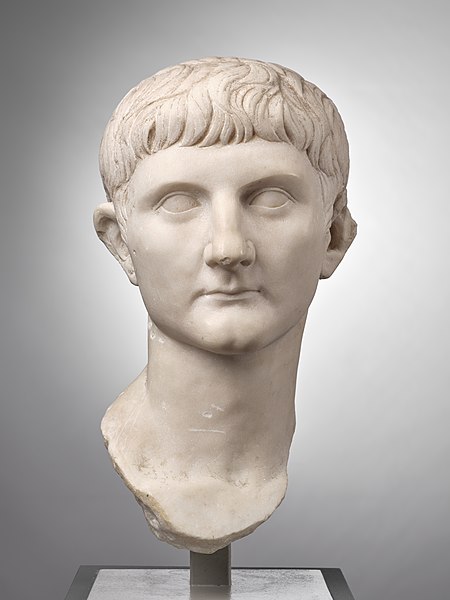
I haven’t given up the search for Crucius, but then I remembered that I hadn’t looked at Germanicus yet.
This chart was originally randomized, but then I decided to rectify it based on the age (34) that he was killed (Mars). I always wonder when the resulting Ascendant is then close to my own @ 18° Sagittarius.
Hmm.
There are two Inconjuncts, neither dependent on a correct time of birth:
Mars Inconjunct Saturn
Sometimes with this aspect there really is someone in your life who discourages you and makes you feel that your efforts are futile. You must learn to avoid negative people who make you feel bad about yourself. Your parents should work very hard to give you self-confidence and show you that you are a valuable and important person.
Jupiter Inconjunct Uranus
You may feel that instead of believing something that others believe, you have to establish your own ideas and values. You may try to be a nonconformist simply for its own sake, which obviously is a waste. The validity of an idea is totally independent of how many people believe it, and it is as bad to automatically reject what others believe as to accept it blindly.
His Death was Two Thousand and Two Years ago Today
I’m writing this on the 10th of October. It seems almost inconceivable that so much time has passed since he was “murdered”. This is what Wikipedia reports:
“He then made his way to Egypt, arriving to a tumultuous reception in January AD 19. He had gone there to relieve a famine in the country vital to Rome’s food supply. The move upset Tiberius, because it had violated an order by Augustus that no senator shall enter the province without consulting the emperor and the Senate (Egypt was an imperial province, and belonged to the emperor). Germanicus entered the province in his capacity as proconsul without first seeking permission to do so. He returned to Syria by summer, where he found that Piso had either ignored or revoked his orders to the cities and legions. Germanicus in turn ordered Piso’s recall to Rome, although this action was probably beyond his authority.
“In the midst of this feud, Germanicus became ill and despite the fact Piso had removed himself to the port of Seleucia, he was convinced that Piso was somehow poisoning him. Tacitus reports that there were signs of black magic in Piso’s house with hidden body-parts and Germanicus’ name inscribed on lead tablets. Germanicus sent Piso a letter formally renouncing their friendship (amicitia). Germanicus died soon after on 10 October of that year. His death aroused much speculation, with several sources blaming Piso, acting under orders from Emperor Tiberius. This was never proven, and Piso later died while facing trial. Tacitus says Tiberius was involved in a conspiracy against Germanicus, and Tiberius’ jealousy and fear of his nephew’s popularity and increasing power was the true motive.
“The death of Germanicus in dubious circumstances greatly affected Tiberius’ popularity in Rome, leading to the creation of a climate of fear in Rome itself. Also suspected of connivance in his death was Tiberius’ chief advisor, Sejanus, who would, in the 20s, create an atmosphere of fear in Roman noble and administrative circles by the use of treason trials and the role of delatores, or informers.”
For his death chart, I set the clock for 12 noon, as I usually do when the exact time is unavailable. As ‘luck’ would have it, Neptune is almost exactly conjunct the Ascendant @ 27° Sagittarius. That has to mean something, right? And at noon, the Moon (in Cancer) was directly opposite Saturn (in Capricorn).
There are some questions, then, as to what really took place. But blaming Sejanus, again, seems to be an attempt to make him retrospectively responsible for all Roman ruling family deaths. Perhaps that is how Tiberius finally got rid of Sejanus. Maybe, Tiberius was the real culprit, after all.
Tears are flowing for the hurts that continue to be experienced in life.
Many lifetimes have passed and some lessons have not been learnt, hence nothing appears to have changed. Segregation and separation still continue, while looking at superficial differences, without realising the underlying truth, that All is One. Judgement and completion are the root causes of much of this, along with a sense of superiority and arrogance. Some lessons are so continuous and resolution of that appears to be impossible. Yes, tears are shed for the lack of compassion and empathy, and with the refusal to accept the brotherhood of man while perpetuating old and cruel attitudes. The missing factor is love.
But times are changing and improvement in relationships is growing. An awakening is beginning to grow with the increase of energies towards a new reality that is on the horizon. The barriers between men are breaking down with new insights.
True forgiveness of others is the mark of awakening consciousness as it shows a deeper awareness for the actions of others, and an understanding towards their reason and rationale. Compassion breaks down the need to judge, and gives space for healing to take place. Forgiveness and compassion for the self comes first and assists in the deeper recognition that all go through life doing the best they can, with the tools and knowledge at their disposal.
A Past Life Regression with Barbara Burgess (October 30, 2012)
My first impression is of wearing sandals
I’m wearing something loose-fitting, like a drape. Toga-like with a belt waist band
Anything on your head? (long hesitation) a kind of crown: a metallic head-dress interchanging (flip-flopping) with a laurel wreath
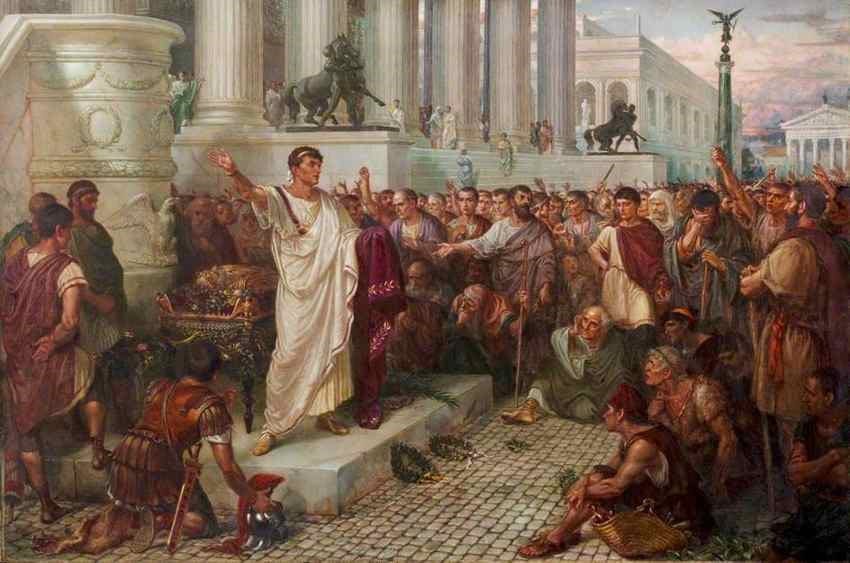
Are you holding anything? “A wooden, elaborately carved rod in my right hand. It has a decorative top to it like an encased ruby … a deep red stone … encased in a wooden nest. Finely carved but smooth to the touch. It looks and feels like some kind of staff of office. In my left hand I have a rolled scroll.” Are you indoors or outside? “I’m standing outdoors at the top of a grand stone staircase with pillars either side. I’m alone but there are military people on either side and behind me, fairly close by. They are all standing erect with what look like spears in their grasp, resting on the floor. I feel no threat, but a sense of camaraderie. There are other people standing behind me.”
Are you surrounded by friends? “Yes, I think so.”
Are there people at the bottom of the staircase? “Yes, I’m about to make a proclamation to people gathering in a public area at the bottom of the steps. We’re all waiting for the appointed moment for the proclamation to be made.”
Do you have any idea what that moment is? (I gave no answer, but then I said) “The proclamation has some kind of military connotation.”
About how old are you? “The number 32 came into my head. Yes, early 30s. I feel it’s a similar age to most of those around me.”
“The weather is calm, warm … a clear blue sky.”
How are you feeling? “Also calm. I feel I’ve done this kind of thing many times before.”
“The pronouncement is about the appointment of a new general: a decision arrived at by me in collaboration with the group of people behind me.”
Quite an important group of people? “Yes, clearly. I’ve now unfurled the scroll and stepped forward to address the public. I’m trying to see the name on the scroll … the name of the newly appointed general. It’s in Latin and it looks like C.R.V.C.I.V.S. (Crucius). My announcement seems to have been greeted with enthusiasm from the people gathered in the forum. I have to say ‘the Senators behind me are echoing the enthusiasm of the people, and congratulating themselves as well.’ The popularity of the appointment of Crucius was not a forgone conclusion, but I have now announced he has been assigned to a campaign in Gaul and is to make his way there without delay, with a large contingent of legionnaires and supplies. The people disperse and I turn to join the group of Senators. We retire to the great hall to take refreshment, and the centurion body guard takes-up new positions.”
What colour is your toga? “Predominantly white with a striking double purple edge. The outer (broad) edge has a narrow, inner purple line running parallel to it. All of those (15-20 others) who were gathered behind me were dressed similarly, and most of them had purple edging to their togas. Those that didn’t (4 or 5 of them) had a reddish coloured edging to their togas. I appear to be the only one wearing a toga with a double purple edge. I guess that denotes some degree of seniority.”
Do you know your name? “I’m trying to reject it because it’s such a well-known name, and one I don’t feel particularly happy with … Nero. I’m trying to work-out if it’s something similar to Nero but with a different sound.”
At this point Barbara said not to worry, as she wanted me to move-on.
After counting 1-2-3 she asked me Where are you now? After some delay, I said, “I’m a long, long way from Rome. It’s somewhere in what we now call Europe … Gaul. It’s dusk, and I’ve come to support Crucius and his army who have been caught-up in some battles. Crucius sent a messenger to me calling for help and, in great haste, I put together a large contingent and marched north to support him. I’m now dressed in military garments, quite heavy duty stuff, including a hefty helmet with a large red adornment at the top. Crucius and I are standing in a tent in candle light with some of Crucius’ junior officers and we’re studying what looks like a map. They all seem to be deferring to me, but I’m trying to encourage them to make their own observations as to how we might bring the local and troublesome tribal elements under control.”
You seem to have had a lot of experience at this sort of thing? “Yes, it would appear so. I’ve earned my senator’s toga through military campaigns stretching back quite a few years, although I’m only 32 … no, I’m not … I’m now 35. Clearly, my earlier campaigns have been successful, yet I still feel ready and willing to come to the aid of a friend and his endangered garrison.”
At this point Barbara asked if anything else was happening? I said no, so she counted 1-2-3 again Is it day or night? “It’s very early morning, the grey light of dawn. Crucius and I are on horseback leading a column of men on the march towards a trouble spot. Scouts were sent out earlier, but they haven’t returned. I’ve halted the column and ordered the forming of a defensive formation. We’re in a gulley in a wooded area on a well-worn pathway. I’ve sent out detachments into both sides of the wood and I’m following one of them. Suddenly five members of the scouting detachment sent-out earlier appear with three prisoners. They’ve been discovered hiding in readiness for an ambush. I call for an interpreter and send them to the rear of the column for interrogation.”
Note: A lot more military manoeuvring takes place under my and Crucius’ direction over the next few minutes, and our plans succeed. As ordered, the legionnaire detachments surprise the main group of hostiles with a pincer movement and return to Crucius and me with yet more prisoners. Before they set-out I had insisted I didn’t want a blood bath and my soldiers followed those orders to the letter. The new prisoners were, likewise, sent to the rear for interrogation, after which they would be taken to Rome and sold as slaves. That evening, Crucius and I spent time among the prisoners and we discovered a chieftain had been captured. We questioned him via our interpreter and, in the end, he agreed he should accompany Crucius and me to a meeting of the other elders in his village. That visit is successful and results in a peace pact. Crucius and I celebrate that evening in my tent “toasting each other with quite a big jar of wine and some fruit”. The following morning I receive a request to return to Rome without delay.
Barbara takes us to the next phase … 1-2-3
What’s happening now? “I’m back in Rome and it’s rather troublesome. While I was away a conspiracy against the emperor was uncovered. I’ve been warned by some of my colleagues that I’ve been implicated in the conspiracy. But how could I have been involved in a conspiracy while I was hundreds of miles away? I know nothing of it.”
Note: at this point I referred to the emperor by name as “Nero”. And I added “he’s started a witch hunt … he’s a madman … and one whose name I share”.
Are you frightened? My (chuckling) reply is, “Yeah … knowing Nero, one has every reason to be frightened. I’m being advised by my aids to make myself scarce, but I tell them there are things to do here in Rome and I’m confident of being able to persuade Nero I have nothing to do with the conspiracy. I’m going to try and reason with him and his appointed judges. Hopefully I will be able to convince them that I’m as shocked as they are about the conspiracy.”
Moving forward in time, how did that go? “Badly … badly. I’m in a cell with others.”
Do you know those others? “I know some of the faces and I know some of the names, but I don’t know that I could point to any of them and say ‘here’s somebody I know very well’. They’re all vague acquaintances.
What’s happening in that cell? “It’s a pretty filthy place to be. There’s not a lot anyone can do in these circumstances but sit and ponder … and wonder why.”
Have they decided that you’re guilty? “I don’t think any of us have been tried yet. As far as I can make-out there has been no attempt to uncover the conspiracy either in public or private. A group of people – me included – have been rounded-up on flimsy evidence. Quite what’s going to happen to us I don’t know. Nero is paranoid … he’s mad. For all his poetry, his singing, his dancing, he’s not a nice person and one has to bear that in mind. It doesn’t look good for any of us in this cell.”
Are you fearful for your life? “Yes”
Is there anyone you’re thinking of? “My wife who I’ve seen so little of over the past few years. It’s at moments like this I realise how much I’ve missed her company.”
Is there anything else happening? “This cell is a very troubled place. I can hear movement outside and, along with most of us in the cell, I’m beginning to back-off and fear for my life. Sure enough … the doors of the cell have been flung open and there are a bunch of scruffy looking mercenaries facing us. They’ve all got swords and daggers. We’ve got nothing. What does one do in such circumstances?” Do you put-up a fight? “Most of those in the cell are looking at me for some kind of guidance. The only thing I can do … I think I can see the ring leader of the group and I’ve rushed him in a desperate attempt to disarm him, but I’ve failed. He’s skewered me in the belly with his sword and swiftly stabbed me in the neck with his dagger. I’m still struggling with him, but I realise my life is ebbing away, my strength is going. I’ve got my hands around his throat but I can’t bring any pressure to bear with my fingers. He’s sort of smiling at me as if to say, “Go on try it … you haven’t got the strength”. And with that, he thrust his dagger in my neck again and now everything has gone black.”
Was that the moment you breathed your last breath? “Yes”
What was the last thought in your mind as you breathed your last breath? “I feel as if I’m smiling. So this is what death is all about? And I’m feeling a great weight being lifted off my shoulders. All the responsibility I’ve had has been released and, in its place, there’s a sense of freedom”
And as you breathe your last breath and your soul leaves your body for the last time, do you stay with your body, or do you leave immediately? “Strangely, I feel I am in one of the tightest corners of the cell, looking down on what’s happening. I recognise my own body. I tried to defend myself … and my innocence. But what can you do against an armed rabble? All of the other prisoners have been dispatched. In fact I sense that one or two of them are with me here in this tight little corner of the cell and we’re looking down at the rabble wiping their swords and daggers, cleaning them of the innocent blood they’ve just shed.”
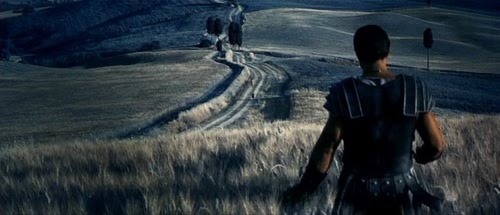
Do you stay there with the bodies for long or do you move on? “No, I’ve just thought, I don’t want to be here anymore, and I’m not. I’m out in a cornfield … a beautiful place. I’ve just seen a tree in the distance and thought, what a beautiful tree. I must take a closer look at it. And there I was in an instant! I’m now sitting under that tree. I know I’ve died. I know I’ve moved from that physical existence into a completely different sphere. This is the afterlife they spoke of … our priests told us about. And it’s not bad.”
Image from “Gladiator”
Do you stay on the earth plain for long, or do you move into the light? “In fact, as I sat under the tree I looked into the distance towards the horizon. The sun was quite high in the sky, but the brightness of that horizon was unimaginable. I just had to go and investigate and I found myself on a little green hill, looking at a bridge over a brook. And I could see some people over the other side of the bridge. First among them, I recognised my mother, and standing beside her, my father and my grandparents each side of them. And my little sister who died at the age of six. So many other faces I remember from my earlier years … relatives, friends … they’re all smiling, waving, beckoning.”
“I’m crossing over the bridge, and I’ve reached the other side. They all surge forward, my mother first. It’s such a happy reunion. I haven’t got enough length in my arms to embrace them all at once, so I embrace them two at a time. But I keep hold of my Mum. This is such a joyous experience. It is much, much more than the priests told us it would be like. Such happiness. I just can’t find the words to express.”
Before you bid farewell to the life you’ve just left, is there anyone from that life you’d like to leave a message for? Crucius for example? Something you never had a chance to say to him? “My memory is not that good and I may have said this to Crucius during our campaigning together, but I must say to him ‘thank you for you comradeship’. Comradeship like that is so important, not only in a military sense, but in a humanitarian sense too. That two grown men can bond with each other like brothers, yet not be brothers is remarkable. We didn’t have much in common. We didn’t look anything like each other. He was quite short and tubby. I was a lot taller than him and (dare I say it) more muscular. But, then, I’d probably had more opportunity to properly exercise my body over the years than he had. We were like chalk and cheese in many ways, but when it came to matters military, we were blood brothers.”
Note: Under Barbara’s guidance, I then moved forward several years to rejoice over the way I had still been able to ‘join’ Crucius mind-to-mind on some of his military exploits and even get subliminal impressions of what action to take, through to him, when he was in tricky situations on the battlefield. “These moments took our relationship onto a different level. They were invaluable experiences for me … him still in his body, me out of mine. But we were still working together. That’s good. I promise myself, I will be near or at the front of those waiting to greet him when it’s his turn to cross over that bridge.”
Now, the rabble who broke into the cell and killed you. Is there anything you’d like to say to them? “I understand their actions. I forgive them. They were as afraid for their lives as I was for mine, but they had the advantage of weapons. They were asked to do a job at pain of death, and they did it. I understand what they did and why they did it, and I forgive them.”
Is there anyone else you’d like to talk to from that life? “Yes, my wife Lucrecia. I know I had to spend a lot of time away from you, but that never diminished my love for you. Not one jot.”
I would now like your spirit guide to come in to review the life you’ve just left … “Life is one battle after another. One campaign after another, but to succeed in life you must take responsibility for your actions. There is a purpose to every event in your life: good, bad or indifferent. And from that life’s perspective, what I’m saying is ‘you rose to quite a lofty height but, unlike many others, the power you had didn’t corrupt you.’ Most important of all, you remained true to yourself. These are all major objectives in life … take responsible for your actions, don’t allow power to corrupt and, above all, remain true to yourself.”
Can the spirit guide tell you what connection he has to your current life? “There is no connection. Not with this particular incarnation. He’s telling me there are other incarnations that have a direct connection with my present incarnation.”
Is there some reason you were shown this particular incarnation? “He’s just said to me … ‘it just proves it’s not all bad’ (Barbara laughed). And he’s corrected himself. ‘Come to think of it, there is a connection … when the chips are down, you’re a good tactician.’
Does your guide have a name? “Name, hmmm … I’m questioning it, and he’s said … ‘look, it sounds the same, but it’s spelt differently … it’s Zenn … Z.E.N.N.’”
Before we leave the spirit realm is there anything else Zenn would like to say to you? “He’s just repeated, ‘be true to yourself.’” Barbara then asked me to remain in that lovely place for a short while longer, then slowly brought me back into full consciousness.