Carlos Castaneda: In His Own Words

selfimportance1

Introduction to The Wheel of Time*

This series of specially selected quotations was gathered from the first eight books that I wrote about the world of the shamans of ancient Mexico. The quotations were taken directly from the explanations given to me as an anthropologist by my teacher and mentor don Juan Matus, a Yaqui Indian shaman from Mexico. He belonged to a lineage of shamans that traced its origins all the way back to the shamans who lived in Mexico in ancient times.

In the most effective manner he could afford, don Juan Matus ushered me into his world, which was, naturally, the world of those shamans of antiquity. Don Juan was, therefore, in a key position. He knew about the existence of another realm of reality, a realm which was neither illusory, nor the product of outbursts of fantasy. For don Juan and the rest of his shaman-companions — there were fifteen of them — the world of the shamans of antiquity was as real and as pragmatic as anything could be.

This work started as a very simple attempt to collect a series of vignettes, sayings, and ideas from the lore of those shamans that would be interesting to read and think about, but once the work was in progress, an unforeseeable twist of direction took place: I realized that the quotations by themselves were imbued with an extraordinary impetus. They revealed a covert train of thought that had never been evident to me before. They were pointing out the direction that don Juan’s explanations had taken over the thirteen years in which he guided me as an apprentice.

Better than any type pf conceptualization, the quotations revealed an unsuspected and unwavering line of action that don Juan had followed in order to promote and facilitate my entrance into his world. It became something beyond a speculation to me that if don Juan had followed that line, this must have also been the way in which his own teacher had propelled him into the world of shamans.

A Different Cognitive System

Don Juan Matus’s line of action was his intentional attempt to pull me into what he said was another cognitive system. By cognitive system, he meant the standard definition of cognition: “the processes responsible for the awareness of everyday life, processes which include memory, experience, perception, and the express use of any given syntax.” Don Juan’s claim was that the shamans of ancient Mexico had indeed a different cognitive system than the average man’s.

Following all the logic and reasoning available to me as a student of the social sciences, I had to reject his statement. I pointed out to don Juan time and time again that whatever he was claiming was preposterous. It was, to me, an intellectual aberration at best.

It took thirteen years of hard labor on his part and on mine to discombobulate my trust in the normal system of cognition that makes the world around us comprehensible to us. This maneuver pushed me into a very strange state: a state of quasi-mistrust in the otherwise implicit acceptance of the cognitive processes of our daily world.

After thirteen years of heavy onslaughts, I realized, against my very will, that don Juan Matus was indeed proceeding from another point of view. Therefore, the shamans of ancient Mexico must have had another system of cognition. To admit this burned my very being. I felt like a traitor. I felt as if I were voicing the most horrendous heresy.

Seeing Energy Flow

When he felt that he had overcome my worst resistance, don Juan drove his point as far and as deep as he could into me, and I had to admit, without reservations, that in the world of shamans, shaman practitioners judged the world from points of view which were indescribable to our conceptualization devices. For instance, they perceived energy as it flowed freely in the universe, energy free from the bindings of socialization and syntax, pure vibratory energy. They called this act seeing.

Don Juan’s prime objective was to help me to perceive energy as it flows in the universe. In the world of shamans, to perceive energy in such a manner is the first mandatory step toward a more engulfing, freer view of a different cognitive system. In order to elicit a seeing response in me, don Juan utilized other foreign units of cognition. One of the most important units, he called the recapitulation, which consisted of a systematic scrutiny of one’s life, segment by segment, an examination made not in the light of criticism or finding flaw, but in the light of an effort to understand one’s life, and to change its course. Don Juan’s claim was that once any practitioner has viewed his life in the detached manner that the recapitulation requires, there’s no way to go back to the same life.

To see energy as it flows in the universe meant, to don Juan, the capacity to see a human being as a luminous egg or luminous ball of energy, and to be able to distinguish, in that luminous ball of energy, certain features shared by men in common, such as a point of brilliance in the already brilliant luminous ball of energy. The claim of shamans was that it was on that point of brilliance, which those shamans called the assemblage point, that perception was assembled. They could extend this thought logically to mean that it was on that point of brilliance that our cognition of the world was manufactured. Odd as it may seem, don Juan Matus was right, in the sense that this is exactly what happens.

Some Energetic Facts

The perception of shamans, therefore, was subject to a different process than the perception of average men. Shamans claimed that perceiving energy directly led them to what they called energetic facts. By energetic fact, they meant a view obtained by seeing energy directly that led to conclusions that were final and irreducible: they couldn’t be tampered with by speculation, or by trying to fit them into our standard system of interpretation.

Don Juan said that for the shamans of his lineage, it was an energetic fact that the world around us is defined by the processes of cognition, and those processes are not unalterable: they are not givens. They are a matter of training, a matter of practicality and usage. This thought was extended further, to another energetic fact: the processes of standard cognition are the product of our upbringing, no more than that.

Don Juan Matus knew, beyond the shadow of a doubt, that whatever he was telling me about the cognitive system of the shamans of ancient Mexico was a reality. Don Juan was, among other things, a nagual, which meant, for shaman practitioners, a natural leader, a person who was capable of viewing energetic facts without detriment to his well-being. He was, therefore, capacitated to lead his fellow men successfully into avenues of thought and perception impossible to describe.

Understanding Intent

Considering all the facts that don Juan had taught me about his cognitive world, I arrived at the conclusion, which was the conclusion that he himself shared, that the most important unit of such a world was the idea of intent. For the shamans of ancient Mexico, intent was a force they could visualize when they saw energy as it flows in the universe. They considered it an all-pervasive force that intervened in every aspect of time and space. It was the impetus behind everything: but what was the inconceivable value to those shamans was that intent — a pure abstraction — was intimately attached to man. Man could always manipulate it. The shamans of ancient Mexico realized that the only way to affect this force was through impeccable behavior. Only the most disciplined practitioner could attempt this feat.

Infinity Beyond Time

Another stupendous unit of that strange cognitive system was the shamans’ understanding and usage of the concepts of time and space. For them, time and space were not the same phenomena that form part of our lives by virtue of being an integral part of our normal cognitive system. For the average man, the standard definition of time is “a nonspatial continuum in which events occur in apparently irreversible succession from the past through the present to the future.” And space is defined as “the infinite extension of the three-dimensional field in which stars and galaxies exist: the universe.”

For the shamans of ancient Mexico,, time was something like a thought: a thought thought by something unrealizable in its magnitude. The logical argument for them was that man, being part of that thought which was thought by forces inconceivable to his mentality, still retained a small percentage of that thought: a percentage which under certain circumstances of extraordinary discipline could be redeemed.

Space was, for those shamans, an abstract realm of activity. They called it infinity, and referred to it as the sum total of all the endeavors of living creatures. Space was, for them, more accessible, something almost down-to-earth. It was as if they had a bigger percentage in the abstract formulation of space. According to the versions given by don Juan, the shamans of ancient Mexico never regarded time and space as obscure abstracts the way we do. For them, both time and space, although incomprehensible in their formulations, were an integral part of man.

The Wheel of Time

Those shamans had another cognitive unit called the wheel of time. The way they explained the wheel of time was to say that time was like a tunnel of infinite length and width, a tunnel with reflective furrows. Every furrow was infinite, and there were infinite numbers of them. Living creatures were compulsorily made, by the force of life, to gaze into one furrow. To gaze into one furrow alone meant to be trapped by it, to live that furrow.

A warrior’s final aim is to focus, through an act of profound discipline, his unwavering attention on the wheel of time in order to make it turn. Warriors who have succeeded in turning the wheel of time can gaze into any furrow and draw from it whatever they desire. To be free from the spellbinding force of gazing into only one of these furrows means that warriors can look in either direction: as time retreats or as it advances on them.

Viewed in this manner, the wheel of time is an overpowering influence which reaches through the life of the warrior and beyond, as is the case with the quotations of this book. They seem to be strung together by a coil that has a life of its own. That coil, explained by the cognition of shamans, is the wheel of time.

Under the impact of the wheel of time, the aim of this book became, then something that had not been part of the original plan. The quotations became the ruling factor, by themselves and in themselves, and the drive imposed on me by them was one of staying as close as I possibly could to the spirit in which the quotations were given. They were given in the spirit of frugality and ultimate directness.

Organizing Principles

Another thing that I tried unsuccessfully to do with the quotations was to organize them into a series of categories that would make reading them easier. However, the categorization of the quotations became untenable. There was no way of setting arbitrary categories of meaning that suited me personally to something so amorphous, so vast as a total cognitive world.

The only thing that could be done was to follow the quotations, and let them create a sketch of the skeletal form of the thoughts and feelings that the shamans of ancient Mexico had about life, death, the universe, energy. They are reflections of how those shamans understood not only the universe, but the processes of living and coexisting in our world. And more important yet, they point out the possibility of handling two systems of cognition at once without any detriment to the self.


 

* Published by Washington Square Press – Toronto – 1998 (pp 1-9)

Posted in reviews | Tagged , , , , | Comments Off on Carlos Castaneda: In His Own Words

Big Corporations vs Big Labour Unions

General Motors Plant in Oshawa

Closure of the Oshawa Car Assembly Plant

Another hundred-year-old story is coming to a close. And Unifor is not happy about it. Well, that’s what happens when you give your whole life to the company store.

General Motors has been associated with Oshawa for more than 110 years, the car assembly plant since 1953. Whole families have been employed there, and Oshawa has been a one-plant location since forever, it seems.

But in recent years, there have been layoffs, and the writing has been on the wall since 2014. GM has had a bailout or two since 2008, and that allowed them to continue employing workers, but GM only promised to keep the assembly plant open until 2020. Now they’re closing it in December 2019, and the Unifor’s National President, Jerry Dias, vows to fight GM to the bitter end.

Lessons Learned?

In the 1980’s, the UK decided to close down their coal mines. Arthur Scargill, President of the National Union of Mineworkers (NUM) challenged the Thatcher government by holding a series of strikes during 1984-85. The government won, in the end, and the coal mines wee closed. So much for fighting the government, eh?

In this country, the Harper government attempted to appease GM (and other auto makers) by bailing them out of the financial mess they were in. In the end, this will also come to nothing, as the world needs to clean up its act, and fossil fuels need to be phased out. This will happen, whether the humble men who do the work want it to or not.

Shareholders

The stock market liked the GM announcement: it means that there will be more money for dividends, once the waste of money cars are stopped. They have no interest in what happens to the ‘little guy’. They only worry about themselves.

Governments

Trump says he was ‘very tough’ on the CEO of GM. His promises to keep GM jobs in Ohio have come undone. I suppose that’s political shorthand for “It’s not my fault!”

Doug Ford’s “Ontario is open for business” looks hollow, too. Poor guy: he thought he’d be the saviour of the province.

Conclusion

But it’s not the end of the world, folks. Something new, and better, will come along. It always does.

And the David and Goliath fight will turn out to be a skirmish. Really.

You read it here first.

Posted in history | Tagged , , , , , | Leave a comment

The Snowman and the Star

DSCN1368

Posted in personal | Tagged , , , | Leave a comment

Is This a Turning Point?


Sundown for Sedans?

Today, GM announced the ‘unallocation’ of four automotive plants in the US and one in Canada. Our in-house reaction was “Why do they always announce these things just before Christmas?” A CBS newscast tonight pointed out the obvious American perspective: GM announced this on the first day back to work from their Thanksgiving weekend holiday.

This announcement follows news that Ford was going out of the sedan business. Ford plans to concentrate on SUV’s and trucks.

GM wants to concentrate on electric and self-driving cars.

It’s all changing, folks.

Posted in paranoia | Tagged , , , , , | Leave a comment

Carlos Castaneda Quotes 4

86d1e3caea1b4fcb1baafa903a2dc5ad

The Eagle

On Parenting

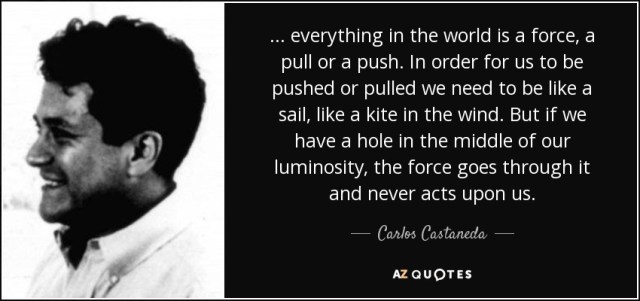
This is proving to be a bit of a stretch, trying to locate the quote about how a hole in our luminosity occurs when we become parents. It haunts me, because I know when I read it, it made perfect sense.

The gist of the text is that fibers of awareness emanate from the gut area of our bodies. These are our link with the manifest world. But once we have a child, that connection is broken: the child then becomes our emissary instead. And a hole appears as a dark spot in the centre of our luminous ‘egg’.

This, then, is the result:

quote-everything-in-the-world-is-a-force-a-pull-or-a-push-in-order-for-us-to-be-pushed-or-carlos-castaneda-138-56-47

 
“My benefactor told me that my father and mother had lived and died just to have me, and that their own parents had done the same for them. He said that warriors were different in that they shift their assemblage points enough to realize the tremendous price that has been paid for their lives. This shift gives them the respect and awe that their parents never felt for life in general, or for being alive in particular.”
― Carlos Castaneda, Fire from Within
.
bc96c77e4e4aa09d57b44f9d544001e6--the-challenge-quotes-about
carlos-castaneda-590850
Posted in paranoia, spirituality | Tagged , , , , | Leave a comment

You’re Talking My Language

Text of an undated talk given by my father, James Ewart Miller

30154-babel.800w.tn

The Tower of Babel

Remember the story of the tower of Babel where men tried to build a tower that would reach to heaven? Those ancient people were engaged in an unworthy enterprise. They were trying to make gods of themselves. When they couldn’t understand each other’s languages, their plans were thwarted. Being unable to communicate, they could no longer cooperate. The building of the tower had to stop.

Suppose that men have a worthy goal. Suppose that we strive in our day for such ideals as justice, brotherhood, and peace. The achievement of the goal will never come to pass unless men, regardless of color or religion or political party, learn to speak the same language. Take the word “democracy”, for example: when a Canadian talks about democracy he is apt to mean one thing; when a Russian talks about democracy he is almost certain to mean another. Is it any wonder that in many areas of life men cannot cooperate? The failure of mankind to achieve the worthy goals for which it has often striven, results from a failure of communication, for there is no common language among the broken fragments of the family of man.

The Good Samaritan

the-parable-of-the-good-samaritan-1575-francesco-bassano

The language of deeds is understood by all. This point is illustrated in the story of the good Samaritan. The gulf between the Jews and the Samaritans was bridged in Jesus’ story by a kindly deed. The Samaritan in the story did not try to communicate with the Jew in speech. He dispensed with the language of words and substituted the language of deeds. He went to him and picked him up. He washed and bandaged his wounds. Then he put him on his own beast. The story does not record a single word that passed between them. Even if words had been possible they would not have been necessary. The language of deed was all that was required. The language of deeds is the common language that all men understand. By means of this language it is possible to communicate across the chasms that separate the fragments of the family of man.

Pentecost

3171298293

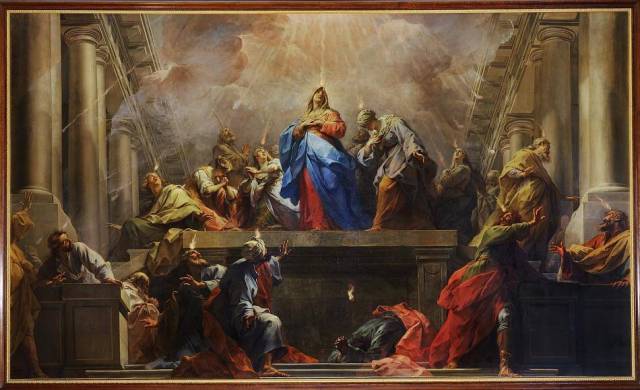
There is a third story in the Bible which has to do with the subject of language; like the other two it is, in a sense, a parable. The Book of Acts tells us that the disciples of Jesus did not begin to preach immediately after the resurrection. They were still confused by what had happened and they were also, without doubt, afraid to show themselves in public. But on the day of Pentecost they were suddenly emboldened to preach the good news of Jesus in the open street. It was Peter who first did this. He went out of the house where they were gathered and began to address the people passing by. He told them the story of Jesus. As he spoke, men stopped to listen. They had come, we are told, from many different places. They all spoke different languages. But although Peter spoke to them in the common Jewish tongue of Aramaic, they were all able to understand him. And they exclaimed in amazement, we are told, when they discovered that his words were being miraculously translated … in mid-air so to speak … into their own tongues.

What is the meaning of this?

2011 Story of Jesus

Does it mean, at least, that the story of Jesus proved to have a universal meaning? Those early apostles spoke the story in words and deeds. It did not matter where a man might have come from; when he heard the story of Jesus spoken in loving words and kindly deeds, he said to the teller, “Mister, you’re talking my language.” Most likely the language of deeds was more convincing than the language of words.

The story of Jesus is a universal language. It talks about the common terms upon which the alienation dividing man from man can be brought to an end, and the broken fragments of the family of man can be brought back together again to become the one family of God.

Posted in family, spirituality | Tagged , , , , , | 2 Comments

ω: Double Ur Fun

47a2882609936_16616n

Wrigley’s Doublemint Gum

We probably all remember the words to this advertisment:

Double your pleasure / Double your fun / with Doublemint, Doublemint, Doublemint gum.

Well, it’s being recited here because I want to discuss the letter W.

Double U

In spite of the fact that it is really a ‘double V’ (even the French say double vé), we call the letter ‘double u’. Have you ever wondered why?

Was it because of cursive writing?

Or is this again just a direct transliteration of the Greek letter omega, (OMG) in lower case?

Whatever the reason, it is a very useful letter in the English alphabet.

W5

In Canada we have a weekly news program on CTV that asks the “W” questions:


They could have also included “How?” since it has a W, too.

WoW!

Is it too much to have two W’s in one three-letter word? The word ‘wow’ gives us a picture of an open mouth with two open hands bracketing it, as if it’s shouting out the word, like a megaphone. There’s many a time where that’s about all anyone can say…

(W)rite or (W)rong

The silent nature of the letter ‘w’ lets it be present but without a sound, except in breathing.

ΙΑΩ (Iota Alpha Omega) is a case in point: Father-Son-Holy Spirit is an inherent concept like breathing. It has always been there in the Trinity, but our usual thinking process wants to separate it into three components: in-breath, hold, out-breath. In truth, you cannot have any one part without the other two. But we insist on separation, don’t we?

Conclusion

The next time you order a ‘double-double’ at Tim Horton’s think about what you’re really saying: we all just want to have fun.

Posted in paranoia, personal | Tagged , , , , , , , | Leave a comment

Carlos Castaneda Quotes 3

untitled_drawing_by_kristina070-d5wgrf3

Girl on Fire by Kristina070 on DeviantArt

Death

“It doesn’t matter how one was brought up. What determines the way one does anything is personal power. A man is only the sum of his personal power, and that sum determines how he lives and how he dies.” (Journey to Ixtlan)

“To cross over to freedom does not mean eternal life as eternity is commonly understood — that is, as living forever. Rather, warriors can keep their awareness, which is ordinarily relinquished at the moment of dying. At the moment of crossing, the body in its entirety is kindled with knowledge. Every cell at once becomes aware of itself and also aware of the totality of the body.” (The Eagle’s Gift)

“Warriors who deliberately attain total awareness are a sight to behold. That is the moment when they burn from within. The fire from within consumes them. And in full awareness they fuse themselves to the emanation of the Eagle at large, and glide into eternity.” (The Fire From Within)

Posted in spirituality | Tagged , , , , , | Leave a comment

Carlos Castaneda Quotes 2

ChakraLuminousEgg

Chakra Luminous Egg

Round Luminous Beings

“Human beings are not objects; they have no solidity. They are round, luminous beings; they are boundless. The world of objects and solidity is only a description that was created to help them, to make their passage on earth convenient.” (Tales of Power)

“When they are seen as fields of energy, human beings appear to be like fibers of light, like white cobwebs, very fine threads from the head to the toes. Thus to the eye of the seer, a man looks like an egg of circulating fibers. And his arms and legs are like luminous bristles, bursting out in all directions.” (A Separate Reality)

Posted in spirituality | Tagged , , , | 1 Comment

Carlos Castaneda Quote 1

f35dbadd24aae976a631233f28b24562

We must balance the linearity of the known universe with the non-linearity of the unknown universe

Catching a Glimpse

“In the Art of Dreaming Don Juan tells Carlos, “… most of our energy goes into upholding our importance… if we were capable of losing some of that importance, two extraordinary things would happen to us. One, we would free our energy from trying to maintain the illusory idea of our grandeur; and two we would provide ourselves with enough energy to … catch a glimpse of the actual grandeur of the universe.”” ~ Carlos Castaneda

Posted in spirituality | Tagged , , , , , | 1 Comment