This is an uncomfortable question. Most people deny that there is even such a thing as reincarnation, let alone splitting a soul in two to double its chances of success.
But I’ve experienced it too many times in my past life research to ignore this concept.
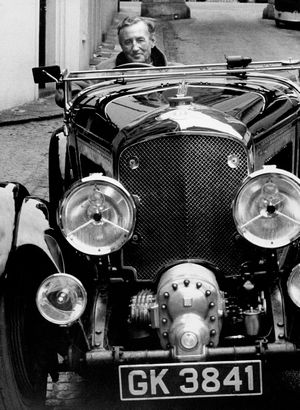
Two great double acts in history that I know about are seemingly connected to me:
It’s not that I’m being greedy, it’s just that collaboration makes my labours worthwhile. Even in this life, I’ve worked with my friend, David, since the early 1990’s and it seems that at one point in the early 20th century, we (jointly) may have been “Ramsay“.
“Most of my colleagues who work with past life clients have listened to overlapping time chronologies from people living on Earth in two places at once. Occasionally, there are three or more parallel lives. Souls in almost any stage of development are capable of living multiple physical lives, but I really don’t see much of this in my cases. Many people feel the idea of souls having the capacity to divide in the spirit world and then attaching to two or more human bodies is against all their preconceptions of a singular, individualized spirit. I confess that I too felt uncomfortable the first time a client told me about having parallel lives. I can understand why some people find the concept of soul duality perplexing, especially when faced with the further proposition that one soul may even be capable of living in different dimensions during the same relative time. What we must appreciate is, if our souls are all part of one great over-soul energy force which divides, or extends itself to create our souls, then why shouldn’t the offspring of this intelligent soul energy have the same capacity to detach and then recombine?” Chapter Ten The Intermediate Soul” ― Michael Newton, Journey of Souls: Case Studies of Life Between Lives
There, does that help to explain what I’m trying to say?
The more I research this particular subject matter, the more it seems to be true. Take the text from this online site:
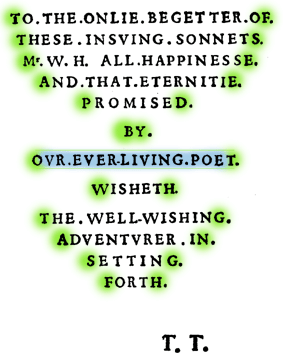
The Dedication to the Sonnets
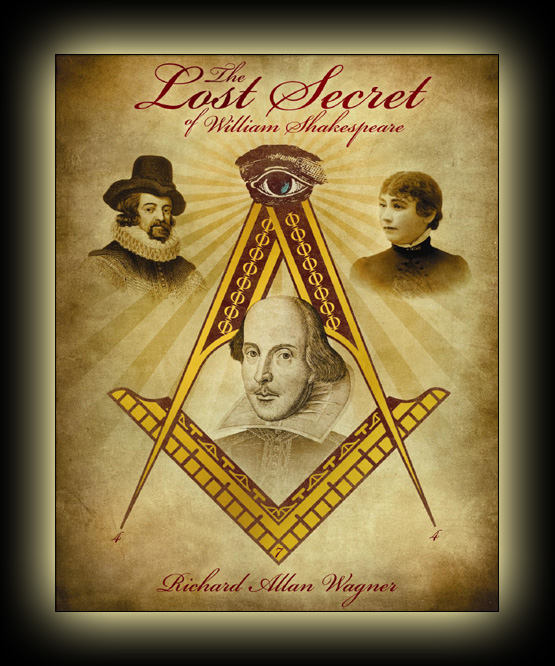
The dedication prefixed to Shakespeare’s Sonnets is one of the most enigmatic pieces of prose in the English language. The reason for its convoluted syntax is explained by the fact that it is an intricate cryptogram. Gematria considerations play a key role in distorting the phraseology.
When examining its numerology, one figure sticks out above all others – 2120. This number encapsulates the dedication because it forms the sum of the first and last letters on each of the 12 lines (in green). 2120 is also found as the exact value of the 7th line – the line at the heart of the dedication explicitly referring to the author (in blue):
The value of the ‘outside’ letters T F T S M E A E P D B Y O T W H T G A N S G F H is: 100 + 6 + 100 + 90 + 30 + 5 + 1 + 5 + 60 + 4 + 2 + 400 + 50 + 100 + 900 + 8 + 100 + 7 + 1 + 40 + 90 + 7 + 6 + 8 = 2120
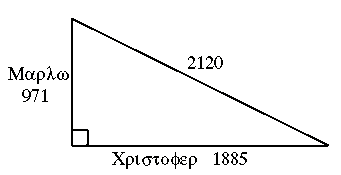
The reason why Christopher Marlowe is ‘Our ever-living poet’ resides in the way that 2120 squares his name by means of a right-angled triangle. Such a triangle whose perpendicular members measure 971 and 1885 has a hypotenuse of 2120.
The horizontal side has the value of Christopher and the vertical side that of Marlowe – when his name is written in Greek. Therefore 2120 is a true and square Masonic cipher for his name.
This, of course, opens that old can of worms that Christopher Marlowe was the true author of William Shakespeare’s work, and one cannot help but wonder what that truly means for the rest of us plebs. Have we been hood-winked for over four centuries?
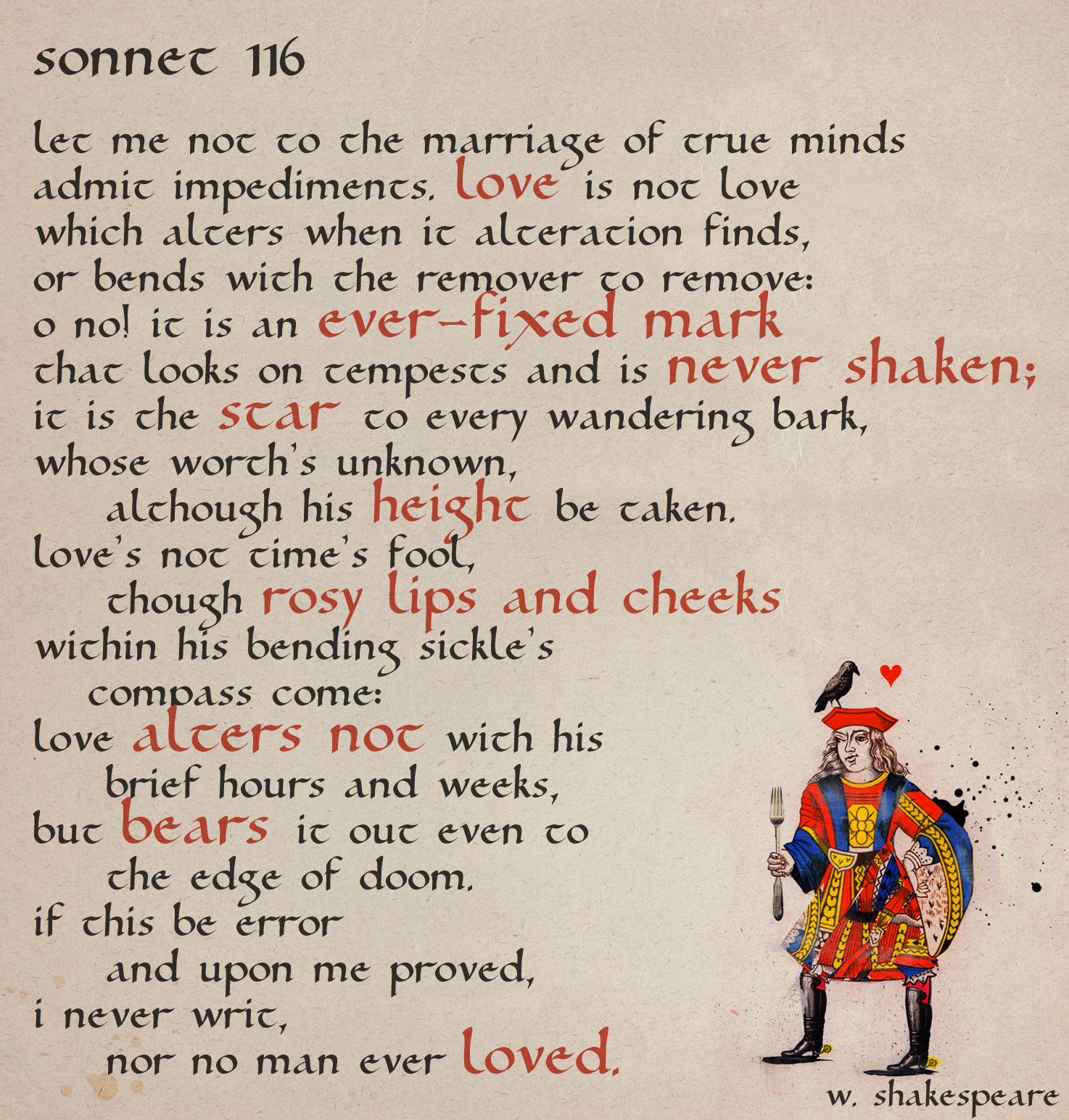
At any rate, the proof is in the pudding, as shown by Sonnet 116:
The words shown in red are Freemason terms. And, like me, William seemed to like to hide his messages in his sonnets, in the open, where only Freemasons would see them.
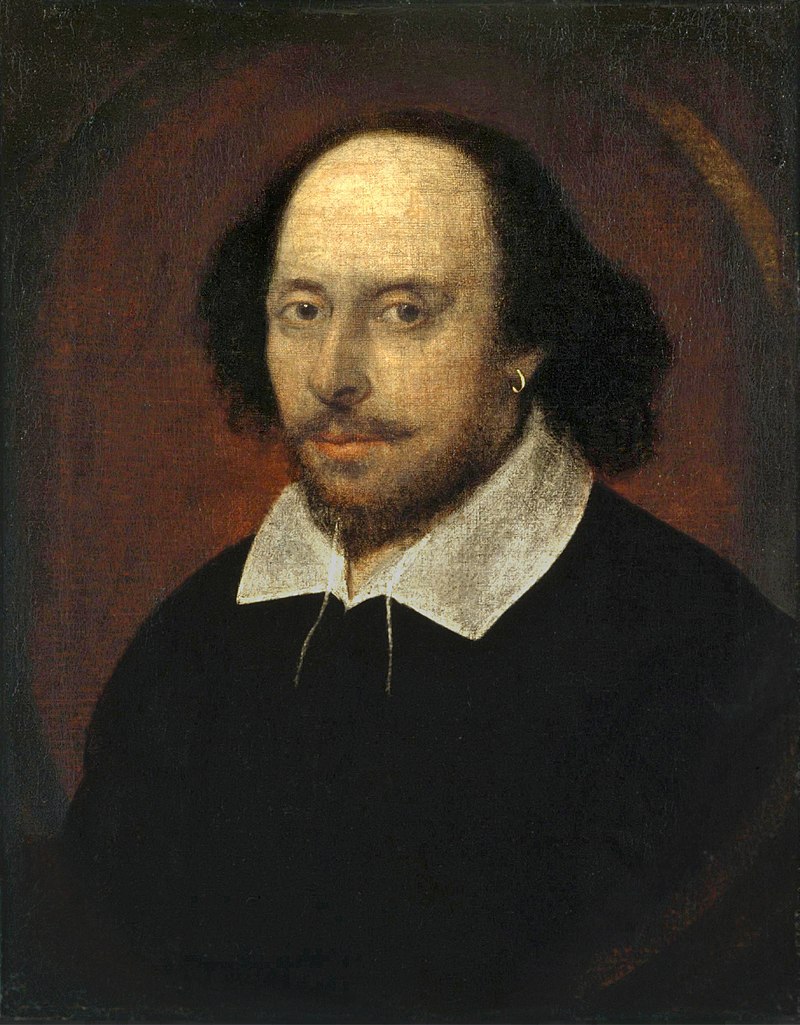
William Shakespeare (April 23, 1564 – April 23, 1616)
The ‘Chandos’ Portrait
Another WordPress blogger posted an interesting question today: was Shakespeare a Mason? I’d never considered that before. But it begs the question: how did he know so much of the ‘hidden’ history of world events? Was he spiritually guided?
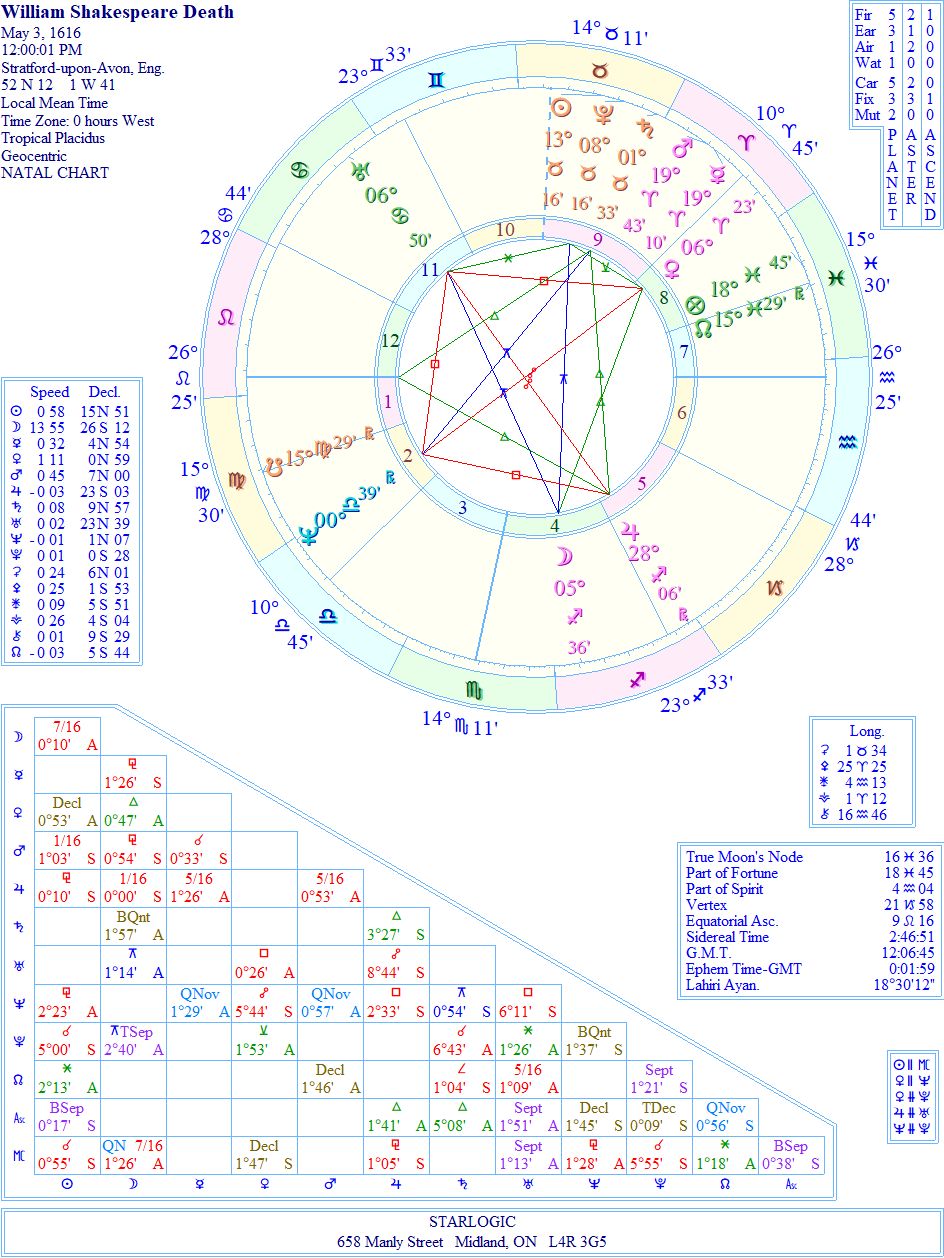
Previously, I had written a post about Shakespeare’s birth chart. The Yod that was featured there is significant to my way of thinking: it was pointing at the Moon.
Even though I have set his time of death a 12:00 noon, another Yod featuring the Moon is revealed, this time involving inconjuncts to Uranus and Pluto. That may be significant to our inquiry. At the same time, there is an inconjunct between Saturn and Neptune.
Moon Inconjunct Uranus
With this aspect you must learn to control sudden outbursts of emotion that occur at difficult times when you least expect it. Also your present home life may not be a stable situation in which you can grow up emotionally secure and confident. A particular incident when you were very young may have given you the feeling that you can’t count on anything or anyone for support. Later in life, you may try very hard to get away from anything that reminds you of your earliest childhood, even if your childhood had not been difficult. You just feel that you have to get away and go somewhere else.
Moon Inconjunct Pluto
This aspect means that your emotions are very intense and not always easy to deal with. Often your feelings make you want to do or say something without knowing why. Also you may have very intense moods in which you withdraw from those around you into a world of your own. This should not be a very serious problem unless you have been brought up to have all sorts of fears and worries. In that case your actions will be driven by your fears, and you may behave quite strangely. If you do not feel accepted and emotionally supported at home, you may constantly feel guilty for what you think you have done to others, or jealous that people aren’t paying enough attention to you, or generally possessive of those around you.
You probably enjoy exploring the mysterious and probing hidden secrets. Even while you are young, you will understand human nature better than most people, but to use this ability positively, you must be reasonably calm about your feelings.
Saturn Inconjunct Neptune
This aspect can have a variety of effects, one of which may be difficulty in relating fantasy and imagination, on one hand, to reality, duty, obligation and work, on the other. Usually the reality, duty and work aspect of the combination is dominant, at least at first. Your imaginative side tends to be transformed into nervousness, fear and irrational anxieties. The most negative manifestation of this aspect is a feeling that you have to keep a tight lid on yourself and that if you look inside yourself too closely, you will find only emptiness and disintegration. It is difficult for you to realize that this is not the truth about your inner self.
Shakespeare died on 23 April 1616, at the age of 52. He died within a month of signing his will, a document which he begins by describing himself as being in “perfect health”. No extant contemporary source explains how or why he died. Half a century later, John Ward, the vicar of Stratford, wrote in his notebook: “Shakespeare, Drayton, and Ben Jonson had a merry meeting and, it seems, drank too hard, for Shakespeare died of a fever there contracted”, not an impossible scenario since Shakespeare knew Jonson and Drayton. Of the tributes from fellow authors, one refers to his relatively sudden death: “We wondered, Shakespeare, that thou went’st so soon / From the world’s stage to the grave’s tiring room.”
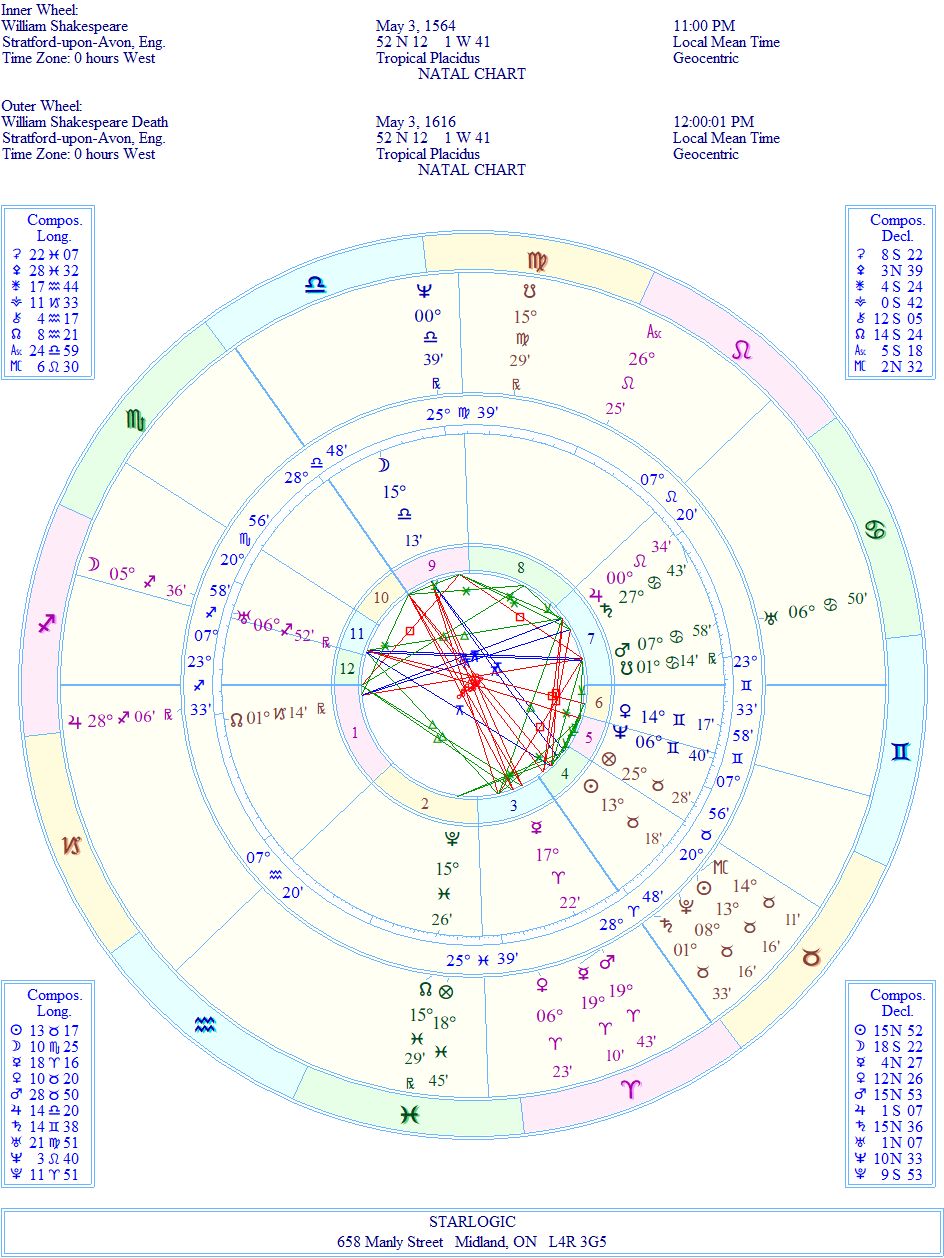
We can see by the combined birth and death charts above, that it looks as if the tumblers of a lock moved into alignment and the man was released from prison.
But we have not proven if he was a Mason or not. Looks like I need to read this:
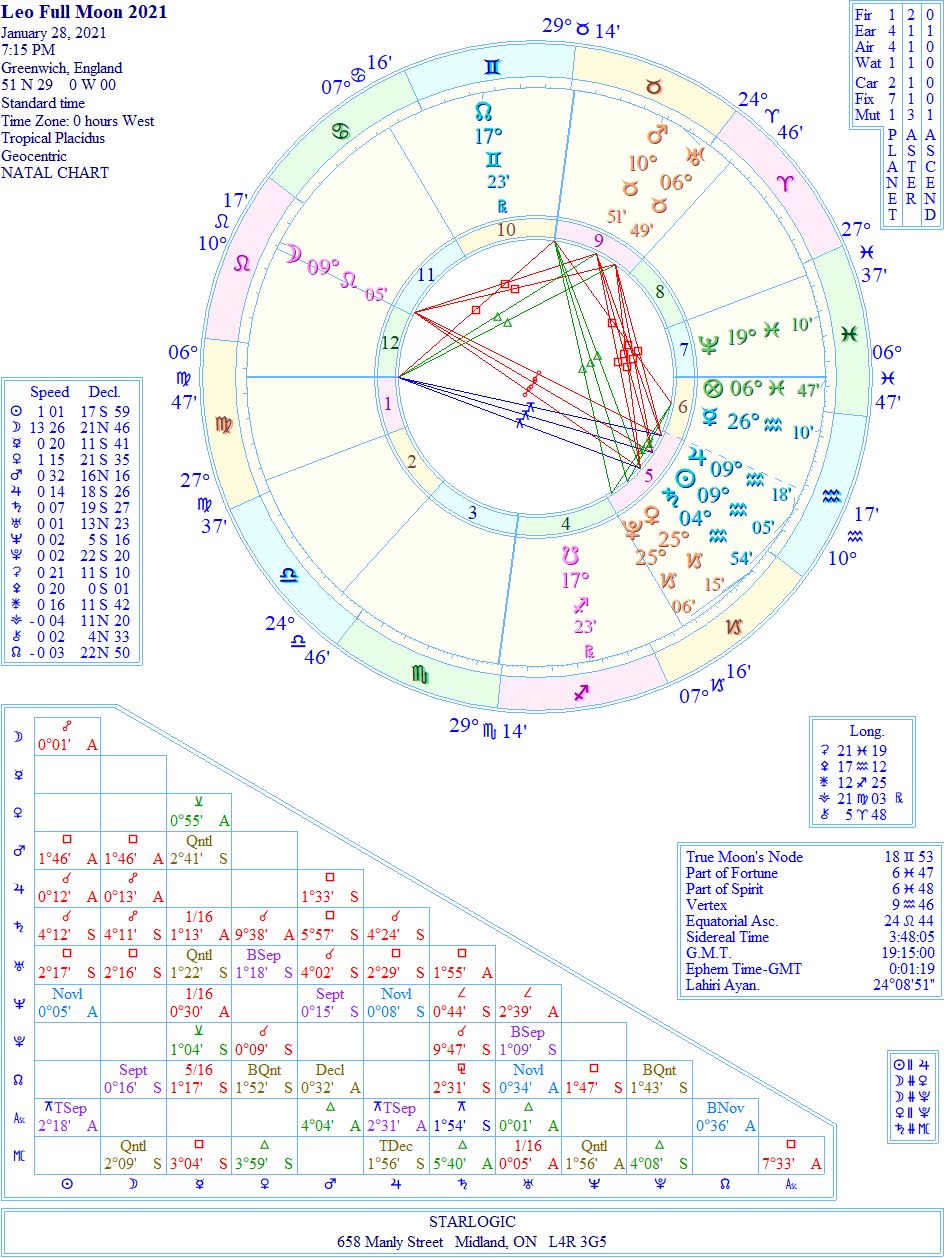
The synchronicity is amazing. Watching CNN yesterday, the real ‘Wolf of Wall Street’ was being interviewed about the GameStop shares battle going on between ‘ordinary’ investors (via Reddit) and the big investment companies. It was riveting television.
As you know by now, I look for the inconjuncts in a chart, to see what is going on behind the scenes. Last night’s full Moon in Leo is no exception. There were three.
Sun Inconjunct Ascendant
Your relationships with other people can be very intense. While you are young, they may be quite difficult, because you feel that others will accept you only if you deny yourself in some way. Or you may constantly feel that you should put off doing what you want in order to do what you have to do. Usually your ideas about what you have to do come from the people around you. Also, contacts with other people will frequently force you to make serious, major psychological changes. Difficulties in your relationships with friends and family are signs of profound internal changes.
Jupiter Inconjunct Ascendant
With this aspect, you may discover that in order to grow and get ahead in life, you will have to put aside your own needs and do whatever he situation or other people require. At times you will go through tremendous and possibly painful creative changes in your life, in which everything that you are is replaced by a new order. Your environment may change radically, or you may lose all your old friends and find a whole set of new ones. During these times you will arrive at new understandings and realizations that make it impossible for your life to continue as before. You must always be open to new ideas and be willing to change your outlook on life.
Saturn Inconjunct Ascendant
With this aspect you probably have a rather serious attitude toward life and other people. It may be quite difficult for you to simply go out and have a good time. You want to be serious and to spend all your time performing significant tasks. This attitude may have developed because you were discouraged from enjoying yourself when you were younger. You may have been made to feel that only work is important, that play serves no useful purpose. This is not true, however, because playing has a positive and useful function in the development of the adult mind and body. Not only does it serve to release tensions, but it also actually helps train you in social and physical skills that will be useful in any work you do later.
I remember this film. At the time, I thought it was fiction, but now has been proven true. And wouldn’t you know it: Ian Fleming may have written the plot.
In 1943, Royal Navy Lieutenant Commander Ewen Montagu (Clifton Webb) devises a scheme to deceive the Nazis about the impending invasion of Southern Europe. It entails releasing a corpse with a fictional identity off the coast of Spain. The strong currents would almost certainly carry it ashore near where a known German secret agent operates. The non-existent Royal Marine, Major William Martin, would appear to be a plane-crash victim carrying falsified letters about a forthcoming Allied invasion of German-occupied Greece, rather than Sicily, the more obvious target. Montagu receives approval to carry out Operation Mincemeat.
Following a medical expert’s advice, Montagu procures the body of a man who died of pneumonia so it appears he drowned. After proper preparations, the corpse is placed in a canister packed with dry ice and transferred to a waiting submarine. The body is released in the Mediterranean where it washes ashore on a Spanish beach. The local authorities, observed by German and British consulate staff, process the body. After the attaché case containing the letters is returned to London, a forensics expert confirms the key letter, describing the (false) Allied invasion in Greece, was cleverly opened, photographed, and resealed.
Hitler is convinced the document is genuine, though Admiral Wilhelm Canaris, head of the Abwehr, is skeptical. The Nazis dispatch Patrick O’Reilly (Stephen Boyd), a pro-German IRA spy, to London to investigate. O’Reilly investigates Martin’s “fiancée”, Lucy Sherwood (Gloria Grahame), who is the roommate of Montagu’s assistant, Pam (Josephine Griffin). O’Reilly arrives at their flat, posing as Martin’s old friend, on the same day Lucy received news that her real boyfriend was killed in action. Her genuine grief mostly convinces O’Reilly. As a final test, however, he gives Lucy his north London address, telling her to contact him if she needs anything. He then radios his German contacts saying that if he does not send another message in one hour, it means he has been arrested. As Montagu, General Coburn (Michael Hordern) of Scotland Yard’s Special Branch and police officers are en route to O’Reilly’s flat, Montagu realises why he left his address. Montagu convinces a reluctant Hordern to let O’Reilly go. After no one arrives to arrest him, O’Reilly sends a “Martin genuine!” radio message. The Germans then transfer most of their Sicily-based forces to Greece, making the Allied deception successful.
After the war, Montagu leaves his OBE medal at the grave of “the man who never was”.
Interesting, isn’t it that the name remained the same when the film was made?
In September of 1939, the man who would go on to write the James Bond novels was practically working as a spy himself. Specifically, Lieutenant Commander Ian Fleming was the personal assistant of Admiral John Godfrey, Britain’s wartime director of naval intelligence. As one might expect, Fleming had quite the flair for the dramatic, and the internal memo he likely wrote that September (although sent out under Godfrey’s name) was full of outlandish schemes of deception and fiction-telling.
Yet perhaps none of these plans was quite as outlandish, or quite as macabre, as number 28 on the list, a half-formed idea called “A Suggestion (not a very nice one).” It described how one might pass false information to the enemy by dressing a corpse as a military officer and dropping it in enemy territory. It was an idea pulled straight from a spy novel (literally), and like most of the other suggestions in the memo, it probably seemed destined to fizzle out before it was ever put into practice.
In a bizarre twist of fate, however, this particular suggestion would end up providing the spark for a plan whose effects would be felt at every level of every military in World War II, a plan that would fittingly go on to be called Operation Mincemeat.
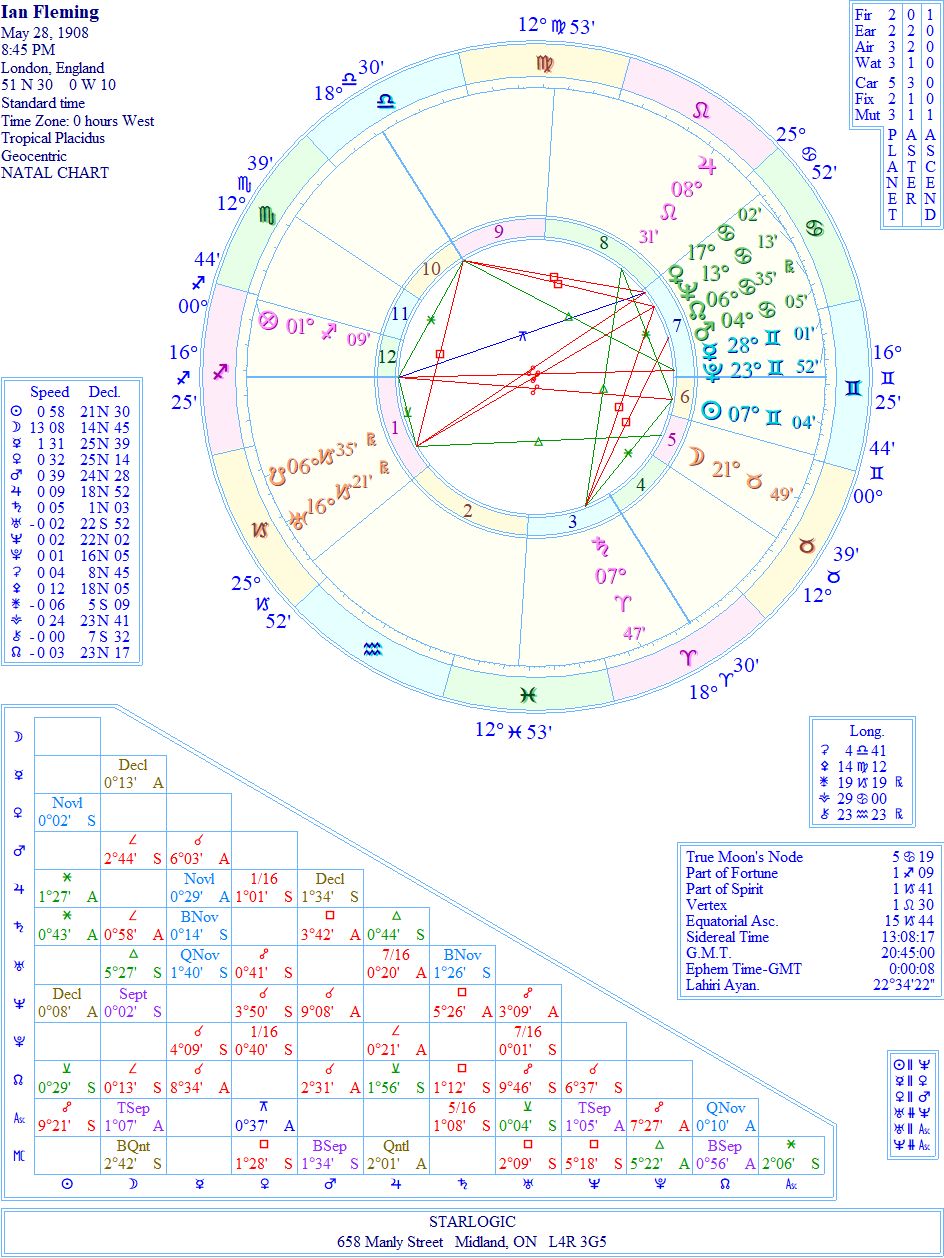
I knew I’d get around to this individual eventually. His story reads like a spy novel, full of twists and turns, and unexpected resolutions, including James Bond’s number.
I have rectified this birth chart to recognize the age (9) when Ian’s father (Saturn) was killed in the Great War (1917). By the time, Ian was ready to get his schooling (starting at Eton), his mother (Moon) was in charge of all his decision making. She engineered most of the steps it took to get him into the Admiralty as an adult. She even broke up some of his relationships as being unsuitable: an unmovable force in his life, for sure.
Venus Inconjunct Ascendant
You often feel that you haven’t any right to ask much of those whom you love. You feel that you must do favors for them instead of asking for their help. For you, love is an act of service, not self-gratification. Also, through relationships with others, you try to learn more about your own and other people’s inner workings. For this reason your relationships are more deep and profound than most people’s. But they are somewhat difficult, too. Your close friends and loved ones discover that you are quite different in a close relationship than you appear at first. It is not that you are dishonest, but that you show a side of yourself to your friends that you usually keep hidden, often because you are not entirely confident in that role. You may feel unsure that others will like you or accept your affection. This is one reason why you express your love by doing nice things for people. You are trying to win them over.
(Have you ever wondered why James Bond, his avatar, loved them and left them? I think Ian Fleming was trying to exercise his shortcomings.)
About that OO7 Designation
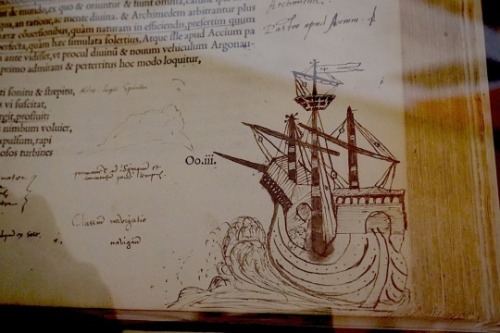
Illustration from a book in John Dee’s library
Oo.iii. It’s something and nothing to most observers. But the occultists recognize it as a way to impart sacred numbers secretly.
Dee often corresponded with the queen on confidential matters. He took to signing his letters “007” to designate letters for the queen’s eyes only. The zeroes represented eyes, and the seven was thought to be a lucky number that offered protection. Many scholars believe that Dee was one of Elizabeth’s spies, and that his travels throughout Europe were not for “spiritual conferences,” but rather to gather intelligence. It’s known that Elizabeth employed a number of spies, especially after the Pope declared her an illegitimate ruler in 1570. She was constantly threatened by conspiracy plots, all of which were quashed by her secret service. Dee would have been a formidable member of this team; his reputation for magic preceded him, and he was obviously well connected through his position at court.
So, let’s be clear about this, since there are skeptical readers everywhere who doubt it: ‘For your eyes only’ is a phrase we now associate with the British Secret Services. “Oo” is the short form for that phrase. Dee wouldn’t have written 7, though; he would have written ‘vii’. Are we clear, here? For all intents and purposes it looks like a Latin word.
And note that it has always been spoken as ‘Double-O seven’, not ‘zero-zero-7’ (007).
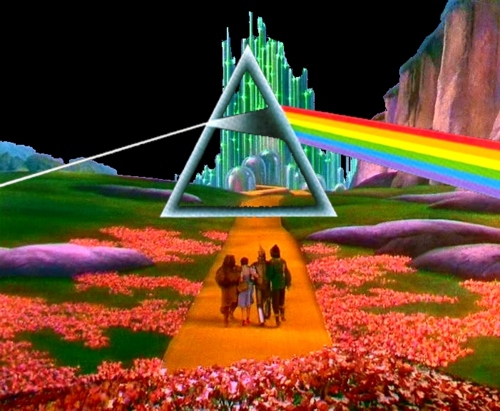
I remember reading about this before: it appears to totally sync together if you run the movie, The Wizard of Oz, while listening to Pink Floyd’s “Dark Side of the Moon”.
I suspect that playing the LP would be the preferred method, but a CD is a close second. Unfortunately, the album is only 43 minutes long, while the movie is just over a 100 minutes. Here’s where I read about it lately.
Branwell Brontë (June 26, 1817 – September 24, 1848)
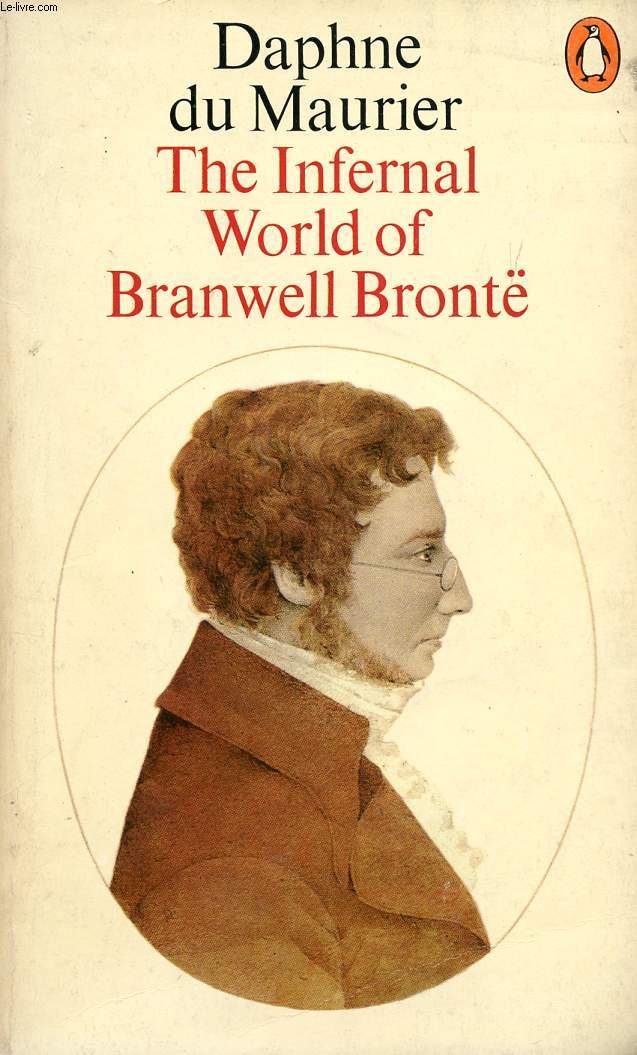
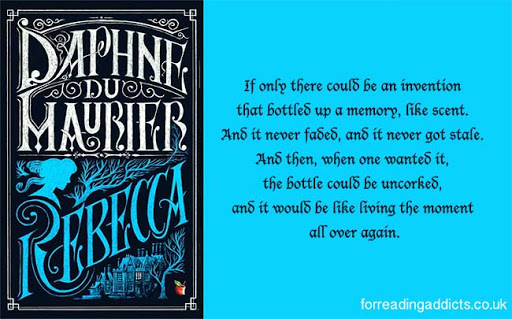
I have not read this book yet, although I do have a digital copy on my computer. But I know, from reading about it, that Daphne du Maurier thought her husband was Branwell reincarnated. It’s a long shot, I know, but I think she may have been right.
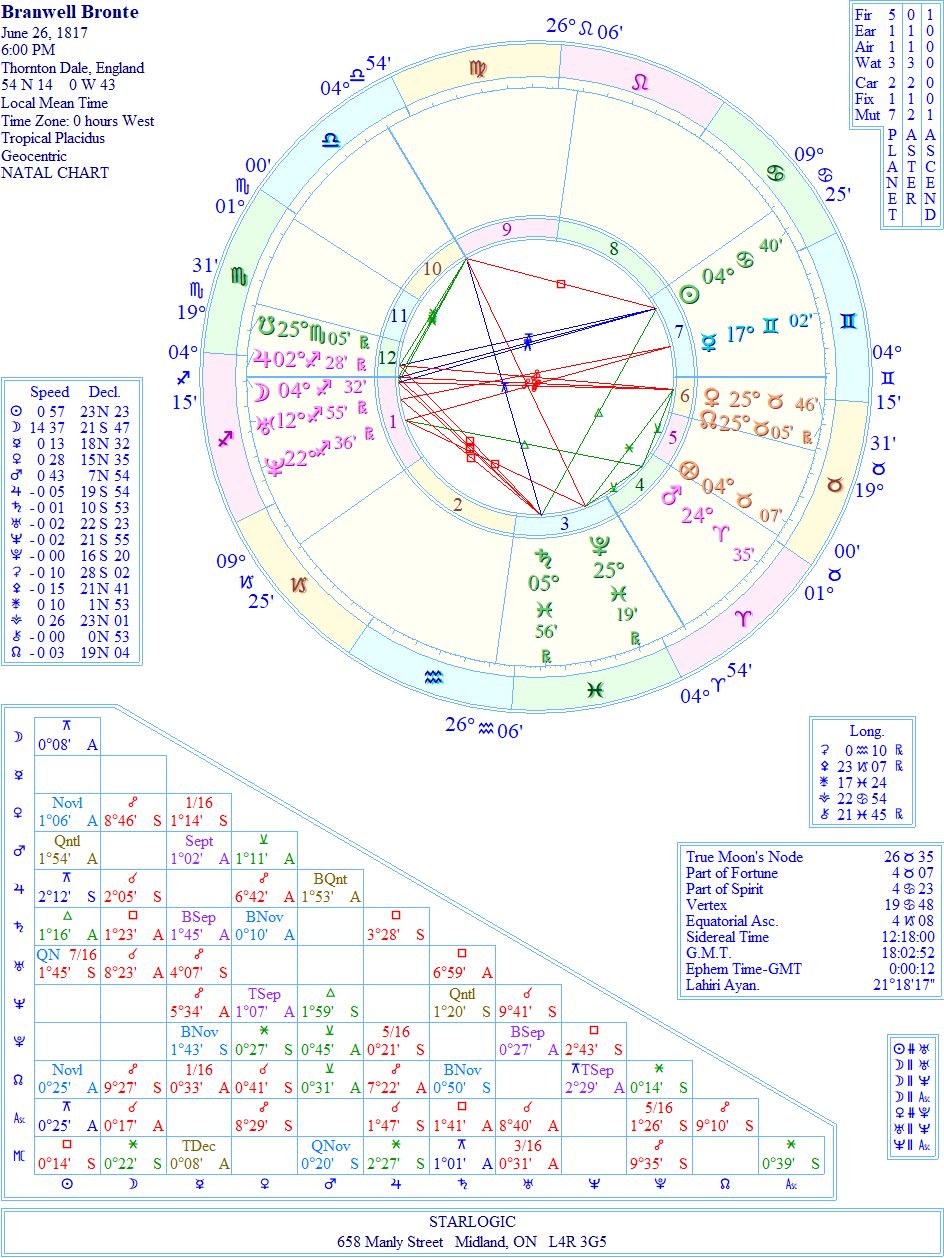
The timing is a guess, partially because of the load-up of planets clustered around the Ascendant. They speak of a young man who was ‘imprisoned’ by his father: he yearned to be free every day of his short life. The four inconjuncts back this idea completely.
Sun Inconjunct Moon
This aspect suggests that there is a subtle conflict going on inside you that may sometimes create emotional problems. The Sun signifies your conscious personality, the way in which you act and the kinds of activities that you like to get involved in. The Moon signifies the emotional and less conscious side of you. It indicates the habits that take over when you are not acting consciously and feelings that come up from deep inside you. The inconjunct aspect between the Sun and Moon means that the Sun part of your personality is quite different from the Moon part, and it may be hard for you to relate them to each other. It is as if you are divided in two, so that whenever you have to make an important decision, especially one that involves your feelings, the different sides of your personality want to go in [not quite] opposite directions. You sometimes find it difficult to decide if you like something or if you want to take part in some activity.
The only solution is to accept both sides of your personality, for they are both you, and it is important to express them both. It is only your attitude of rejection that makes one side good and the other side bad.
Sun Inconjunct Jupiter
This can be an extremely useful aspect, if you learn to have more self-control in what you do. Jupiter is always high-spirited, wanting to do and encounter everything and enjoy life thoroughly. Yet in some combinations, it means that you are unwilling to work for what you want. You may feel that you are such a fine person tat you deserve to have everything done for you. Certainly you are worthwhile in your own way, but that doesn’t give you a right to be taken care of without contributing your share. As with all Sun-Jupiter energies, if you learn to support others, to make them feel good and happy in your presence, you will get their support as well. Then there will always be someone to help you when you need it. But if you act arrogant towards others, they may not stay around to support you.
Sun Inconjunct Ascendant
Your relationships with other people can be very intense. While you are young, they may be quite difficult, because you feel that others will accept you only if you deny yourself in some way. Or you may constantly feel you should put off doing what you want in order to do what you have to do. Usually your ideas about what you have to do come from the people around you. Also, contacts with other people will frequently force you to make serious, psychological changes. Difficulties in your relationships with friends and family are sign of profound internal changes.
You may find that no matter how hard you try to show others who you really are, they misunderstand you somehow. This is because the angular relationship between your rising sign and Sun sign indicates that your internal energies are quite different from the energies that you show to the world. You are not intentionally dishonest with the world, you simply present a confusing complex of energies.
Saturn Inconjunct Midheaven
This aspect indicates that you very much need a positive relationship with your parents, especially your father. You should not be disciplines sternly unless you are given lots of love at the same time. Otherwise, giving and receiving love from others will be a real problem for the rest of your life. Unless you are truly supported by your family and friends, you will begin to feel lonely and isolated from others and inferior to them. Also you are likely to have very serious difficulties with authority figures, because you are afraid of how they will treat you, not expecting that anyone will ever give you the loving guidance you need. You will see all authorities only as potential threats to your freedom and as sources of pain and trouble.
He died on Sunday morning, the 24th of September,
1848. He was thirty-one years old. He died in the room
which he had shared with his father for so long, and in
which, as a little boy, he had awakened to find the moon
shining through the curtainless windows and his father
upon his knees, praying. The room, for too many months
now, had been part refuge and part prison-cell. It had
been refuge from the accusing or indifferent eyes of his
sisters, refuge from the averted gaze of his father, whose
offer of help in dressing spelt reproach. But when he was
alone again, the family downstairs and about their busi-
ness, only the familiar sounds of day-by-day penetrating
his solitude — the cry of a child in the road, the chiming
of the church clock, the opening and closing of the gar-
den gate as someone called upon parish concerns — then
the room turned to the cold walls of a dungeon, or, worse,
oppressed him with the stifling weight of a tomb be-
neath whose heavy stone the dead-alive know perpetual
suffocation. The minutes would tick away to half-past
twelve or half -past four — for the hours of day were mean-
ingless once appetite was lost and the routine of life
relinquished; and the slow cough of the clock on the stairs
proceeded inexorably towards that half-choke before the
hour, followed at once by the stroke from the church, with
no pause or respite. Eternal reproach, eternal accusation.

"I know only that it is time for me to be something  when I am nothing. That my father cannot have long to  live, and that when he dies my evening, which is already  twilight, will become night. That I shall then have a constitution still so strong that it will keep me years in torture and despair when I should every hour pray that I  might die." (Chapter One - The Infernal World of Branwell Brontë)
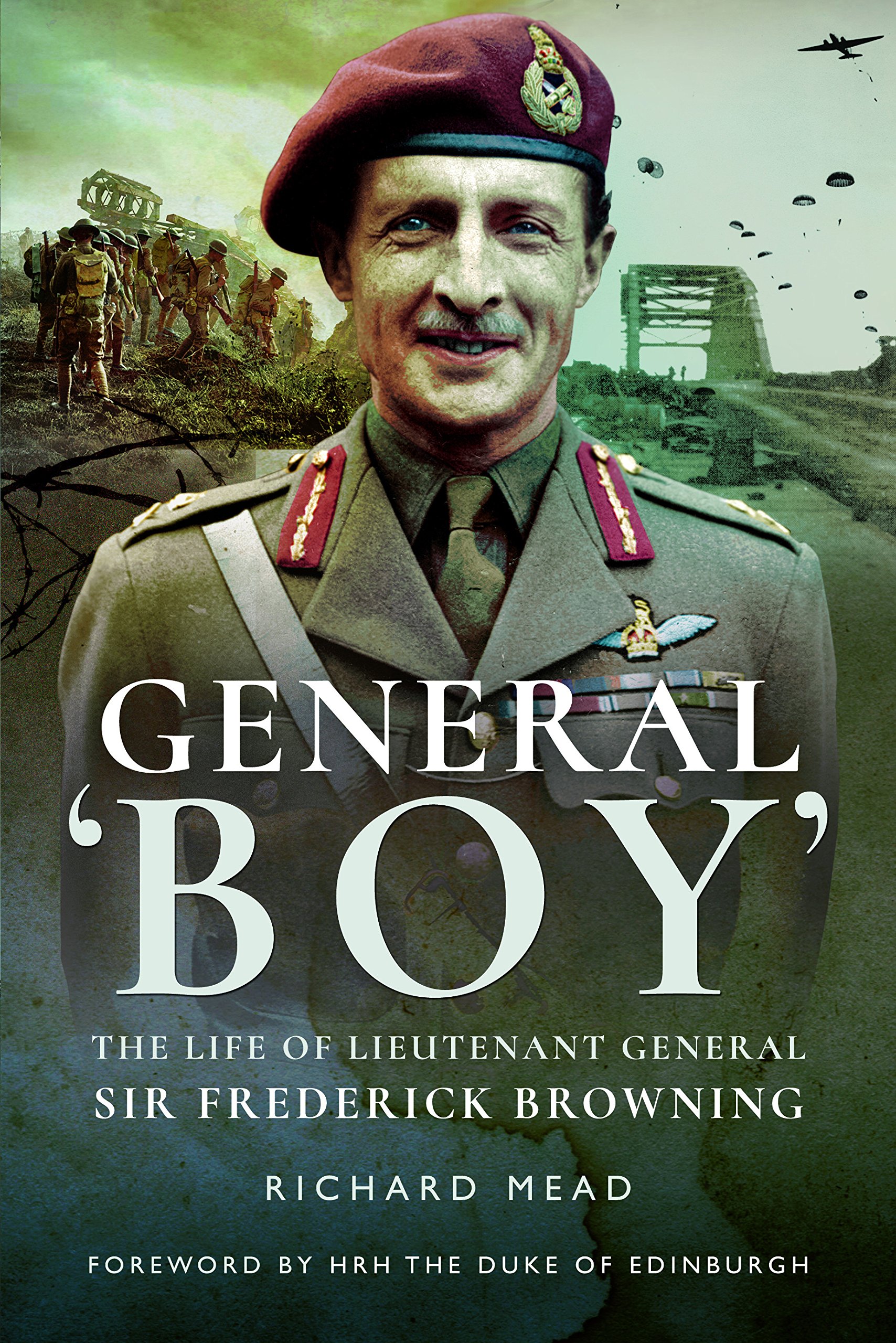
Sir Frederick Browning (December 20, 1896 – March 14, 1965)
Now here is a man that was a soldier during both World Wars. After the WWII he served Elizabeth II before she was made Queen. He was knighted for this service.
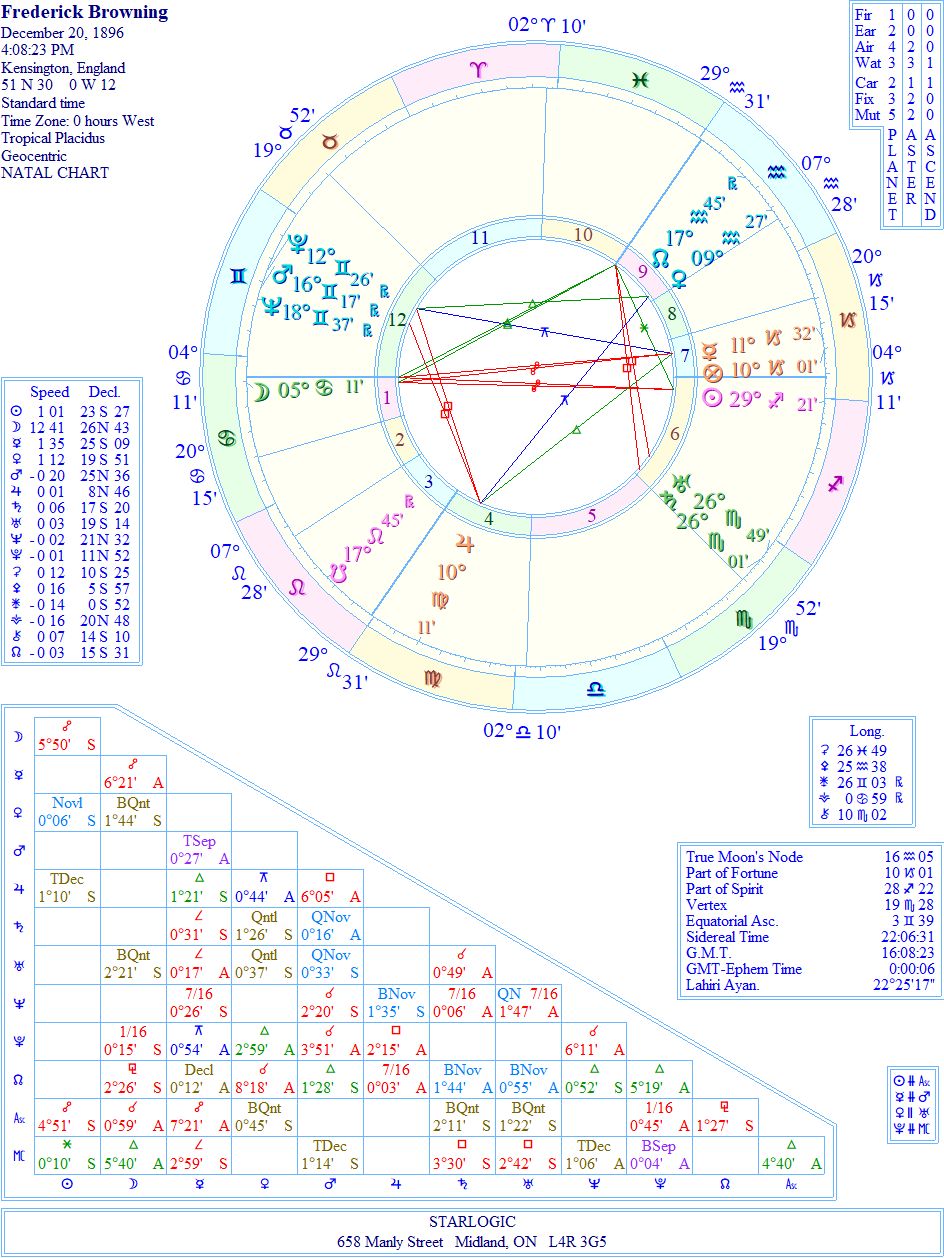
The timing of this chart is randomized. As neither of the two inconjuncts are dependent on this time, I think we are on fairly solid ground. Note, too, the Moon conjunct Ascendant, in Cancer. This may be where the drinking problem that plagued his later life comes from. But the Mars/Neptune/Pluto conjunction may have made him a soldier.
Mercury Inconjunct Pluto
You have a rather complicated and sometimes tricky mind. You usually prefer to do things in roundabout and involved ways instead of being simple and direct.
On the positive side, this means that you enjoy solving puzzles, tracking down mysteries and finding out about hidden matters. At school you might do research in science. You have a natural ability to understand how people’s minds work, what makes them act as they do, and what they are thinking, which is quite amazing for someone of your age.
On the negative side, however, you might misuse thia ability by trying to control people’s thoughts and words. Also you may love mysteries so much that you get involved in complicated plots and arrangements with your friends. You may enjoy working is secret and creating an air of mystery about yourself, but this could backfire and make others misunderstand you or even fear what you are doing. It is important to show people that you are honest and that you are not hiding anything. Otherwise hey will probably suspect you, even if you are totally innocent. And if you aren’t, they will know it for certain.
On another level, this aspect can mean that at certain times in your life you will go through tremendous psychological changes. All your thoughts and opinions will change completely. These stages may seem difficult, but you will be much better off if you let go of the past and welcome the new ideas.
Venus Inconjunct Jupiter
This can be a positive aspect if you learn to control some of its negative possibilities. You are likely to lack energy and to be rather passive. You may wait for opportunities to come to you, rather than go after them. You may not have enough energy to pursue your ambitions, or you may not have much ambition. Or you may love your comfort so much that you are unwilling to make any effort or put up with any pain that could help you grow and develop. However, if there are any indications of energy in your chart, they should overcome the passivity.
On the plus side, you need love and affection, and you can usually be very warm and affectionate as well. However, it is very important that you choose your close friends carefully, because you may attract people who are difficult to get along with, who order you around or act as if they are better than you. Avoid such people, for they will do you no good.
If you do associate with difficult people, you may be unable to live up to your own standards of behavior. You may do things that you usually wouldn’t approve of, because somehow the relationship weakens your resolve to do what is right. But this won’t happen if you choose your friends carefully and avoid people who are not good for you.
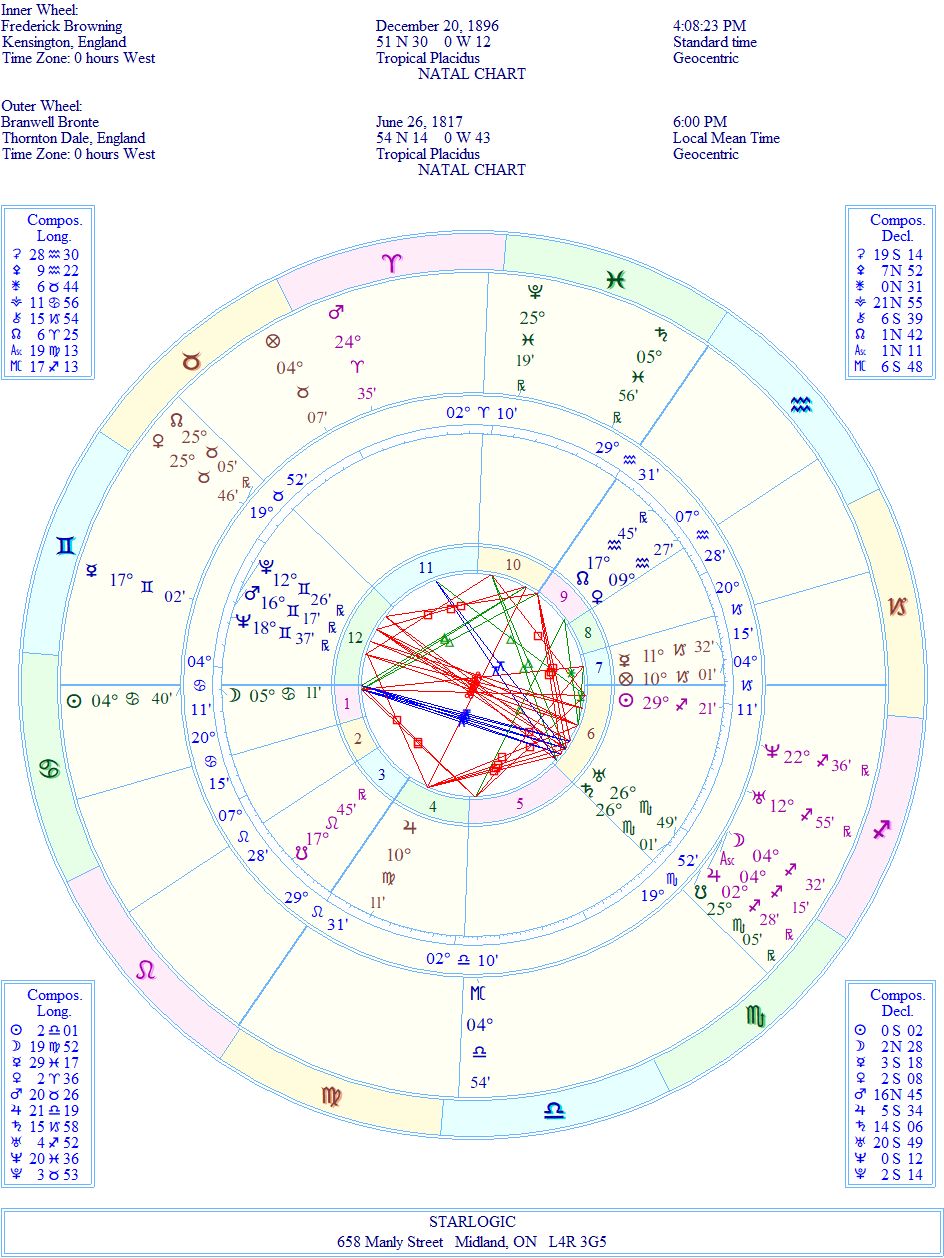
Birth Chart Comparison
I don’t think I could have asked for a more perfect example of a pair of birth charts lining up to demonstrate the concept of reincarnation. Now, obviously, we cannot get the same degree of connection that Edgar Cayce and David Wilcock have between them, but we can get a glimpse as to why Daphne du Maurier ‘felt’ her husband was her brother from the early 19th century reborn. The Moon/Ascendant in Cancer in Frederick’s chart is almost exactly conjunct Branwell’s Sun. And the exact conjunction in Frederick’s chart between Saturn and Uranus is connected to Branwell’s South Node in Scorpio. Furthermore, Branwell’s Moon/Jupiter/Ascendant conjunction in Sagittarius is inconjunct Frederick’s Moon/Ascendant conjunction, while Branwell’s Mars is inconjunct Frederick’s Saturn/Uranus conjunction. Finally, Branwell’s Mercury is midway between Frederick’s Mars/Neptune conjunction in Gemini. Is that enough?
Conclusion
Daphne du Maurier was the reincarnation of Charlotte Brontë, at least in my opinion. To recognize her own brother in the man she married must have been surprising…
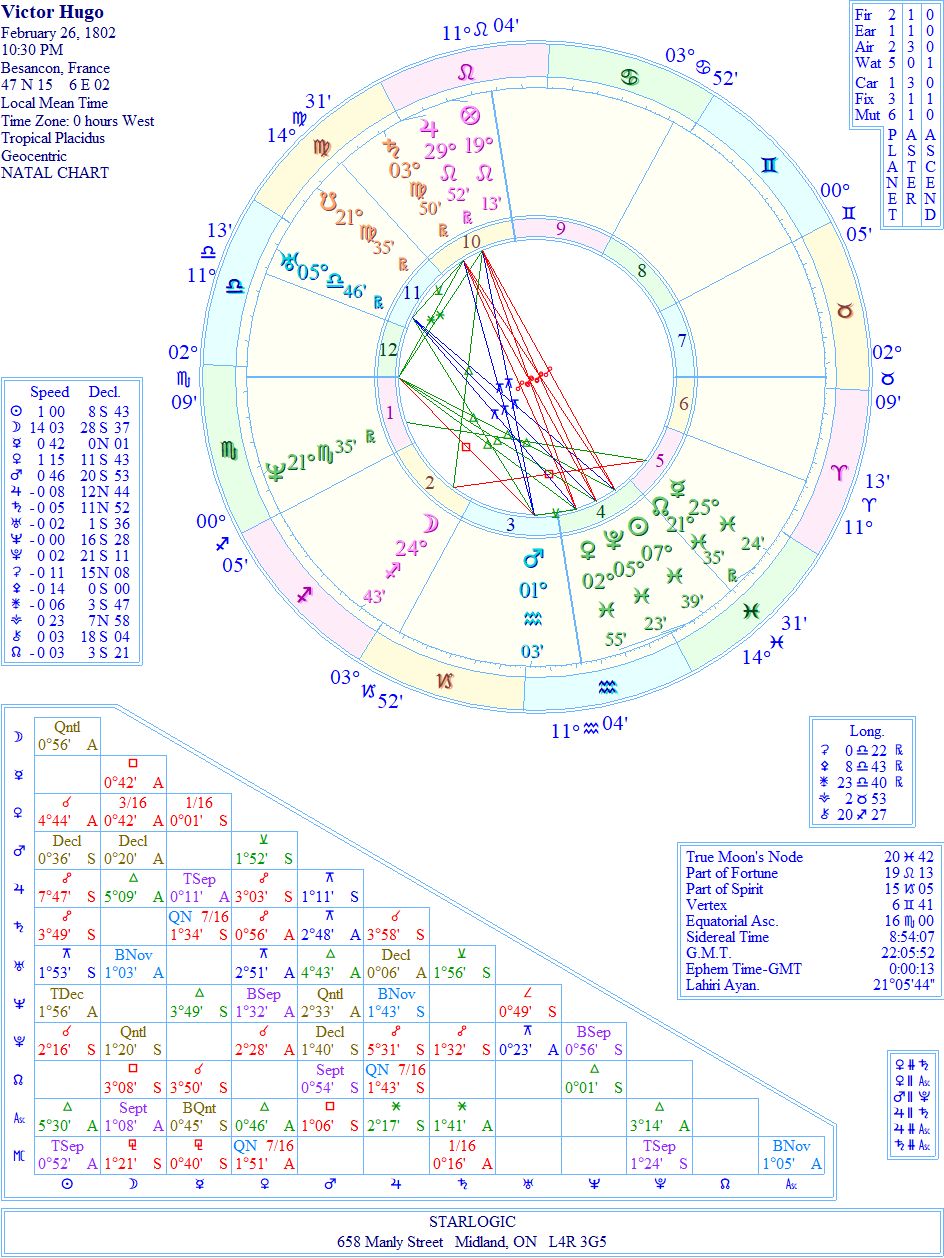
It’s not often that an individual can know exactly when he was conceived, but Victor Hugo did, and he encoded the date into one of his most famous stories.
Since Hugo’s father was an officer in Napoleon’s army, the family moved frequently from posting to posting, Sophie had three children in four years. Léopold Hugo wrote to his son that he had been conceived on one of the highest peaks in the Vosges Mountains, on a journey from Lunéville to Besançon. “This elevated origin”, he went on, “seems to have had effects on you so that your muse is now continually sublime.” Hugo believed himself to have been conceived on 24 June 1801, which is the origin of Jean Valjean’s prisoner number 24601.
Les Misérables also contained other autobiographical details, played out through the character of Marius, who falls in love with Cosette, Jean Valjean’s ward. Victor’s full name was Victor-Marie Hugo. He, no doubt, personally experienced the events of that story. Perhaps that is why it touches so many people’s hearts.
The time of 10:30 pm is consistent across all astrology sites, and yet it misses the salient events of his life by being about two hours later than it should be. I will not rectify it, but I want you to know that astrology is not mocked by small mistakes like this one. If I told you that the age Venus shows up in this chart is 7, whereas it should be 20. See what I mean? That indicates to me that the Ascendant should move 50 degrees back to about the cusp of the 11th House (12 Virgo). However, the inconjuncts remain the same.
Sun Inconjunct Uranus
There is a side of your personality that is very restless and impatient with rules, even when you know that they are for your own good. You want very much to go your own way and do your own thing, even when you aren’t entirely sure that it is the right direction for you. So you rebel in sudden ways by having sudden fits of obstinacy and moods of feeling very contrary, especially to your parents or other authority figures.
Venus Inconjunct Uranus
You feel mixed up about whether you want to be close to others or be free. When you are really close to a loved one, you feel smothered and want to get away by yourself to do what you want. But when you are alone and free to do what you want, you miss your loved ones and want to be with them. It will take you several years to understand yourself enough so that you can strike a balance between these two needs, so be patient.
Mars Inconjunct Jupiter
With this aspect you probably are quite active, with abundant energy for anything you want to do. But you must learn to control your energies rather than have them control you. You may be inclined to take excessive risks, to try out things that you ae not sure you can do. But be careful, because with this aspect the energies of Mars and Jupiter do not work very smoothly together. If you overextend yourself and try to do more than you are physically capable of, you may have an accident. Also you may be clumsy when you take up a new activity until you learn to control your physical body better.
Mars Inconjunct Saturn
This can be a difficult aspect because it signifies a conflict between your sense of responsibility and your desire to fulfill your own needs and do what you want. This leads to a struggle within you that may keep you from acting decisively. Instead of deciding what you will do, you feel caught between these two forces, wondering whether you have the right to do what you want. You may feel that others are trying to frustrate you, but it is only your own indecisiveness that is causing the trouble. Sometimes this conflict makes you very irritable and resentful about nothing in particular. Then, when someone happens to act in a way that is obviously annoying, you focus all your built-up anger on that person.
Uranus Inconjunct Pluto
This aspect indicates changes in the world of the people who were born at these times, changes that were difficult to understand because they were very revolutionary but subtle in many ways.
(As I read through the descriptions of these aspects, I was struck by the idea that Hugo personified the striving towards republicanism that the French went through in those times. He was a ‘rebel with a cause’ and he lived his whole life to further that cause.)
Though a committed royalist when he was young, Hugo’s views changed as the decades passed, and he became a passionate supporter of republicanism serving in politics as both deputy and senator. His work touched upon most of the political and social issues and the artistic trends of his time. His opposition to absolutism and his colossal literary achievement established him as a national hero.
Wikipedia
(It also spoke volumes about his irascible nature.)